
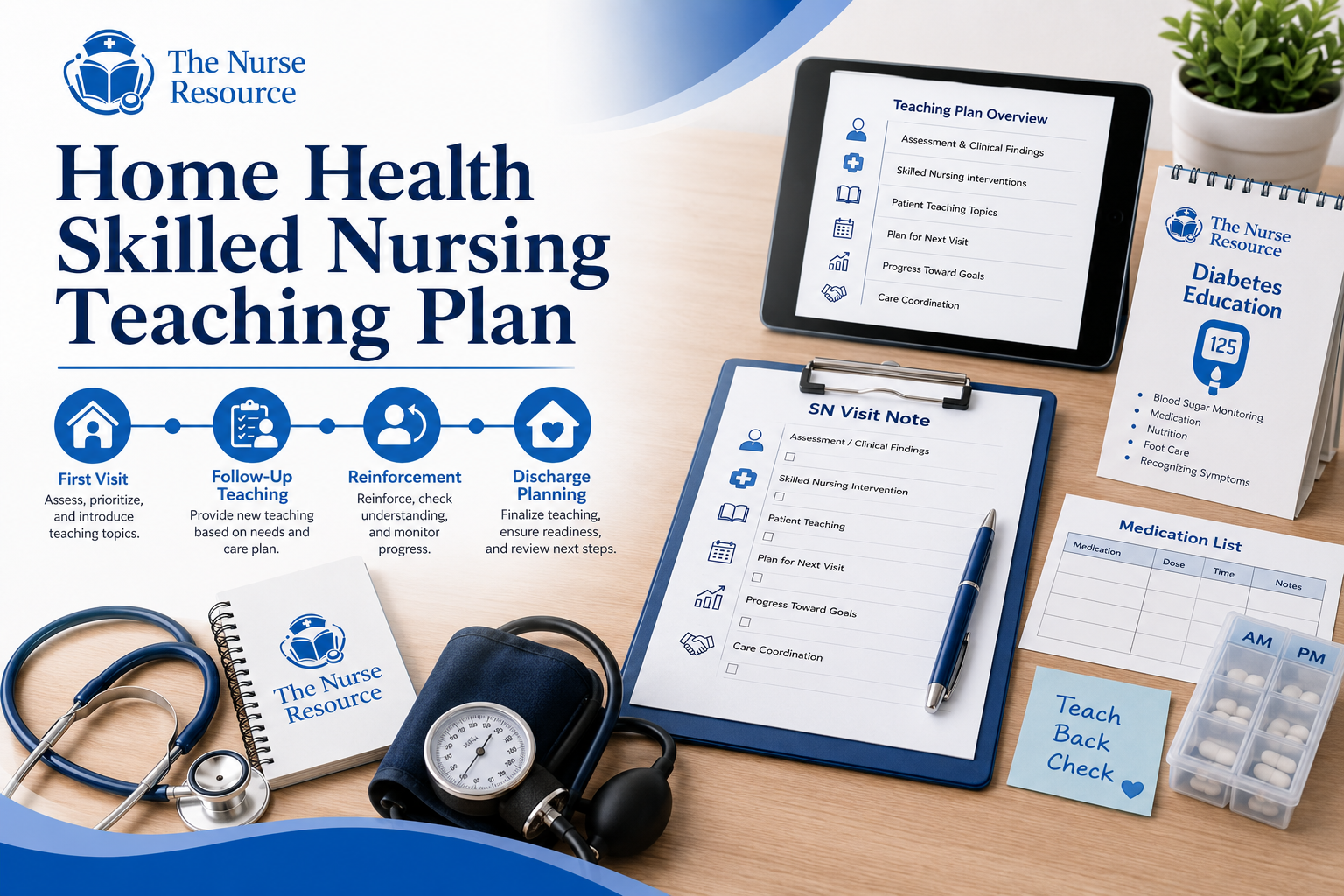
Patient teaching is a major part of home health skilled nursing, but effective teaching should not look exactly the same at every visit.
A patient may need basic safety and medication teaching during the first SN visit, reinforcement during early follow-up visits, application and teach-back during mid-episode visits, and independence-focused teaching as discharge approaches.
When nurses repeat the same general education at every visit without showing patient-specific progress, barriers, new risks, or continued skilled need, teaching may begin to look routine rather than skilled.
A stronger approach is to build a teaching plan across the episode. Each visit should connect to patient diagnosis, current risks, provider orders, plan of care, visit frequency, patient or PCG response, and findings from prior visits.
Quick Summary
A home health skilled nursing teaching plan should answer:
- What is highest priority for this patient today?
- What diagnosis, symptom, medication, or safety risk does teaching address?
- What has already been taught?
- What did patient or PCG understand?
- What still requires reinforcement?
- Did patient condition, medication profile, or care plan change?
- What should be addressed during next SN visit?
- Is patient moving toward safe self-management or discharge?
Teaching should progress across the episode instead of restarting from beginning at every visit.
Free Home Health Nurse Starter Pack
Get four practical printable tools for home health skilled nursing visits, including SN documentation review, patient/PCG teaching follow-through, escalation guidance, and an end-of-visit review sheet.
Free download. No credit card required.
Why Teaching Should Be Planned Across the Episode
Many home health patients have several diagnoses, multiple medications, functional limitations, recent Hospitalization, limited health literacy, memory concerns, or dependence on a PCG.
Trying to teach everything during one visit can overwhelm patient and make it difficult to determine what was actually understood.
Teaching across the episode allows SN to:
- address urgent risks first
- break complex information into manageable parts
- evaluate patient or PCG understanding over time
- reinforce areas where teach-back is incomplete
- identify barriers affecting follow-through
- respond to changes in condition
- prepare patient and PCG for greater independence
- support safe discharge planning
Teaching should also change as patient condition changes. A planned Blood Pressure teaching visit may need to shift if patient reports dizziness, has repeated abnormal readings, experiences a fall, starts a new medication, or returns from Hospital.
A teaching plan provides structure, but skilled nursing judgment determines what should be prioritized during each visit.
Connect Teaching to Patient-Specific Skilled Need
Patient education is not skilled simply because education occurred.
Skilled teaching should be connected to a patient-specific diagnosis, risk, knowledge deficit, change in condition, medication concern, safety issue, or need for clinical evaluation.
Before selecting a teaching topic, consider six areas.
1. Diagnosis and Current Condition
Teaching should relate to conditions affecting patient care.
Examples may include:
- Blood Pressure management
- Blood Sugar monitoring
- medication safety
- wound and skin care
- infection prevention
- fall prevention
- symptom recognition
- emergency escalation
Diagnosis alone should not determine every teaching topic. Current symptoms, functional ability, medication changes, home environment, and patient understanding also matter.
2. Patient-Specific Risk
Ask what complication or safety concern teaching is intended to reduce.
Possible concerns include:
- medication error
- delayed symptom reporting
- fall or injury
- infection
- worsening wound
- abnormal Blood Pressure or Blood Sugar
- poor disease self-management
- avoidable Hospitalization
Teaching is stronger when it responds to a clear patient risk rather than a generic diagnosis list.
3. Provider Orders and Plan of Care
Teaching should remain consistent with:
- provider orders
- medication profile
- ordered treatments
- plan of care
- therapy recommendations when applicable
- agency policy
- patient-specific goals
SN should not create new medical instructions, medication parameters, diets, treatments, or restrictions that are not supported by provider orders or care plan.
4. Visit Frequency
Visit frequency affects how much teaching can reasonably be addressed during each visit.
A patient receiving several visits in one week may benefit from shorter, focused teaching topics with follow-up soon afterward.
A patient receiving one visit per week may require careful prioritization, clear reinforcement, and a practical plan for what patient or PCG should monitor between visits.
Visit frequency should not create a rigid teaching schedule. It should help SN decide how to pace education safely.
5. Skilled Need
Each visit should reflect why licensed nursing skill remains necessary.
Examples of skilled teaching needs may include:
- new diagnosis
- recent Hospitalization
- new or changed medication
- inability to safely follow care instructions
- incomplete teach-back
- fluctuating readings
- worsening symptoms
- wound or infection concerns
- cognitive, physical, or environmental barriers
- PCG requiring education or reinforcement
6. Patient or PCG Response
Teaching decisions for next visit should be based partly on what happened during current visit.
The existing Skilled Nursing Documentation Quick Guide emphasizes documenting patient-specific skilled need, skilled action, patient or PCG response, abnormal findings or follow-up needs, and reason continued skilled care remains necessary.
A patient who accurately explains medication schedule may be ready to move to side-effect recognition or refill planning.
A patient who cannot explain what symptoms to report may need continued reinforcement before moving to a new topic.
What to Focus on During First SN Visit or Early Episode
First SN visit establishes foundation for teaching plan.
SN usually needs to identify immediate risks, baseline understanding, available support, and barriers that may affect care.
Teaching priorities may include:
- purpose of home health services
- basic plan of care
- medication safety and medication list review
- immediate disease-related warning signs
- when to notify PCP or home health agency
- when emergency help may be needed
- ordered monitoring, such as Blood Pressure or Blood Sugar
- fall prevention and home safety
- infection prevention
- wound or treatment precautions when applicable
- role of PCG
- agency contact information
This does not mean every topic must be taught in full during first visit.
Questions to Guide First-Visit Teaching
- What does patient understand about reason for home health?
- What changed before referral or Hospital discharge?
- Which diagnosis or medication creates highest immediate risk?
- Can patient describe current medication routine?
- Can patient or PCG follow ordered monitoring safely?
- Are there fall, wound, infection, or emergency risks?
- Who is available to help?
- Are there language, memory, vision, hearing, financial, or transportation barriers?
- What must patient know before SN leaves today?
- What can safely wait until a follow-up visit?
First-Visit Goal
First-visit goal is not to finish all education.
Goal is to establish priorities, address immediate safety needs, determine baseline knowledge, and create a reasonable teaching sequence for upcoming visits.
What to Focus on During Early Follow-Up Visits
Early follow-up visits should build on first visit rather than repeat it word for word.
SN should review what patient or PCG retained and determine whether instructions were followed safely between visits.
Focus may include:
- checking understanding of previous teaching
- reviewing medication routine
- evaluating ordered monitoring technique
- reviewing Blood Pressure, Blood Sugar, weight, symptom, or wound records when applicable
- identifying missed doses, refill concerns, or medication confusion
- evaluating fall precautions and assistive device use
- reviewing wound or skin observations
- reinforcing symptoms that should be reported
- addressing barriers discovered after patient attempted care independently
- involving PCG when patient requires assistance
Teach-Back During Early Follow-Up
Teach-back helps SN evaluate whether patient can explain or demonstrate information in patient’s own words.
Teach-back should be used to identify:
- correct understanding
- partial understanding
- incorrect understanding
- memory problems
- need for cueing
- inability to apply instructions
- areas requiring PCG support
- need for additional skilled reinforcement
Teach-back is not a test of patient. It is a way to determine whether education was clear and whether more teaching is needed.
What to Focus on During Mid-Episode Visits
By mid-episode, teaching should begin moving from basic information toward practical application and self-management.
SN should assess whether patient or PCG can use information during daily care.
Mid-episode teaching may focus on:
- recognizing patterns in symptoms or readings
- connecting symptoms to reporting instructions
- following medication schedule consistently
- planning refills before medication runs out
- applying fall precautions during daily activity
- recognizing wound or skin changes
- using infection prevention practices correctly
- knowing who to contact for non-emergency concerns
- recognizing when symptoms may require emergency help
- correcting unsafe habits
- addressing repeated barriers
- measuring progress toward plan-of-care goals
Mid-Episode Questions
- Is patient following instructions more consistently?
- Can patient or PCG explain warning signs?
- Are there repeated mistakes or unsafe behaviors?
- Have symptoms or readings changed?
- Is patient relying less on SN for routine reminders?
- Does PCG understand role and limitations?
- Is current teaching plan still appropriate?
- Does plan of care need review because condition has changed?
- What remains skilled about upcoming visits?
Teaching should not continue only because a topic appears on care plan. SN should evaluate whether continued teaching, assessment, monitoring, or care coordination remains clinically necessary.
Teaching During Recertification or Ongoing Visits
Recertification or continued visits should not automatically result in repeating original teaching plan.
SN should reassess:
- current patient condition
- progress toward goals
- remaining knowledge deficits
- changes since prior certification period
- new medications or treatments
- recent falls or near falls
- abnormal readings
- new wound or skin concerns
- recent infection
- recent Hospital or emergency care
- PCG availability and ability
- continued risk for complications
- continued need for licensed nursing judgment
If patient has already demonstrated safe understanding and independence, repeating same general teaching may not support skilled need by itself.
Continued teaching should reflect an ongoing clinical reason, such as:
- incomplete teach-back
- inconsistent follow-through
- new or changed condition
- new medication
- fluctuating symptoms or readings
- new safety concern
- PCG change
- worsening wound
- repeated need for clinical assessment
- continued risk requiring skilled monitoring and reinforcement
For more guidance on showing why nursing skill is required, see Skilled vs Non-Skilled Nursing in Home Health. That resource explains how assessment, teaching, patient response, clinical risk, and ongoing skilled need work together in a stronger visit note.
Teaching When Patient Condition Changes
A planned teaching sequence should change when new clinical concerns arise.
SN should use assessment findings, provider orders, agency policy, and clinical judgment to determine whether planned education remains appropriate.
Change in Condition
Teaching may need to shift toward:
- recognizing worsening symptoms
- following provider instructions
- understanding new monitoring expectations
- knowing when to contact PCP or agency
- understanding emergency escalation
- involving PCG in observation and reporting
Changes should be reported and managed according to provider orders, plan of care, and agency policy.
Medication Change
After a medication change, teaching may need to address:
- updated medication schedule
- purpose of medication as listed in medication profile
- precautions ordered by provider
- possible side effects to report
- medication organization
- refill planning
- avoiding duplicate or discontinued medications
- when to contact PCP or pharmacy
SN should not tell patient to stop, restart, hold, or change medication unless acting under a valid provider order or approved agency process.
Abnormal Blood Pressure or Blood Sugar
Teaching may need to focus on:
- ordered monitoring technique
- recording readings
- symptoms associated with abnormal readings
- medication follow-through
- diet or fluid instructions already ordered
- safety precautions
- provider notification parameters
- when emergency evaluation may be needed
Avoid creating universal numeric reporting parameters. Follow patient-specific provider orders and agency policy.
Fall or Increased Fall Risk
Teaching may need to shift toward:
- immediate safety
- injury assessment
- safe transfers
- assistive device use
- slow position changes
- medication-related dizziness or weakness
- environmental hazards
- PCG assistance
- reporting falls and near falls
Wound or Skin Concern
Teaching may need to address:
- protecting dressing as ordered
- observing wound and surrounding skin
- infection warning signs
- pressure and moisture protection
- supply safety
- hand hygiene
- when to notify PCP, wound provider, or agency
Teaching must remain consistent with wound care orders.
Infection Risk
Teaching may need to include:
- hand hygiene
- equipment and supply cleanliness
- wound or device precautions
- symptoms that should be reported
- medication compliance when ordered
- avoiding contamination
- timely provider notification
How to Use Visit Frequency to Pace Teaching
There is no single teaching schedule that fits every patient.
Visit frequency should help SN decide how much education is reasonable during each visit.
Higher Visit Frequency
When SN visits occur several times per week:
- focus on one or two priorities at a time
- check retention during next visit
- reinforce technique
- monitor response closely
- adjust teaching quickly when barriers appear
Weekly Visits
When SN visits occur weekly:
- prioritize highest-risk topics
- review what happened between visits
- use patient or PCG logs when ordered
- address barriers to follow-through
- clearly identify what needs review next time
Reduced or Tapered Frequency
As visit frequency decreases:
- focus more on independence
- confirm patient or PCG knows who to call
- evaluate consistency without frequent SN prompting
- review remaining safety gaps
- strengthen discharge preparation
Visit frequency should reflect provider orders, plan of care, patient condition, payer requirements, agency policy, and clinical judgment.
How to Document Patient or PCG Response and Progress
Documentation should show more than topic taught.
A useful teaching entry should communicate:
- Why teaching was needed
Connect teaching to patient condition, risk, medication, symptom, or plan of care. - What was addressed
Identify specific education provided without relying only on phrases such as “teaching completed.” - How patient or PCG responded
Note whether information was understood, explained back, demonstrated, misunderstood, or required cueing. - What barriers were identified
Examples include memory limitations, vision problems, low health literacy, language needs, medication confusion, limited PCG support, or inability to perform a task safely. - What progress occurred
Compare response to prior visits when possible. - What remains for next visit
Identify what requires reinforcement, reassessment, monitoring, or care coordination.
The purpose is not to make note longer. Purpose is to make teaching patient-specific and show how nursing judgment guided visit.
Detailed copy-ready patient and PCG response wording, progress-toward-goals phrases, ongoing skilled need wording, and narrative templates are available inside Premium Library.
Need help turning teaching, patient response, progress, and ongoing skilled need into stronger SN visit notes? Premium Library members can access the Home Health SN Narrative Builder Pack for phrase banks, weak vs stronger examples, visit note checklists, and fill-in-the-blank SN narrative templates.
A Simple Teaching Plan Framework
Use this five-step framework before and after each SN visit.
Step 1: Assess
Review:
- current condition
- Vital Signs and other ordered measurements
- medication profile
- symptoms
- recent changes
- previous teaching
- patient or PCG understanding
- barriers
- provider communication
- plan-of-care goals
Step 2: Prioritize
Choose teaching based on:
- immediate safety
- highest clinical risk
- recent change
- incomplete understanding
- provider orders
- upcoming discharge needs
Avoid trying to cover every diagnosis during every visit.
Step 3: Teach
Provide focused, patient-specific education using clear language.
Include PCG when appropriate and permitted.
Step 4: Evaluate
Use questions, teach-back, observation, or return demonstration when applicable.
Determine whether patient or PCG:
- understood
- partially understood
- demonstrated correctly
- required cueing
- remained unable to perform safely
- needs additional skilled reinforcement
Step 5: Plan
Decide:
- what should be reinforced next visit
- what requires reassessment
- whether PCP or another provider must be contacted
- whether teaching plan should change
- whether patient is progressing toward independence
- what remains part of ongoing skilled need
Short Example of Teaching Across Several Visits
Consider a patient returning home after Hospitalization with medication changes, Blood Pressure monitoring orders, weakness, and fall risk.
First Visit
Primary focus may be immediate medication safety, ordered Blood Pressure monitoring, fall precautions, agency contact information, and warning signs that require reporting.
Early Follow-Up
SN may evaluate medication organization, review Blood Pressure log if ordered, assess dizziness or weakness, and check whether patient can explain when to contact PCP.
Mid-Episode
SN may focus on consistent follow-through, refill planning, safe mobility, symptom recognition, and PCG ability to assist.
Later Visit
SN may evaluate whether patient and PCG can manage routine care safely with less prompting, identify remaining gaps, and begin more focused discharge preparation.
This is only a planning example. Actual teaching should follow patient-specific orders, condition, visit findings, and plan of care.
Preparing for Discharge Teaching
Discharge teaching should begin before final visit.
Waiting until final visit can leave insufficient time to correct gaps or involve PCG.
Discharge preparation may include confirming that patient or PCG understands:
- current medication list
- medication schedule
- ordered monitoring
- warning signs to report
- when to call PCP
- when to call home health agency
- when to call 911
- follow-up appointments
- supply or refill needs
- wound or treatment instructions
- fall prevention plan
- infection prevention
- who will assist after discharge
SN should also identify unresolved barriers before discharge, including:
- inability to manage medications
- inability to perform ordered monitoring
- continued confusion about symptoms
- unavailable or unprepared PCG
- unsafe home setup
- unresolved supply problems
- poor follow-through with appointments
- need for additional provider or community support
Discharge readiness should be based on patient condition, progress, provider orders, plan of care, agency policy, and skilled nursing judgment.
Common Teaching and Documentation Mistakes
Repeating Same Teaching Every Visit
Repeated education may be appropriate when patient has not mastered topic, but note should explain why reinforcement remains necessary.
Teaching Too Many Topics at Once
Too much information can make it difficult to assess what patient understood.
Prioritize highest-risk needs first.
Listing Topic Without Clinical Reason
“Medication teaching completed” does not explain why teaching required skilled nursing.
Connect topic to patient-specific risk or knowledge deficit.
Documenting Only “Verbalized Understanding”
This does not show whether patient can explain or apply information.
Include teach-back, demonstration, cueing, barriers, or reinforcement needs when applicable.
Failing to Review Previous Teaching
Each visit should build on prior response.
Without comparison, note may look repetitive rather than progressive.
Ignoring PCG Role
Some patients cannot safely manage care independently. PCG understanding and ability may be central to teaching plan.
Failing to Adjust After Change in Condition
A new fall, wound concern, medication change, abnormal reading, or Hospital visit may require teaching plan to be reprioritized.
Missing Plan for Next Visit
Current teaching should help determine what next SN visit needs to address.
Using Identical Documentation Across Visits
Documentation should reflect current findings, current response, current barriers, progress, and ongoing skilled need.
Next SN Teaching Visit Checklist
Before planning next visit, ask:
- What was highest-risk concern during current visit?
- What teaching was completed?
- What did patient or PCG understand?
- Was teach-back or demonstration successful?
- What required cueing or reinforcement?
- Were new barriers identified?
- Were abnormal findings present?
- Was PCP or agency notification needed?
- Did medications, symptoms, readings, wound status, or fall risk change?
- What should be reassessed next visit?
- What teaching should continue?
- Is patient progressing toward plan-of-care goals?
- What still supports skilled need?
- Is discharge preparation appropriate yet?
Final Thoughts
A strong home health skilled nursing teaching plan is not a list of topics repeated across every visit.
It is a patient-specific sequence based on diagnosis, risk, provider orders, plan of care, visit frequency, current findings, patient or PCG response, and progress toward safe self-management.
Each visit should build on previous visit.
SN should assess what patient knows, prioritize current risks, teach focused information, evaluate response, and plan next step. When condition changes, teaching plan should change with it.
This approach supports clearer patient education, stronger continuity of care, more meaningful documentation, and better discharge preparation.
Related Resources
Home Health SN Narrative Builder Pack
How to Write a Home Health SN Visit Note
Skilled vs Non-Skilled Nursing in Home Health
Medication Safety Resource Pack
Blood Pressure Teaching Resource Pack
Fall Prevention Teaching Pack
Wound and Skin Teaching Pack
Infection Control Teaching Resource Pack
Emergency Signs and Escalation Pack
Resources to help patients and PCGs understand when to call PCP, home health agency, or 911.
Premium Library
Need Copy-Ready Support for Building Stronger SN Visit Notes?
Premium Library members can access the Home Health SN Narrative Builder Pack, which includes structured support for:
- assessment and clinical findings
- skilled nursing interventions and teachings
- patient and PCG response wording
- progress toward goals
- plan for next visit
- discharge planning
- ongoing skilled need
- weak vs stronger SN narrative examples
- daily visit note completion checklist
- fill-in-the-blank SN narrative templates
These resources are designed to help home health nurses build clearer, patient-specific visit notes without relying on vague or repetitive documentation.
Premium Library
For home health nurses and agency leaders
Ready-to-use teaching packs, documentation tools, patient handouts, PCG checklists, nurse quick charting sheets, and premium downloads.
– Premium teaching packs
– Patient handouts
– Nurse quick charting sheets
– PCG monitoring checklists
– Skilled documentation examples
– Teach-back prompts
– Red flag guidance
– New resources added regularly
$9/month
Cancel anytime. New resources added regularly.
Leave a Reply