
Introduction
One of the most common challenges home health nurses face is understanding and clearly documenting the difference between skilled nursing and non-skilled nursing care.
This distinction matters because a home health SN visit note should show more than task completion. The note should explain why the patient required the assessment, clinical judgment, teaching, monitoring, coordination, or intervention of a licensed nurse.
Vague documentation may make a visit look routine, even when skilled nursing care was actually provided. Clear documentation helps support medical necessity, skilled need, patient-specific care, and continued home health services when appropriate.
This guide explains the difference between skilled and non-skilled nursing in home health and how nurses can document skilled care more clearly without relying on generic phrases.
Quick Summary
A skilled nursing note should show:
- what the nurse assessed
- what clinical risk or concern was addressed
- what skilled teaching or intervention was provided
- how the patient or PCG responded
- what still needs reinforcement
- why continued skilled nursing may still be needed
A task may be skilled at first, especially when the patient has a new diagnosis, medication change, wound, recent Hospital stay, poor understanding, or risk for complications. But once the patient or caregiver can safely perform the task without nursing judgment, the same task may become non-skilled or supportive care.
Free Home Health Nurse Starter Pack
Get four practical printable tools for home health skilled nursing visits, including SN documentation review, patient/PCG teaching follow-through, escalation guidance, and an end-of-visit review sheet.
Free download. No credit card required.
What Is Skilled Nursing in Home Health?
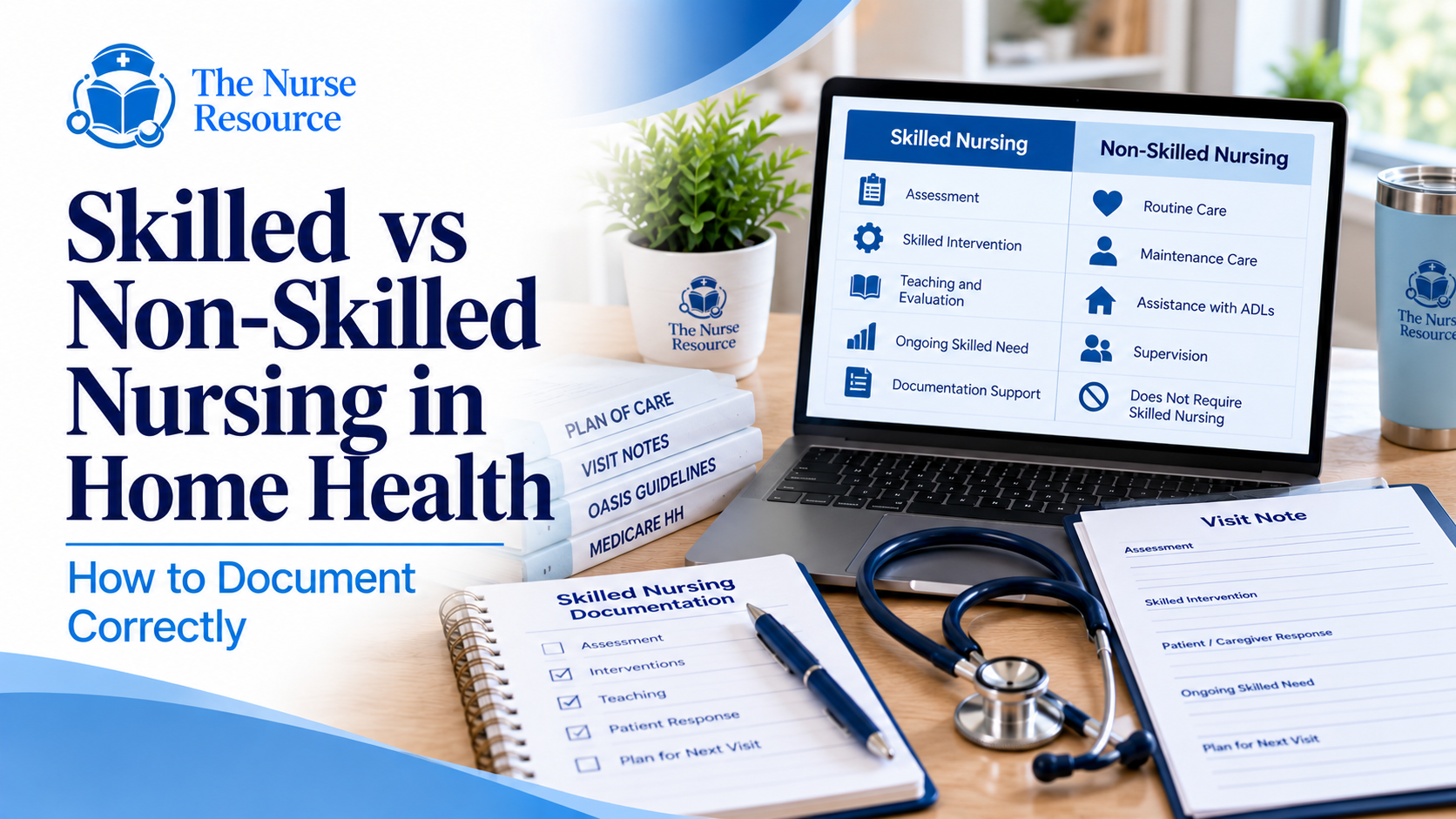
Skilled nursing refers to care that requires the clinical judgment, assessment, teaching, monitoring, or intervention of a licensed nurse.
Skilled nursing care is usually connected to the patient’s diagnosis, current condition, recent change, medication risk, wound status, safety risk, disease process, or plan of care.
Skilled nursing care may include:
- skilled assessment related to a medical condition
- wound assessment and ordered wound care
- medication review or medication teaching
- disease process teaching requiring nursing judgment
- Blood Pressure or Blood Sugar teaching and monitoring support
- monitoring for complications or change in condition
- evaluation of patient or PCG response
- care coordination and provider communication
- patient/PCG teaching with evaluation of understanding
The key is not just what task was done. The note should show why nursing judgment was needed.
Medicare does not pay for tasks alone—it pays for clinical decision-making.
What Is Considered Non-Skilled Care?
Non-skilled care usually includes tasks that are routine, repetitive, or can be safely performed by the patient or caregiver after instruction.
Examples may include:
- routine Vital Signs with no clinical interpretation
- simple medication reminders without teaching or evaluation
- general observation without skilled assessment
- assistance with ADLs alone
- simple repetitive tasks without nursing judgment
- repeating the same generic teaching every visit without evaluating response
- documenting “patient tolerated well” without explaining skilled need
Important:
A task can start as skilled and later become non-skilled if the patient or caregiver becomes independent and there is no longer a need for nursing assessment, teaching, monitoring, or judgment.
Why the Skilled vs Non-Skilled Distinction Matters
The visit note should answer the question:
Why did this patient need a skilled nurse today?
Reviewers may look for:
- what skilled assessment was performed
- what risk or condition required nursing judgment
- what teaching was patient-specific
- how the patient or PCG responded
- whether the patient still needs reinforcement
- how the visit supports the plan of care
- why continued skilled nursing is still needed
If the note only lists tasks, the visit may look routine. If the note connects assessment, teaching, response, and skilled need, it is usually stronger.
How to Document Skilled Nursing Correctly
1. Start With the Skilled Need
The note should show why skilled nursing was required.
Weak example:
“SN visit completed for wound care.”
Better direction:
Show the wound-related risk, the need for skilled assessment, the ordered care performed, and the patient/PCG teaching or monitoring need.
Do not just document the task. Document the skilled reason behind the task.
2. Document Assessment With Clinical Judgment
Avoid relying only on vague phrases such as:
- stable
- doing well
- no complaints
- continue to monitor
Instead, document what was assessed and why it mattered.
Helpful details may include:
- objective findings
- comparison to prior visit if applicable
- patient-reported symptoms
- changes or concerns
- clinical risk
- whether provider notification was needed
The goal is to show that the nurse assessed the patient’s condition and used nursing judgment.
3. Show That Teaching Was Skilled
Patient teaching is stronger when it is specific to the patient’s condition, risk, medication, wound, diagnosis, or care plan.
Teaching becomes skilled when it:
- disease-specific
- medication-specific
- related to a safety risk
- related to a new or changed condition
- evaluated through teach-back
- reinforced due to poor understanding or continued risk
Weak:
SN instructed patient on disease management.
Better direction:
Name the teaching topic, connect it to the patient’s diagnosis or risk, and document whether the patient or PCG understood or needed reinforcement.
4. Document Patient or Caregiver Response
This is one of the most important parts of skilled documentation.
Instead of writing only:
Patient verbalized understanding.
Document the response more clearly:
- verbalized understanding
- verbalized partial understanding
- required cueing
- unable to teach back
- demonstrated correct technique
- required repeated instruction
- PCG participated
- PCG unavailable
- needs continued reinforcement
- This helps show whether skilled teaching is still needed.
5. Connect Today’s Visit to the Plan of Care
The note should explain how today’s visit supports the patient’s plan of care.
Weak:
Continue POC.
Better direction:
Connect the next visit to the patient’s condition, teaching need, monitoring need, safety risk, medication concern, wound status, or ongoing skilled need.
The note should make it clear why the next skilled visit is appropriate.
Explore More Home Health Nursing Practice Guides
Looking for more practical guidance on visit planning, skilled nursing workflow, communication, and documentation? Explore our
Home Health Nursing Practice Guides
Skilled vs Non-Skilled Documentation: Quick Examples
These examples are intentionally short. They show the pattern of stronger documentation without giving full copy-ready charting phrases.
Medication teaching
Weak:
SN reviewed medications. Patient verbalized understanding.
Stronger direction:
Document the medication concern, what teaching was provided, how the patient or PCG responded, and whether continued reinforcement is needed.
Blood Pressure monitoring
Weak:
SN checked Blood Pressure. Continue to monitor.
Stronger direction:
Document the Blood Pressure concern, trend or symptom if applicable, teaching provided, patient response, and when PCP notification is needed.
Wound care
Weak:
Dressing changed. Patient tolerated well.
Stronger direction:
Document wound assessment findings, ordered care performed, patient/PCG teaching, infection risk, wound changes, and provider notification when indicated.
Diabetes teaching
Weak:
SN taught diabetes. Patient understood.
Stronger direction:
Document Blood Sugar monitoring if ordered, diabetes medication teaching, hypo/hyperglycemia symptoms reviewed, patient teach-back, and need for reinforcement.
Fall prevention
Weak:
SN instructed patient on safety.
Stronger direction:
Document fall risk assessment, specific safety teaching, patient or PCG response, barriers, and why continued reinforcement is needed.
Common Documentation Mistakes That Make Skilled Care Look Routine
Avoid these common documentation problems:
- listing tasks without explaining skilled need
- documenting only “patient tolerated well”
- writing “patient verbalized understanding” without response detail
- using the same note every visit
- failing to document patient or PCG response
- failing to connect teaching to diagnosis or risk
- documenting “education provided” without naming the topic
- not documenting abnormal findings or changes
- not documenting provider notification when indicated
- not explaining why the next skilled visit is needed
The goal is not to write a longer note. The goal is to write a clearer, patient-specific skilled note.
How This Connects to Stronger SN Visit Notes
Skilled documentation is part of a strong SN visit note. A complete note should usually show:
- assessment findings
- skilled intervention
- patient teaching
- patient or PCG response
- progress toward goals
- care coordination
- plan for next visit
- ongoing skilled need
For a deeper guide, read:
Related post:
How to Write a Home Health SN Visit Note for Skilled Nursing Documentation
That guide explains how to build a stronger SN visit note from assessment through ongoing skilled need.
Related Resources for Home Health Nurses
Use these related resources to support stronger home health teaching and documentation:
- How to Write a Home Health SN Visit Note for Skilled Nursing Documentation
- Medication Teaching Lookup for Home Health Nurses
- Blood Pressure Teaching Resource Pack
- Medication Safety Resource Pack
- Fall Prevention Teaching Pack
- Wound and Skin Teaching Pack
- Infection Control Teaching Resource Pack
- Emergency Signs and Escalation Pack
Need Copy-Friendly Skilled Nursing Documentation Support?
The free guide above explains the framework. If you need more copy-ready documentation support, the Home Health SN Narrative Builder Pack is part of the Premium Library.
The pack is designed to help home health nurses build stronger daily SN visit notes with structured support for:
- Assessment / Clinical Findings
- Skilled Nursing Interventions / Teachings
- Patient / PCG Response
- Progress Toward Goals
- Plan for Next Visit
- Ongoing Skilled Need
- Weak vs Stronger SN Note Examples
- Daily Visit Note Quick Charting Template
Ready to access the full Premium Library?
Get teaching packs, patient handouts, charting sheets, PCG checklists, documentation examples, and premium downloads for home health practice.
Final Thoughts
Understanding skilled vs non-skilled nursing helps home health nurses document more clearly and protect the purpose of the skilled visit.
A strong note does not need to be long. It needs to show the patient’s condition, risk, skilled intervention, response, and continued need for nursing assessment, teaching, monitoring, or coordination.
When documentation clearly connects the visit to skilled need, the note becomes stronger, more patient-specific, and more useful for care coordination.
Important Use Note
This post is for education and home health documentation support only. It does not replace provider orders, patient-specific plan of care, agency policy, payer requirements, state regulations, Medicare guidance, accreditation standards, or skilled nursing judgment.
Documentation should always be individualized to the patient’s condition, diagnosis, provider orders, medication profile, plan of care, visit findings, agency policy, and applicable clinical judgment.
Leave a Reply