
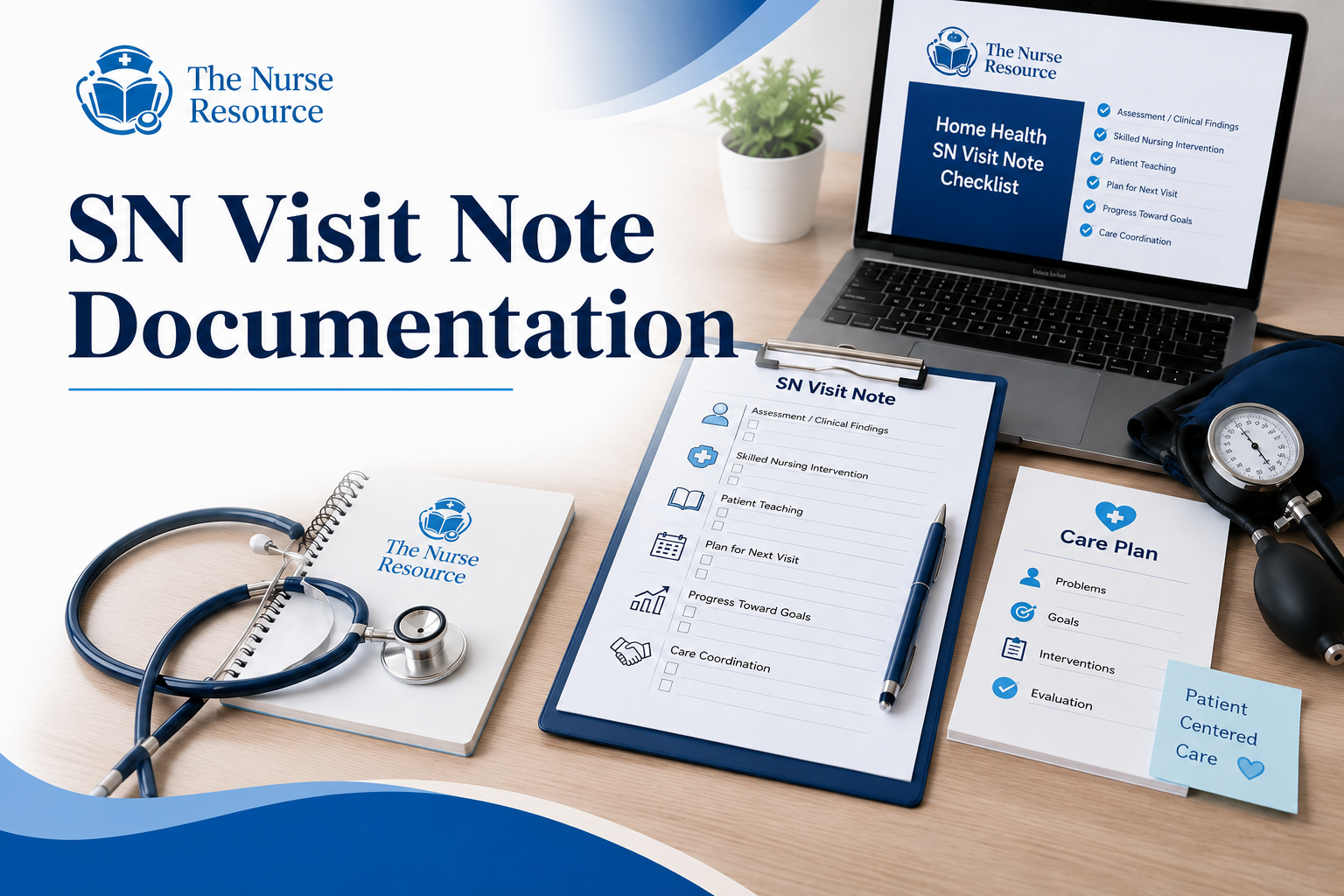
Writing a strong home health skilled nursing visit note is more than documenting that the patient was seen. A good SN visit note should show what the nurse assessed, what skilled intervention was provided, what teaching was completed, how the patient or PCG responded, what changed, and why skilled nursing remains medically necessary.
Many home health notes become weak because they are too general. Phrases like “patient tolerated visit well,” “SN instructed patient,” or “patient verbalized understanding” may not clearly show the skilled nursing value of the visit. A stronger note connects the patient’s condition, risks, teaching needs, response, and plan for the next visit.
This guide explains the main parts of a home health SN visit note and how nurses can document more clearly, practically, and consistently.
Quick Summary
A strong home health SN visit note should show assessment findings, skilled nursing intervention, patient teaching, patient/PCG response, progress toward goals, plan for next visit, and ongoing skilled need.
What Is a Home Health SN Visit Note?
A home health SN visit note is the skilled nursing documentation completed after a nurse provides care in the patient’s home.
The note should describe what happened during the visit, but it should also support why the visit required skilled nursing.
A strong SN note may include:
- patient assessment and clinical findings
- changes in condition
- skilled nursing interventions
- medication review or medication teaching
- disease process teaching
- patient or PCG response to teaching
- progress or lack of progress toward goals
- care coordination or provider notification
- plan for the next visit
- reason skilled nursing remains needed
The note should be patient-specific. It should not read like the same generic sentence copied from visit to visit.
Free Home Health Nurse Starter Pack
Get four practical printable tools for home health skilled nursing visits, including SN documentation review, patient/PCG teaching follow-through, escalation guidance, and an end-of-visit review sheet.
Free download. No credit card required.
Why Generic SN Documentation Is Weak
Generic documentation may be easy to write, but it often does not show the skilled work performed by the nurse.
Weak examples include:
- “SN assessed patient.”
- “SN instructed patient on medications.”
- “Patient verbalized understanding.”
- “No complaints noted.”
- “Continue with plan of care.”
These phrases are not always wrong, but they are incomplete. They do not explain what was assessed, what was taught, what the patient understood, what the patient still needs help with, or why another skilled visit is needed.
A stronger note answers:
- What did the nurse assess?
- What problem or risk was addressed?
- What skilled teaching or intervention was provided?
- How did the patient or PCG respond?
- Was teach-back complete, partial, or poor?
- What needs reinforcement?
- What is the plan for the next visit?
- Why is skilled nursing still needed?
Need Copy-Friendly SN Documentation Support?
This free guide explains the structure of a stronger home health SN visit note. For nurses who need more copy-friendly documentation help, the Home Health SN Narrative Builder Pack includes assessment wording, skilled nursing intervention phrases, patient/PCG response wording, progress toward goals phrases, plan for next visit wording, ongoing skilled need support, weak vs stronger examples, and a daily SN visit note quick charting template.
Premium Library members can access the full pack inside the
Main Parts of a Strong Home Health SN Visit Note
A complete SN visit note does not need to be overly long, but it should be clear. The goal is not to write more words. The goal is to write better, more specific documentation.
A strong home health SN visit note usually includes these parts:
- Assessment / Clinical Findings
- Skilled Nursing Intervention
- Patient Teaching
- Patient or PCG Response
- Progress Toward Goals
- Care Coordination
- Plan for Next Visit
- Ongoing Skilled Need
Each part helps explain the value of the skilled nursing visit.
1. Assessment / Clinical Findings
The assessment section should document what the nurse observed, measured, reviewed, or identified during the visit.
Depending on the patient, this may include:
- Vital Signs
- Blood Pressure readings
- Blood Sugar readings
- pain level
- respiratory status
- edema
- wound status
- medication concerns
- fall risk
- skin condition
- appetite or hydration concerns
- mental status
- caregiver support
- safety risks
- change in condition
Instead of writing:
Weak:
SN assessed patient.
Write something more specific:
Stronger:
SN assessed patient’s cardiopulmonary status, Blood Pressure trend, edema, medication compliance, fall risk, and understanding of current medication plan.
The stronger version shows what skilled assessment was performed.
2. Skilled Nursing Intervention
The skilled intervention section should explain what the nurse did that required nursing skill.
This may include:
- skilled assessment
- medication reconciliation or medication teaching
- disease process teaching
- wound assessment or wound care per order
- Blood Pressure or Blood Sugar monitoring education
- fall prevention teaching
- infection prevention teaching
- symptom monitoring
- provider notification
- care coordination
- reinforcement of discharge instructions
- evaluation of patient response to treatment or teaching
Instead of writing:
Weak:
SN provided teaching.
Write:
Stronger:
SN provided skilled teaching on medication compliance, Blood Pressure monitoring, dizziness precautions, and when to notify PCP for repeated abnormal readings or worsening symptoms.
The stronger version identifies what was taught and why it mattered.
3. Patient Teaching
Patient teaching is one of the most common skilled nursing interventions in home health, but it should be specific.
Avoid documenting only:
Weak:
SN instructed patient on disease management.
Instead, name the topic:
Stronger:
SN instructed patient on CHF symptom monitoring, including daily weight tracking if ordered, edema monitoring, shortness of breath reporting, medication compliance, low-sodium diet reminders as ordered, and when to notify PCP.
Teaching should match the patient’s condition, risk, and plan of care.
Common home health teaching topics may include:
- medication safety
- Blood Pressure monitoring
- Blood Sugar monitoring
- CHF symptom reporting
- COPD breathing symptom reporting
- wound infection signs
- fall prevention
- infection control
- emergency signs
- diet or fluid instructions as ordered
- oxygen safety
- pain management
- anticoagulant precautions
- insulin safety
- patient-specific disease management
The teaching should be practical and connected to the patient’s actual needs.
4. Patient or PCG Response
This is one of the most important parts of the visit note.
A note is stronger when it documents how the patient or PCG responded to teaching or intervention.
Instead of always writing:
Weak:
Patient verbalized understanding.
Use more specific wording:
Stronger:
Patient verbalized partial understanding of medication teaching and required cueing during teach-back regarding side effects to report and when to notify PCP.
Or:
Stronger:
PCG participated in teaching and was able to verbalize two signs of wound infection to report, including increased redness and increased drainage.
Patient response may include:
- verbalized understanding
- partial understanding
- poor understanding
- required cueing
- unable to teach back
- demonstrated correct technique
- required reinforcement
- PCG participated
- PCG unavailable
- patient refused teaching
- patient needs continued reinforcement
The response section helps support whether ongoing skilled teaching is still needed.
5. Progress Toward Goals
The visit note should show whether the patient is improving, stable, declining, or still needing reinforcement.
Examples:
Weak:
Patient progressing.
Stronger:
Patient is making gradual progress toward medication management goal as evidenced by improved ability to identify medication purpose, but continues to require reinforcement regarding side effects to report and refill planning.
Or:
Stronger:
Patient shows limited progress toward fall prevention goal due to continued unsafe transfers and poor recall of safety instructions. Continued SN teaching and reinforcement needed.
Progress does not always mean the patient is fully independent. Sometimes the note should show that the patient still has barriers.
Common barriers may include:
- poor recall
- medication confusion
- cognitive limitation
- language barrier
- lack of PCG support
- recent Hospital stay
- new medication order
- abnormal readings
- fall risk
- wound changes
- poor teach-back
- repeated need for reinforcement
6. Care Coordination
Care coordination should be documented when the nurse contacts or updates another provider, caregiver, agency staff member, or discipline.
This may include:
- PCP notification
- wound provider notification
- pharmacy clarification
- therapy coordination
- case manager update
- caregiver instruction
- DCS/supervisor notification
- reporting abnormal Vital Signs
- reporting fall or change in condition
- medication discrepancy clarification
Example:
Stronger:
SN notified PCP office regarding patient report of increased dizziness and repeated low Blood Pressure readings. Awaiting provider response. Patient instructed to follow provider instructions and call 911 for emergency symptoms.
Care coordination supports that the nurse identified a concern and followed appropriate reporting steps.
7. Plan for Next Visit
A strong note should include what skilled nursing will focus on next.
Instead of:
Weak:
Continue POC.
Write:
Stronger:
Plan for next SN visit is to reassess Blood Pressure trend, reinforce medication teaching, review patient’s Blood Pressure log if available, assess dizziness/fall risk, and evaluate patient teach-back of PCP notification guidelines.
The plan should connect to the patient’s current problem and skilled need.
Examples of next visit focus:
- reassess wound status
- reinforce medication teaching
- review Blood Sugar log
- evaluate Blood Pressure monitoring
- assess edema and shortness of breath
- reinforce fall prevention
- assess pain control
- evaluate patient teach-back
- follow up on provider notification
- reinforce emergency signs teaching
- assess response to recent medication change
8. Ongoing Skilled Need
Ongoing skilled need explains why the patient still requires SN visits.
This section is important because home health nursing must show more than routine observation. It should support the need for skilled assessment, teaching, monitoring, or intervention.
Weak example:
Weak:
Continue SN visits.
Stronger example:
Stronger:
Continued SN visits needed for skilled assessment, medication teaching, Blood Pressure monitoring reinforcement, fall prevention education, and evaluation of patient response due to medication knowledge deficit, abnormal Blood Pressure history, and risk for complications.
Other examples:
For medication teaching:
Continued skilled teaching needed due to medication knowledge deficit, recent medication changes, poor teach-back, and risk for medication-related complications.
For wound patients:
Continued skilled nursing needed for wound assessment, ordered wound care, infection sign monitoring, patient/PCG teaching, and reporting of wound changes to provider as indicated.
For diabetes:
Continued SN visits needed to reinforce Blood Sugar monitoring if ordered, diabetes medication teaching, hypoglycemia/hyperglycemia symptom reporting, and safe follow-through with provider instructions.
For fall risk:
Continued skilled teaching needed due to fall risk, unsafe transfers, poor recall of safety instructions, and need for reinforcement of home safety precautions.
Explore More Home Health Nursing Practice Guides
Looking for more practical guidance on visit planning, skilled nursing workflow, communication, and documentation? Explore our
Home Health Nursing Practice Guides
Weak vs Stronger SN Visit Note Example
Weak SN note example
SN assessed patient. Vital Signs stable. Patient denies pain. SN instructed patient on medications and safety. Patient verbalized understanding. Continue plan of care.
Why this is weak
This note does not explain:
- what was assessed
- what medication teaching was provided
- what safety issue was addressed
- how the patient responded
- whether teach-back was complete
- what needs reinforcement
- why skilled nursing is still needed
Stronger SN note example
SN assessed patient’s general condition, Vital Signs, medication compliance, fall risk, and understanding of current medication plan. SN provided skilled teaching on medication purpose, medication schedule per medication profile, refill planning, dizziness precautions, and when to notify PCP for worsening symptoms or repeated abnormal readings. Patient verbalized partial understanding and required cueing during teach-back regarding medication side effects to report. SN reinforced slow position changes and fall prevention due to reported intermittent dizziness. No emergency symptoms reported during visit. Continued SN visits needed for skilled assessment, medication teaching reinforcement, fall prevention education, and evaluation of patient understanding due to medication knowledge deficit and risk for complications.
Why this is stronger
This note is stronger because it includes:
- skilled assessment
- patient-specific teaching
- symptom reporting
- patient response
- teach-back result
- safety risk
- reason for continued skilled nursing
It does not need to be overly long. It just needs to be specific.
Home Health SN Visit Note Checklist
Before signing the note, ask:
- Did I document what I assessed?
- Did I explain what skilled intervention I provided?
- Did I identify what teaching was completed?
- Did I document patient or PCG response?
- Did I include teach-back if applicable?
- Did I document abnormal findings or patient concerns?
- Did I document provider notification if needed?
- Did I show progress, lack of progress, or need for reinforcement?
- Did I include the plan for next visit?
- Did I explain why skilled nursing remains needed?
If the note does not answer these questions, it may need more detail.
Common Documentation Mistakes to Avoid
Avoid these common problems:
- using the same note every visit
- documenting only “patient verbalized understanding”
- failing to document patient response
- failing to connect teaching to diagnosis or risk
- documenting teaching without showing skilled need
- leaving out abnormal findings
- failing to document provider notification when indicated
- using vague phrases like “continue to monitor”
- writing long notes that still do not show skilled nursing value
- copying generic phrases that do not match the patient
The goal is not to write a perfect note. The goal is to write a clear, patient-specific, skilled note.
Home Health SN Narrative Builder Pack
If you need more copy-ready documentation help, the Home Health SN Narrative Builder Pack is designed to support daily skilled nursing visit notes.
This Premium pack is designed to help nurses build stronger daily SN visit notes with copy-friendly phrase banks, weak vs stronger examples, and quick charting templates.
The pack may include:
- Assessment / Clinical Findings Builder
- Skilled Nursing Intervention Phrase Bank
- Patient / PCG Response Phrase Bank
- Progress Toward Goals Phrase Bank
- Plan for Next Visit Phrase Bank
- Ongoing Skilled Need Phrase Bank
- Weak vs Stronger SN Note Examples
- Daily Visit Note Quick Charting Template
Need full SN visit note and documentation support?
Premium Library members can access copy-friendly teaching scripts, patient/PCG teaching points, SN charting phrases, patient/PCG response wording, ongoing skilled need phrases, weak vs stronger documentation examples, and quick charting templates.
Related Free Teaching and Documentation Posts
You may also find these resources helpful:
- Diabetes Teaching in Home Health: What Nurses Should Cover Across the Episode
- Hypertension Teaching in Home Health: What Nurses Should Cover Across the Episode
- Atrial Fibrillation Teaching in Home Health: What Nurses Should Cover Across the Episode
- Blood Pressure Teaching in Home Health: 10 Areas Nurses Should Cover Across the Episode
- Medication Teaching Lookup for Home Health Nurses
Premium Library members can access the full resource content, documentation support, and downloadable tools inside each pack.
Related Premium Library Resources
- Home Health SN Narrative Builder Pack
- Blood Pressure Teaching Resource Pack
- Medication Safety Resource Pack
- Fall Prevention Teaching Pack
- Wound and Skin Teaching Pack
- Infection Control Teaching Resource Pack
- Emergency Signs and Escalation Pack
These resources can help nurses connect patient teaching with stronger skilled nursing documentation.
Important Use Note
This post is for educational and home health documentation support only. It does not replace provider orders, patient-specific plan of care, agency policy, payer requirements, state regulations, Medicare guidance, accreditation standards, or skilled nursing judgment.
Documentation should always be individualized to patient condition, diagnosis, provider orders, medication profile, plan of care, visit findings, agency policy, and applicable clinical judgment.
This content does not guarantee payment, claim approval, survey compliance, or regulatory compliance.