
Introduction
CHF teaching is a common skilled nursing need in home health, especially after Hospitalization, medication changes, worsening symptoms, or difficulty following CHF care plan.
SN may need to teach and reinforce daily weight routines if ordered, edema monitoring, shortness of breath reporting, medication safety, refill planning, patient-specific diet or fluid instructions, PCG support, fall prevention when weakness or dizziness is present, and when to notify PCP or call 911.
Teaching should develop across the episode of care rather than repeat same general information at every visit. Current symptoms, patient understanding, PCG involvement, barriers, provider instructions, and remaining skilled need should help guide what SN addresses during each visit.
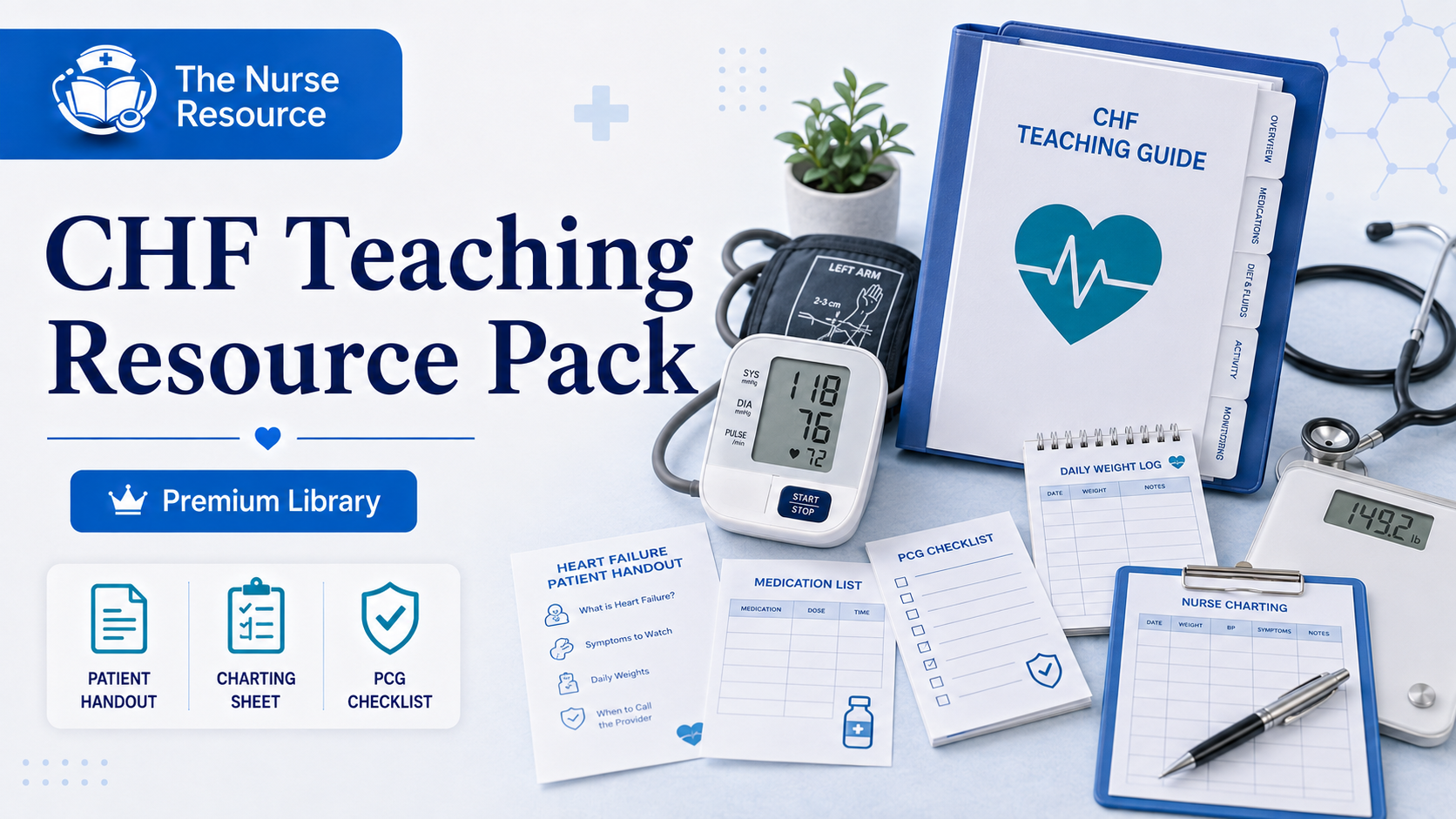
This Premium Library resource pack gives home health nurses practical CHF teaching and documentation support while allowing care to be individualized according to patient condition, provider orders, medication profile, plan of care, agency policy, and skilled nursing judgment.
Get the CHF Teaching Resource Pack
Need practical CHF teaching support for home health nursing visits?
The CHF Teaching Resource Pack gives Premium Library members patient teaching support, PCG monitoring tools, nurse quick charting support, documentation examples, phrase banks, and downloadable resources for CHF care at home.
Premium Library members can access full online resource inside Premium Library.
What This Pack Helps With
This pack helps home health nurses organize CHF teaching around:
- CHF diagnosis understanding.
- Daily weight monitoring if ordered.
- Edema and swelling observation.
- Shortness of breath reporting.
- Medication safety and refill planning.
- Diet and sodium instructions according to provider orders or plan of care.
- Fluid instructions only when specifically ordered.
- Activity and safety instructions according to patient-specific care plan.
- Symptom recognition and reporting.
- When to notify PCP.
- Emergency signs and when to call 911.
- PCG monitoring and follow-through.
- Skilled nursing documentation.
- Patient and PCG response documentation.
- Ongoing skilled need support.
- Discharge preparation.
Pack is designed to help SN select teaching based on current patient needs rather than trying to cover every CHF topic during every visit.
What’s Included in This Pack
Premium Library members can access:
- CHF Patient Teaching Handout.
- PCG CHF Monitoring Checklist.
- CHF Nurse Quick Charting Sheet.
- CHF symptom reporting support.
- Daily weight teaching support if ordered.
- Edema and shortness of breath teaching support.
- Medication safety teaching support.
- PCP notification and emergency escalation support.
- Documentation examples.
- Weak vs stronger documentation examples.
- Patient / PCG response wording support.
- Ongoing skilled need wording support.
- CHF quick charting support.
- Downloadable PDF tools for Premium Library members.
Detailed teaching scripts, copy-ready documentation wording, phrase banks, expanded examples, and full quick charting tools are available inside Premium Library.
Why This Resource Matters
CHF patients may have recurring symptoms or increased risk for worsening condition. Changes at home may include increased swelling, worsening shortness of breath, reduced activity tolerance, medication problems, refill gaps, weight changes when daily weights are ordered, or difficulty following provider instructions.
Patients and PCGs may understand that CHF requires monitoring but still be unsure about:
- Which symptoms should be reported.
- Who should be called.
- What ordered monitoring should be completed.
- How medications fit into CHF care plan.
- How to follow patient-specific diet or fluid instructions.
- When a symptom is concerning but non-emergent.
- When a severe symptom requires calling 911.
Medication confusion, missed monitoring, diet or fluid misunderstanding, refill problems, or delayed symptom reporting may affect patient safety.
SN documentation should also show more than “CHF teaching completed.” Documentation should help explain:
- What was assessed.
- Why teaching was needed.
- What SN taught or reinforced.
- How patient or PCG responded.
- What barriers remain.
- Whether abnormal findings were present.
- Whether PCP or another provider was notified.
- Why continued skilled assessment or teaching remains needed.
Brief CHF Teaching Framework for Home Health Nurses
A simple approach is:
Assess → Prioritize → Teach → Evaluate → Plan Next Visit
Assess
Review current symptoms, Vital Signs, edema, weight routine if ordered, medication follow-through, ordered diet or fluid instructions, PCG support, and barriers affecting safe care.
Prioritize
Identify highest patient-specific concern for current visit. This may involve worsening symptoms, medication confusion, incomplete monitoring, poor teach-back, fall risk, or another issue requiring skilled attention.
Teach
Focus on one or two patient-specific topics that match current assessment findings, provider orders, and plan of care.
Evaluate
Use teach-back, return demonstration, discussion, or observation when appropriate to determine what patient or PCG understands and what still needs reinforcement.
Plan Next Visit
Use patient response, current risks, abnormal findings, barriers, and progress toward goals to determine next skilled teaching or assessment focus.
Brief Examples of Topics Covered
CHF Teaching Resource Pack may support teaching related to:
- Daily weight monitoring when ordered or instructed.
- Recognizing and reporting increased swelling.
- Recognizing worsening shortness of breath or reduced activity tolerance.
- Medication safety and refill planning.
- Following provider-ordered diet or sodium instructions.
- Following fluid instructions only when specifically ordered.
- PCG assistance with monitoring and symptom reporting.
- Fall prevention when weakness or dizziness affects safety.
- Knowing which changes should be reported to PCP.
- Recognizing severe symptoms that require calling 911.
- Preparing patient or PCG for continued CHF care after home health discharge.
Specific monitoring parameters, diet limits, fluid limits, medication instructions, and reporting parameters should follow patient-specific provider orders and plan of care.
Related Free Teaching and Documentation Posts
You may also find these public home health resources helpful:
- CHF Teaching in Home Health: What Nurses Should Cover Across the Episode
- Hypertension Teaching in Home Health: What Nurses Should Cover Across the Episode
- Atrial Fibrillation Teaching in Home Health: What Nurses Should Cover Across the Episode
- Blood Pressure Teaching in Home Health: 10 Areas Nurses Should Cover Across the Episode
- How to Write a Home Health SN Visit Note for Skilled Nursing Documentation
- Medication Teaching Lookup for Home Health Nurses
Related Premium Library Resources
Premium Library members may also find these resources helpful:
- Medication Safety Resource Pack for Home Health Nurses
- Blood Pressure Teaching Resource Pack for Home Health Nurses
- Emergency Signs and Escalation Pack for Home Health Nurses
- Fall Prevention Teaching Pack for Home Health Nurses
- Home Health SN Narrative Builder Pack
These resources may be useful when CHF care also involves Blood Pressure monitoring, medication safety, dizziness or fall risk, emergency symptom teaching, or continued skilled nursing documentation support.
Sources Used
- Centers for Disease Control and Prevention. About Heart Failure.
- American Heart Association. Heart Failure Signs and Symptoms.
- American Heart Association. Managing Heart Failure Symptoms.
- American Heart Association. Physical Changes to Report for Heart Failure.
- MedlinePlus. Heart Failure.
- MedlinePlus Medical Encyclopedia. Heart Failure – Discharge.
- MedlinePlus Medical Encyclopedia. Heart Failure – Home Monitoring.
- National Heart, Lung, and Blood Institute. Heart Failure – Treatment.
- National Heart, Lung, and Blood Institute. Heart Failure – Living With Heart Failure.
Premium Library Access
Full CHF Teaching Resource Pack is available with Premium Library membership.
Membership Access: This resource is included with Premium Library membership and Agency Inservice Library membership.
Agency Inservice Library membership includes access to Premium Library resources. Premium Library resources remain subject to Premium Library individual-subscriber use terms and are not automatically licensed for agency-wide redistribution, shared staff distribution, or agency-wide staff inservice use. Agency Inservice Library materials are separate resources designed for agency staff education.
Premium members can access the full CHF teaching framework, daily weight monitoring support, edema and swelling observation, shortness of breath and activity tolerance teaching, Blood Pressure and pulse monitoring when applicable, medication and diuretic follow-through, sodium and fluid teaching according to provider orders and plan of care, warning sign and escalation guidance, patient and PCG education, documentation examples, phrase banks, quick charting support, and companion downloadable resources available within this pack.
Important Use Note
This public preview is for educational and home health documentation support only. Patient teaching and documentation should be individualized to patient condition, provider orders, medication profile, plan of care, agency policy, payer requirements, and skilled nursing judgment.
This resource does not replace provider orders, Hospital discharge instructions, pharmacy guidance, agency policy, emergency protocols, payer requirements, Medicare guidance, accreditation standards, state regulations, or patient-specific plan of care.