
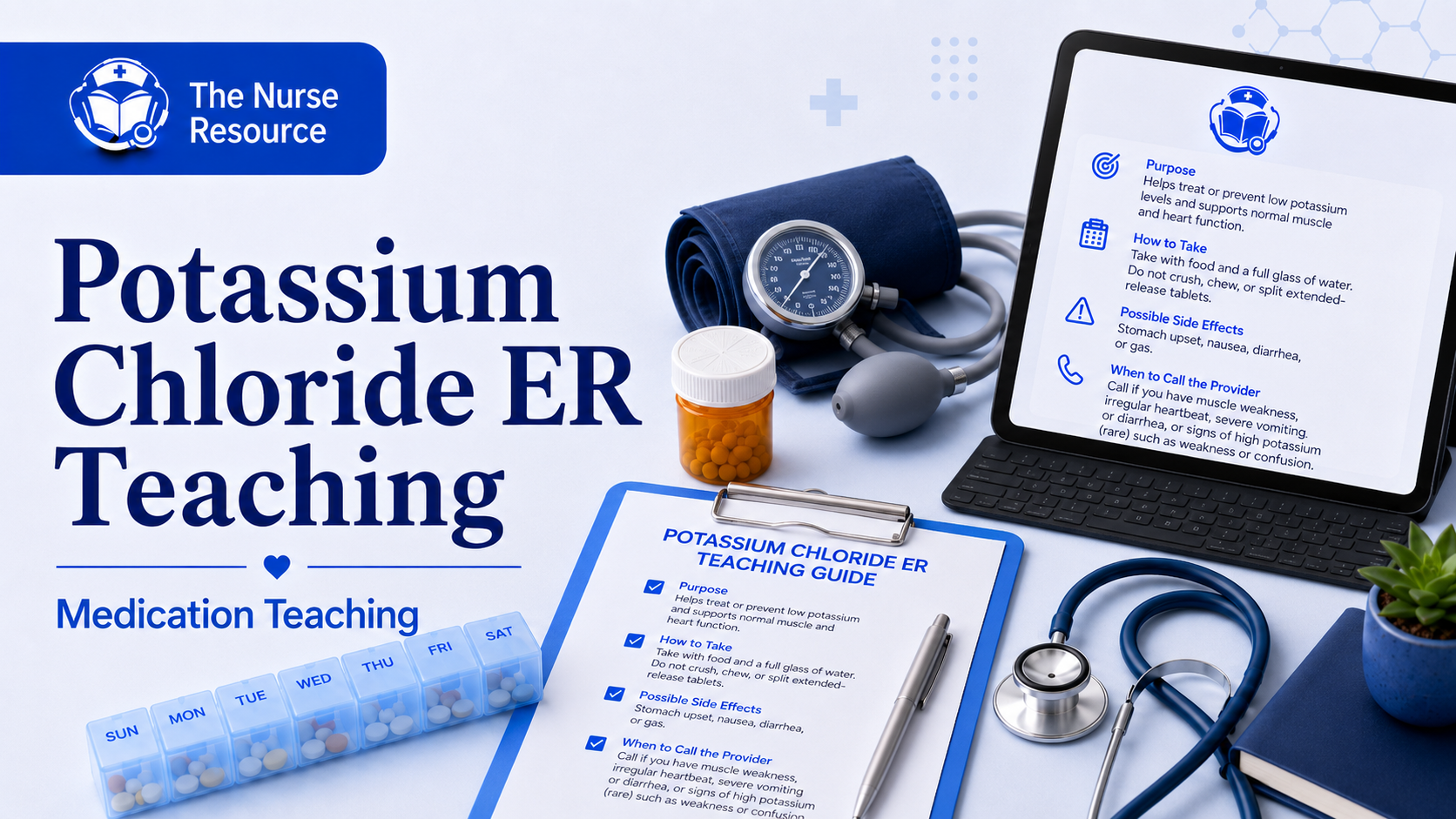
Overview
Potassium chloride extended-release, often written as Potassium Chloride ER, is an electrolyte replacement medication used to replace or prevent low potassium when ordered. Common brand names may include Klor-Con, K-Tab, Micro-K, K-Dur, Klor-Con M, and Klor-Con Sprinkle if listed on the medication profile or pharmacy label.
For home health nurses, Potassium Chloride ER indication and home health teaching often focuses on medication compliance, potassium replacement safety, hypokalemia support when ordered, lab appointment reminders when ordered, medication list review, diuretic-related potassium loss when applicable, kidney-related precautions, cardiac rhythm symptom reporting, GI irritation precautions, swallowing safety for extended-release products, salt substitute caution, and when to notify PCP or call 911.
DailyMed labeling states that Potassium Chloride Extended-Release Tablets are indicated for treatment and prophylaxis of hypokalemia, with or without metabolic alkalosis, in patients where dietary potassium management or diuretic dose reduction is insufficient. MedlinePlus explains that potassium supplements are used to replace potassium losses and prevent potassium deficiency, especially when certain diseases or medications such as diuretics remove potassium from the body.
Potassium Chloride ER may help support potassium replacement as ordered, but patient-specific use, lab monitoring, diet instructions, fluid instructions, administration instructions, and medication safety precautions must always follow provider order, medication profile, pharmacy label, discharge instructions, plan of care, and agency policy.
Medication Quick Information
| Item | Information |
|---|---|
| Generic name | Potassium chloride extended-release |
| Common brand name(s) | Klor-Con, K-Tab, Micro-K, K-Dur, Klor-Con M, Klor-Con Sprinkle |
| Drug classification | Electrolyte replacement / potassium supplement |
| Common home health teaching focus | Medication compliance, potassium replacement safety, hypokalemia support when ordered, lab appointment reminders when ordered, medication list review, diuretic-related potassium loss when applicable, kidney-related precautions, cardiac rhythm symptom reporting, GI irritation precautions, swallowing safety for extended-release products, salt substitute caution, and when to notify PCP or call 911 |
Free Home Health Nurse Starter Pack
Get four practical printable tools for home health skilled nursing visits, including SN documentation review, patient/PCG teaching follow-through, escalation guidance, and an end-of-visit review sheet.
Free download. No credit card required.
Common Indications for Potassium Chloride ER
Common indications may include:
- Hypokalemia
- Low potassium support, when ordered
- Potassium replacement
- Potassium deficiency prevention, when ordered
- Diuretic-related potassium loss support, when ordered
- Electrolyte replacement therapy
- Provider-ordered potassium supplementation
Potassium is important for heart, kidney, muscle, nerve, and digestive function. MedlinePlus notes that diseases such as kidney disease or gastrointestinal disease with vomiting and diarrhea, along with medications such as diuretics, may remove potassium from the body.
Drug classification is not the same as patient-specific indication. For example, Potassium Chloride ER may be classified as an electrolyte replacement or potassium supplement, but the patient-specific indication may be hypokalemia, potassium replacement, potassium deficiency prevention, diuretic-related potassium loss, or another provider-ordered reason.
Short EMR Indication Options
Verify patient-specific reason before use. The examples below are possible short indication options. Select only the indication that matches the patient’s diagnosis, provider order, medication profile, discharge instructions, pharmacy label, or clarified PCP/provider instruction.
| Patient diagnosis / reason | Short EMR indication option |
|---|---|
| Hypokalemia | Hypokalemia treatment |
| Low potassium | Low potassium replacement |
| Potassium deficiency prevention | Potassium deficiency prevention |
| Potassium replacement therapy | Potassium replacement therapy |
| Diuretic-related potassium loss | Diuretic-related K loss |
| Furosemide-related potassium loss support | Diuretic potassium support |
| Electrolyte replacement therapy | Electrolyte replacement |
| Provider-ordered potassium supplement | Potassium supplementation |
| Ordered lab follow-up support | Potassium lab follow-up |
| Medication-related electrolyte support | Medication electrolyte support |
Home Health Teaching Focus
For home health nursing, Potassium Chloride ER teaching often focuses on medication compliance, following the pharmacy label, ER swallowing precautions, GI symptom reporting, lab appointment reminders when labs are ordered, medication list review, potassium supplement safety, salt substitute caution, and when to notify PCP.
Patients may need reinforcement if they have a new Potassium Chloride ER order, recent Hospital stay, hypokalemia, diuretic use, heart-related history, kidney-related precautions, poor intake, vomiting, diarrhea, dehydration concerns, swallowing difficulty, medication confusion, missed doses, refill problems, or PCG involvement.
Patient Teaching Points for Potassium Chloride ER
Basic teaching may include:
- Take Potassium Chloride ER exactly as ordered by PCP/provider and pharmacy label.
- Do not stop, hold, skip, take extra, or change medication unless instructed by PCP/provider.
- Do not crush, chew, suck, split, or open extended-release tablets/capsules unless instructed by PCP/pharmacist.
- Take with food, water, or other liquid only as directed by provider/pharmacy label.
- Keep ordered lab appointments if labs are ordered by PCP/provider.
- Ask PCP or pharmacist before using potassium supplements, salt substitutes, NSAIDs, or new over-the-counter medications.
- Report nausea, vomiting, diarrhea, stomach pain, black/tarry stool, trouble swallowing, muscle weakness, numbness/tingling, confusion, palpitations, or symptoms that continue or worsen.
- Report poor intake, vomiting, diarrhea, dehydration concern, missed doses, refill problems, or medication confusion.
- Call 911 or seek emergency help for chest pain, severe weakness, fainting, severe shortness of breath, severe allergic reaction, severe confusion, trouble breathing, or symptoms that feel life-threatening.
- Keep updated medication list available for PCP, pharmacy, home health agency, and Hospital visits.
Possible Side Effects or Concerns to Report
Possible side effects or concerns may include:
- nausea
- vomiting
- diarrhea
- gas or bloating
- stomach pain or discomfort
- black or tarry stool
- vomiting blood or severe stomach pain
- trouble swallowing
- tablet or capsule swallowing difficulty
- muscle weakness
- numbness, burning, or tingling
- confusion
- palpitations or irregular heartbeat symptoms
- dehydration concerns with vomiting, diarrhea, poor intake, or illness
- rash, swelling, trouble breathing, or allergic-type symptoms
DailyMed lists common adverse reactions to oral potassium salts as nausea, vomiting, flatulence, abdominal pain or discomfort, and diarrhea. DailyMed also warns that solid oral potassium chloride dosage forms can cause gastrointestinal irritation or lesions, especially if the medication stays in contact with GI mucosa for a prolonged time, and it advises medical attention for tarry stools or other signs of GI bleeding.
When to Notify PCP
Call PCP or follow agency/provider instructions if patient has:
- nausea, vomiting, diarrhea, stomach pain, or symptoms that continue
- black or tarry stool
- trouble swallowing Potassium Chloride ER safely
- poor intake, vomiting, diarrhea, or dehydration concern
- muscle weakness, numbness, tingling, confusion, palpitations, or heartbeat changes
- medication confusion
- missed doses
- refill problems
- concerns about potassium supplements, salt substitutes, NSAIDs, or new medications
- missed ordered lab appointment or questions about ordered lab follow-up
- kidney-related concern or change in urination
- symptoms that continue or worsen
DailyMed labeling for Potassium Chloride ER includes interaction warnings related to renin-angiotensin-aldosterone inhibitors and NSAIDs because of hyperkalemia risk, and it identifies renal impairment as a population needing caution.
When to Call 911
Call 911 or get emergency help right away for:
- chest pain or chest pressure
- severe shortness of breath
- fainting or unresponsiveness
- severe weakness with trouble responding
- severe confusion or sudden mental status change
- severe palpitations or severe irregular heartbeat symptoms
- severe allergic reaction symptoms
- severe swelling of face, lips, tongue, or throat
- trouble breathing or swallowing
- vomiting blood
- black or tarry stool with weakness, dizziness, or feeling faint
- symptoms that feel severe or life-threatening
Related Home Health Teaching Resources
You may also find these resources helpful:
- Medication Safety Resource Pack
- Emergency Signs and Escalation Pack
- Home Health SN Narrative Builder Pack
- How to Build a Home Health Skilled Nursing Teaching Plan Across the Episode
- Spironolactone Indication and Home Health Teaching
- Furosemide Indication and Home Health Teaching
- CHF Teaching in Home Health
Premium Library members can access the full resource content, documentation support, and downloadable tools inside each pack.
Important Use Note
This post is for education and home health teaching support only. It does not provide dosing advice, lab interpretation, potassium level interpretation, potassium intake instructions, fluid instructions, medication adjustment instructions, or patient-specific medication profile instructions. It does not replace provider orders, pharmacy guidance, discharge instructions, medication profile, agency policy, payer requirements, or skilled nursing judgment.
Always verify patient-specific Potassium Chloride ER use and indication with provider order, medication profile, discharge instructions, pharmacy label, plan of care, agency policy, and clinical judgment. Drug classification is not the same as patient-specific indication.
This content does not tell patients to increase or restrict potassium, use salt substitutes, start lab monitoring, interpret potassium levels, or change medications. Potassium supplement instructions, diet, fluids, labs, and medication changes must follow provider order, medication profile, pharmacy label, discharge instructions, plan of care, and agency policy.
Public Premium Teaser
Need copy-friendly Potassium Chloride ER teaching and documentation support for home health notes?
The Premium Library section includes a home health teaching script, detailed patient/PCG teaching points, SN charting phrases, patient/PCG response phrases, ongoing skilled need wording, weak vs stronger documentation examples, and a quick charting template for Potassium Chloride ER teaching.
Restricted Premium Library Section
Premium teaching and documentation support below is available for Premium Library and Agency Inservice Library members.
Premium Library Teaching and Documentation Support
Sources Used for Medication Information
- DailyMed / FDA prescribing label for Potassium Chloride Extended-Release Tablets, including listed indication for treatment and prophylaxis of hypokalemia and ER administration precautions.
- DailyMed / FDA prescribing label for Klor-Con extended-release tablets, including GI adverse reaction warnings and patient counseling to avoid crushing, chewing, or sucking tablets and to seek medical attention for tarry stools or other signs of GI bleeding.
- MedlinePlus medication information for Potassium, including use for replacing potassium losses and preventing potassium deficiency, medication forms, and general prescription-label safety reminders.
- Patient-specific use should always be verified with provider order, medication profile, discharge instructions, pharmacy label, agency policy, and clinical judgment.
Leave a Reply