
Introduction
Home health skilled nursing documentation does more than record that a visit occurred. It should accurately reflect patient condition, skilled services actually provided, patient or PCG response, progress, communication, and follow-up.
For Medicare home health services, documentation also helps support why a particular patient required skilled nursing care. That does not mean a certain phrase makes a visit covered or “compliant.” Medicare coverage decisions depend on applicable eligibility and coverage requirements, patient-specific clinical circumstances, services furnished, and supporting medical record.
Federal home health clinical-record requirements, Medicare skilled-services regulations, CMS Medicare coverage guidance, CMS survey guidance, payer requirements, agency policy, state requirements, and accreditation standards each have different roles. They should not all be treated as interchangeable “Medicare documentation rules.”
This refreshed guide focuses on what home health SN documentation should support under current federal requirements and Medicare guidance, rather than providing another step-by-step visit-note writing template.
Quick Navigation / Medicare Documentation Menu
- What Medicare Home Health Documentation Should Support
- Federal Regulation, Medicare Coverage Guidance, and Survey Guidance Are Different
- Patient-Specific Skilled Need
- What Clinical Notes Should Communicate
- Patient and PCG Response
- Progress Across the Home Health Episode
- Abnormal Findings and Provider Communication
- Continued Skilled Need
- Next-Visit Continuity
- Common Documentation Problems
- How This Article Fits With Other TNR Documentation Resources
- Related Free Resources
- Premium Library Documentation Support
- Important Use Note
- Sources Used
Free Home Health Nurse Starter Pack
Get four practical printable tools for home health skilled nursing visits, including SN documentation review, patient/PCG teaching follow-through, escalation guidance, and an end-of-visit review sheet.
Free download. No credit card required.
What Medicare Home Health Documentation Should Support
Taken together, current federal requirements and CMS Medicare guidance point toward documentation that accurately supports:
- Patient-specific reason skilled nursing was needed.
- Relevant current clinical findings.
- Skilled nursing assessment, treatment, teaching, monitoring, or coordination actually provided.
- Patient or PCG response to interventions.
- Progress toward plan-of-care goals.
- Changes in condition or unresolved clinical concerns.
- Follow-up after clinically significant abnormal findings.
- Provider communication when indicated and when it actually occurred.
- Continuity from prior care through current visit.
- Logical next steps.
- Continued skilled need when SN services continue.
42 CFR §484.110 requires HHA clinical records to contain current assessment and clinical information, interventions and responses to interventions, plan-of-care goals, and patient progress toward those goals. Entries must also be clear, complete, appropriately authenticated, dated, and timed. eCFR
CMS Medicare Benefit Policy Manual, Chapter 7 provides additional Medicare coverage guidance. It describes clinical notes as communicating development, course, and outcomes of skilled observations, assessments, treatment, and training. Taken together, notes are expected to tell the story of patient progress toward plan-of-care goals and help demonstrate why skilled services are needed. Centers for Medicare & Medicaid Services
↑ Back to Medicare Documentation Menu
Federal Regulation, Medicare Coverage Guidance, and Survey Guidance Are Different
One of the biggest problems with older documentation education is that everything is sometimes called “Medicare compliance.”
That oversimplifies several different sources.
Federal Home Health Clinical-Record Requirements
42 CFR §484.110 is a federal Condition of Participation addressing HHA clinical records.
It requires accurate clinical records and specifies content that includes:
- Comprehensive assessment and clinical notes.
- Plans of care and provider orders.
- Interventions and responses to interventions.
- Plan-of-care goals and patient progress.
- Required discharge or transfer information.
It also requires entries to be clear, complete, authenticated, dated, and timed. eCFR
42 CFR §484.60 addresses care planning, coordination, and quality of care. It requires an individualized plan of care with patient-specific needs, measurable outcomes and goals, patient and caregiver education, medications and treatments, safety measures, and other required elements. It also requires HHA to promptly alert relevant physician or allowed practitioner when changes in patient condition or needs suggest outcomes are not being achieved or plan of care may need alteration. eCFR
Medicare Skilled-Services Requirements
42 CFR §409.44 addresses Medicare skilled-services requirements.
For skilled nursing, determination is based on beneficiary’s unique condition and individual needs. Regulation states that consideration must be given to complexity of service, beneficiary condition, and accepted standards of medical and nursing practice. It also states that skilled nursing services must be reasonable and necessary for treatment of illness or injury. eCFR
This is important because presence of a diagnosis or performance of a nursing task does not automatically establish Medicare-covered skilled need.
CMS Medicare Coverage Guidance
Medicare Benefit Policy Manual, Chapter 7 provides CMS guidance for Medicare home health coverage.
For skilled nursing documentation, Chapter 7 discusses patient-specific skilled need, pertinent findings, skilled services provided, patient or caregiver response, clinical rationale, and plan for next visit. It also cautions against vague documentation that does not adequately describe need for skilled care. Centers for Medicare & Medicaid Services
This is Medicare coverage guidance. It should not be described as though every sentence in manual is itself a separate Condition of Participation.
CMS Interpretive and Survey Guidance
State Operations Manual Appendix B contains interpretive guidelines and survey procedures related to HHA Conditions of Participation.
CMS itself explains that Interpretive Guidelines clarify regulations and do not impose requirements that are not otherwise established by statute or regulation. Centers for Medicare & Medicaid Services
CMS issued Transmittal 245 on August 5, 2026, adding new acceptance-to-service guidance under §484.105(i) and revising administrator guidance under §484.115(a). CMS specifically states that material not identified as new or revised was previously published and remained unchanged. Centers for Medicare & Medicaid Services
These revisions are relevant to current Appendix B revision history but do not modify the skilled nursing documentation requirements discussed in this article.
Agency, Payer, State, and Accreditation Requirements
Medicare is not the only source that may affect documentation.
An agency may also need to follow:
- Current provider orders.
- Patient-specific plan of care.
- Agency documentation policy.
- Medicare Advantage or other payer requirements.
- Medicaid or commercial payer requirements.
- State law and nursing-practice requirements.
- Accreditation requirements when applicable.
- Agency procedures for late entries, corrections, communication, incidents, and supervisory review.
A documentation practice that is appropriate under one source should not automatically be assumed to satisfy every other requirement.
↑ Back to Medicare Documentation Menu
Patient-Specific Skilled Need
One of the most important Medicare documentation principles is that skilled need is patient-specific.
42 CFR §409.44 states that Medicare coverage decisions regarding reasonable and necessary care are based on information concerning individual beneficiary’s unique medical condition. It also states that coverage should not be denied solely from general assumptions about patients with similar diagnoses or generalized utilization data. eCFR
CMS Chapter 7 similarly states that diagnosis should never be sole factor in determining whether a service is skilled or non-skilled. Centers for Medicare & Medicaid Services
That distinction matters.
A diagnosis such as CHF, COPD, diabetes, hypertension, or wound does not by itself explain why SN was needed during a particular visit.
Documentation should support patient-specific reason nursing knowledge or judgment was necessary.
That may involve evaluating a change, assessing response to treatment, monitoring a significant risk, providing skilled teaching, evaluating patient or PCG ability to safely carry out care, assessing a wound, identifying medication-related concerns, or coordinating care after a clinically significant finding.
Stable Does Not Automatically Mean Non-Skilled
A common documentation misconception is that skilled nursing is appropriate only when patient is unstable or improving.
CMS Chapter 7 specifically explains that a patient’s diagnosis should not be sole factor in determining skilled need and that skilled care may continue to be necessary for a patient whose condition is stable, depending on patient’s unique condition. Centers for Medicare & Medicaid Services
That does not mean every stable patient requires continued SN.
It means stability alone does not answer skilled-need question.
Documentation should support why this particular patient still requires nursing skill, if skilled care continues.
↑ Back to Medicare Documentation Menu
What Clinical Notes Should Communicate
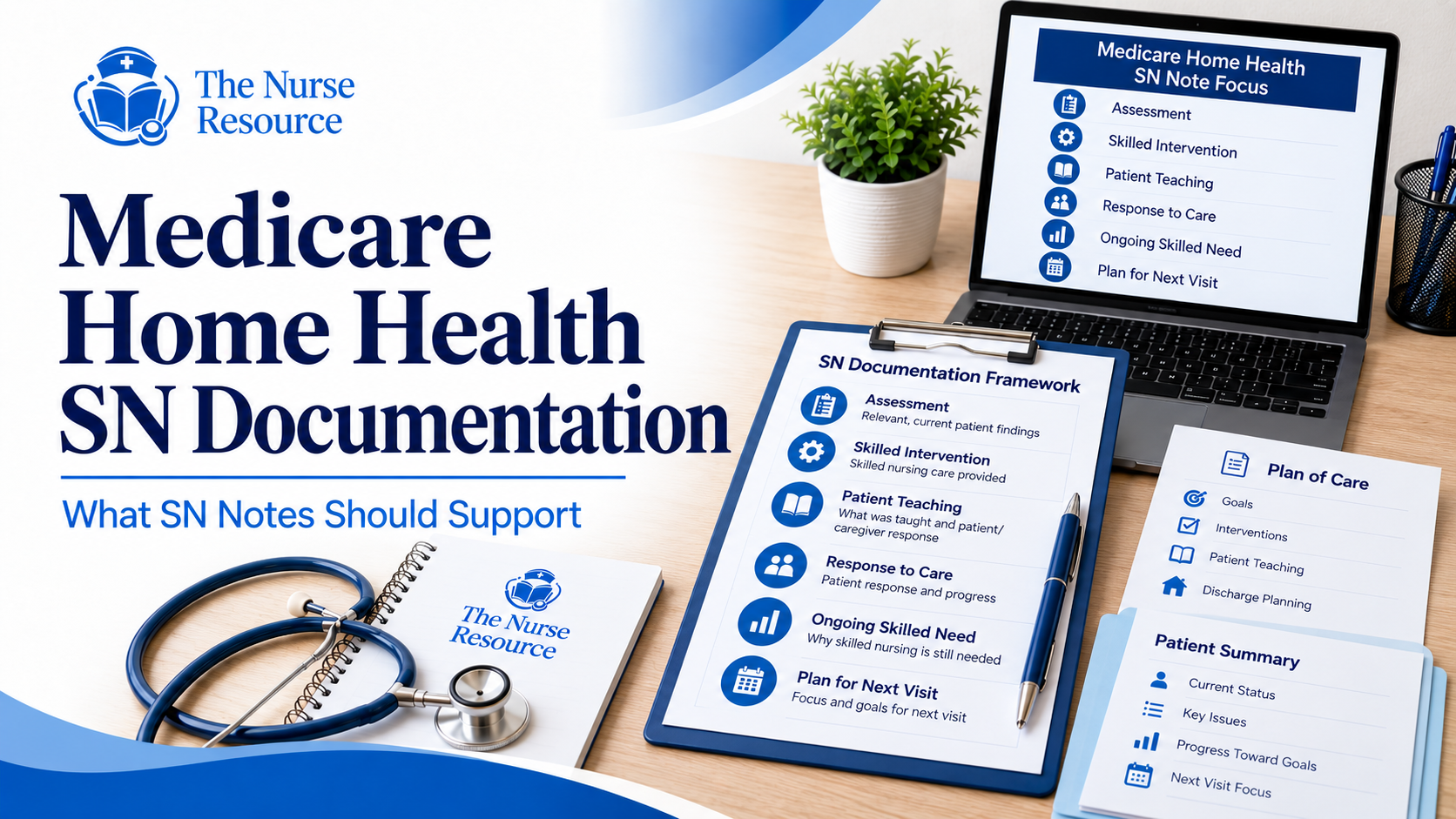
CMS Chapter 7 says home health records for visits are expected to reflect need for skilled medical care provided and to communicate development, course, and outcomes of skilled observations, assessments, treatment, and training. Centers for Medicare & Medicaid Services
Coverage guidance identifies several areas clinical notes should document as appropriate, including:
- Pertinent history and examination related to visit.
- Response or changes following prior skilled services.
- Skilled services provided during current visit.
- Patient or caregiver response.
- Plan for next visit based on prior results.
- Clinical rationale supporting need for skilled service.
- Relevant complexity and patient-specific characteristics.
The goal is not to force every SN note into a fixed sentence pattern.
The goal is for medical record to support a coherent clinical relationship:
Patient-specific condition and need → relevant findings → skilled service → response → progress or follow-up → continued need and next step
This free article intentionally stops at framework level. Detailed narrative builders, phrase banks, and copy-ready templates belong in Premium Library.
↑ Back to Medicare Documentation Menu
Patient and PCG Response
Federal clinical-record requirements specifically include responses to interventions. eCFR
CMS Chapter 7 also identifies patient or caregiver response to skilled services as part of home health clinical-note guidance. It says notes should adequately describe patient reaction to skilled care and provide a clear picture of treatment and next steps. Centers for Medicare & Medicaid Services
That is why documentation such as:
Patient verbalized understanding.
may sometimes be accurate but may provide limited information when patient’s ability to understand or safely perform care is clinically important.
Depending on care provided, a more meaningful record may need to reflect whether patient or PCG:
- Demonstrated a skill.
- Completed teach-back.
- Needed cueing.
- Retained prior teaching.
- Remained confused.
- Could safely perform ordered care.
- Required additional PCG support.
- Declined part of teaching or care.
Document only response actually observed or assessed.
↑ Back to Medicare Documentation Menu
Progress Across the Home Health Episode
Home health documentation should not be viewed only one visit at a time.
42 CFR §484.110 requires clinical record to include patient progress toward plan-of-care goals. eCFR
CMS Chapter 7 describes clinical notes, taken together, as telling story of patient achievement toward goals in plan of care. Centers for Medicare & Medicaid Services
Progress may include improvement, but it can also include:
- Continued barrier.
- Lack of expected progress.
- New risk.
- Worsening condition.
- Improved teach-back.
- Reduced cueing.
- Continued need for PCG assistance.
- Response to provider-directed treatment.
- Greater independence.
- Continued stable status while a patient-specific skilled risk remains.
Documentation should reflect what actually happened.
Changing wording or synonyms from visit to visit does not create clinical progression.
↑ Back to Medicare Documentation Menu
Explore More Home Health Nursing Practice Guides
Looking for more practical guidance on visit planning, skilled nursing workflow, communication, and documentation? Explore our
Home Health Nursing Practice Guides
Abnormal Findings and Provider Communication
An abnormal finding should not simply appear in record without enough context to understand what happened next when follow-up was clinically indicated.
Documentation may need to show connection between:
Finding → relevant assessment → nursing action → communication when indicated → provider instructions or orders actually received → follow-up
42 CFR §484.60 requires HHA to promptly alert relevant physician or allowed practitioner when changes in patient condition or needs suggest outcomes are not being achieved or plan of care should be altered. It also requires communication and coordination among practitioners involved in plan of care. eCFR
This does not mean every abnormal Blood Pressure, Blood Sugar, Vital Sign, symptom, or isolated finding automatically requires same provider notification.
Patient-specific provider parameters, symptoms, baseline, diagnosis, orders, plan of care, agency policy, and skilled nursing judgment matter.
Documentation should accurately reflect communication that actually occurred.
Do not document:
- PCP notification that did not occur.
- Provider response that was not received.
- An order that was not given.
- Patient instruction that was not provided.
- Follow-up assessment that was not performed.
Stronger wording cannot replace missing clinical action.
↑ Back to Medicare Documentation Menu
Continued Skilled Need
Documentation should help support why SN services continue when they remain reasonable and necessary.
That support should come from actual patient-specific clinical circumstances, not from inserting a stock phrase containing words such as “skilled,” “medically necessary,” or “continued SN.”
For example, current record may support continued skilled involvement because of:
- Ongoing need for skilled assessment.
- Change requiring further evaluation.
- Response to new treatment or medication.
- Continued teaching need.
- Incomplete teach-back.
- Medication-management problem.
- Wound or symptom-monitoring need.
- PCG limitation.
- Safety concern.
- New provider instructions.
- Need for ongoing clinical coordination.
42 CFR §409.44 bases skilled nursing coverage on beneficiary’s unique condition, individual needs, complexity of service, and accepted standards of practice. CMS Chapter 7 likewise emphasizes individualized skilled need rather than diagnosis or terminology alone. eCFR
A sentence does not create skilled need.
Documentation supports skilled need by accurately reflecting clinical facts and services.
↑ Back to Medicare Documentation Menu
Next-Visit Continuity
CMS Chapter 7 identifies plan for next visit, based on rationale of prior results, among home health clinical-note considerations. It also says notes should provide a clear picture of treatment and next steps. Centers for Medicare & Medicaid Services
That does not require a complicated next-visit paragraph.
It means current documentation should connect logically with ongoing care.
For example:
- A new medication concern may require reassessment of response.
- Incomplete teach-back may require reevaluation of understanding.
- A wound change may require follow-up of wound status and updated orders.
- Provider communication may require follow-up on response or new instructions.
- A remaining safety barrier may require reassessment before discharge.
A generic statement such as “continue POC” may be accurate, but CMS guidance specifically identifies that type of vague wording as insufficient by itself to adequately describe need for skilled care. Centers for Medicare & Medicaid Services
↑ Back to Medicare Documentation Menu
Common Documentation Problems
Several documentation patterns can make patient-specific skilled story difficult to follow.
Diagnosis Without Current Skilled Reason
A diagnosis identifies condition but may not explain why SN skill was required during current visit.
Tasks Without Clinical Context
Documenting that Vital Signs were obtained, medications were reviewed, or teaching was completed may not explain why those services required skilled nursing for this patient.
Response Without Meaningful Evidence
A generic patient response may not show whether teaching changed understanding, ability, or safety when those issues matter clinically.
Abnormal Finding Without Follow-Up
Record may identify a concerning finding but leave reviewer unable to determine what SN did about it.
Repetitive Notes Without Episode Progression
Repeating same narrative can make it difficult to understand whether patient improved, remained unchanged, developed a new barrier, or still requires reinforcement.
Stock Ongoing Skilled Need Wording
A closing sentence does not substitute for patient-specific assessment and clinical reasoning.
Treating Every CMS Source as Same Type of Requirement
Federal regulation, Medicare coverage guidance, survey interpretation, agency policy, payer rules, state requirements, and accreditation standards should be identified accurately rather than grouped under a blanket claim of “Medicare compliance.”
↑ Back to Medicare Documentation Menu
Two Limited Documentation Illustrations
These examples are intentionally limited and are not full SN templates.
Example 1: Diagnosis Alone
Limited documentation:
Patient has CHF. Continue SN.
This identifies diagnosis but does not explain current patient-specific need for skilled nursing.
Stronger direction:
Documentation should make clear what current CHF-related condition, symptom, risk, treatment response, teaching need, or monitoring concern required skilled assessment or intervention during that visit.
Example 2: Stable Condition
Potential misconception:
Patient is stable, therefore skilled nursing is no longer needed.
That conclusion should not be based on word “stable” alone.
CMS guidance recognizes that skilled care may still be necessary for a stable patient when unique condition and clinical circumstances require nursing skill. Documentation should support actual patient-specific reason continued skilled services remain needed. Centers for Medicare & Medicaid Services
↑ Back to Medicare Documentation Menu
How This Article Fits With Other TNR Documentation Resources
The Nurse Resource documentation cluster now separates several different needs.
Medicare Home Health Skilled Nursing Documentation: What SN Notes Should Support
This article explains federal and Medicare documentation concepts, patient-specific skilled need, authority hierarchy, and what SN documentation should support.
Skilled Nursing Charting in Home Health: What Strong SN Notes Should Show
Use Skilled Nursing Charting in Home Health: What Strong SN Notes Should Show when you want to evaluate whether a completed SN note tells a clear, patient-specific clinical story.
How to Write a Home Health SN Visit Note for Skilled Nursing Documentation
Use How to Write a Home Health SN Visit Note for Skilled Nursing Documentation for basic visit-note organization and explanation of core SN note sections.
Documentation Compliance Skilled Nursing Resource Pack
Premium Library members can use Documentation Compliance Skilled Nursing Resource Pack for Home Health Nurses for deeper documentation-quality review, gap identification, abnormal-finding and provider-communication review, continuity review, and repeat-use documentation tools.
Home Health SN Narrative Builder Pack
Use Home Health SN Narrative Builder Pack when detailed writing support is needed, including narrative builders, patient and PCG response wording, progress wording, ongoing skilled need support, weak vs stronger examples, and fill-in documentation tools.
↑ Back to Medicare Documentation Menu
Related Free Resources
- Skilled Nursing Charting in Home Health: What Strong SN Notes Should Show
- How to Write a Home Health SN Visit Note for Skilled Nursing Documentation
Premium Library Documentation Support
Need a repeat-use tool to review documentation quality and identify missing clinical connections?
Premium Library members can access the Documentation Compliance Skilled Nursing Resource Pack for Home Health Nurses.
This resource focuses on reviewing whether documentation is patient-specific, clinically meaningful, complete, connected across episode, and clear about issues such as abnormal findings, provider communication, patient or PCG response, progress, and continued skilled need. It is designed as a documentation-quality review and gap-identification resource rather than a large public phrase bank.
For nurses who need detailed help organizing and writing SN narratives, the Home Health SN Narrative Builder Pack provides separate copy-friendly narrative support, phrase banks, progress and next-visit wording, ongoing skilled need support, and fill-in tools.
No phrase or template from either resource automatically establishes Medicare coverage, medical necessity, skilled need, payment eligibility, or regulatory compliance.
Important Use Note
This article is for educational and home health documentation support only.
Documentation must accurately reflect actual patient condition, assessment findings, services provided, teaching performed, patient or PCG response, provider communication, orders or instructions actually received, interventions, and follow-up.
Documentation must be individualized to provider orders, patient-specific plan of care, medication profile, agency policy, payer requirements, applicable federal and state requirements, accreditation standards when applicable, and skilled nursing judgment.
No phrase, sentence, template, checklist, or documentation style automatically establishes skilled need, medical necessity, Medicare coverage, payment eligibility, claim approval, survey compliance, regulatory compliance, or audit approval.
This article does not replace provider orders, agency policy, payer requirements, state requirements, accreditation standards, CMS guidance, applicable regulations, or professional clinical judgment.
↑ Back to Medicare Documentation Menu
Sources Used
- Centers for Medicare & Medicaid Services. Medicare Benefit Policy Manual, Chapter 7: Home Health Services
- Electronic Code of Federal Regulations. 42 CFR §409.44, Skilled Services Requirements
- Electronic Code of Federal Regulations. 42 CFR §484.60, Care Planning, Coordination of Services, and Quality of Care
- Electronic Code of Federal Regulations. 42 CFR §484.110, Condition of Participation: Clinical Records
- Centers for Medicare & Medicaid Services. Home Health Agencies: Interpretive Guidelines and Appendix B
- Centers for Medicare & Medicaid Services. Transmittal 245, Revised Appendix B Interpretive Guidelines for Home Health Agencies
Premium Library
For home health nurses and agency leaders
Ready-to-use teaching packs, documentation tools, patient handouts, PCG checklists, nurse quick charting sheets, and premium downloads.
– Premium teaching packs
– Patient handouts
– Nurse quick charting sheets
– PCG monitoring checklists
– Skilled documentation examples
– Teach-back prompts
– Red flag guidance
– New resources added regularly
$9/month
Cancel anytime. New resources added regularly.
Free Resource Library
Coming Soon
Free
Frequently Asked Questions
Can I cancel anytime?
Yes. Premium Library is $9/month and can be canceled anytime.
Who is this for?
Home health nurses, clinical supervisors, QA nurses, DCS/DON, staff educators, and agency leaders.
Are these resources for education only?
Yes. Resources are for educational and clinical support use. Apply based on patient condition, provider orders, agency policy, payer requirements, and skilled nursing judgment.
Are new resources added?
Yes. New teaching packs, documentation tools, and downloads are added regularly.
Can agencies use these resources?
Premium Library resources may be helpful for home health agency leaders, clinical supervisors, QA nurses, DCS/DON, and staff educators. Resources should be adapted to agency policy, payer requirements, provider orders, and skilled nursing judgment.
Ready to access the full Premium Library?
Get teaching packs, patient handouts, charting sheets, PCG checklists, documentation examples, and premium downloads for home health practice.