
Introduction
Wound infection teaching in home health should not be the same script repeated during every SN visit.
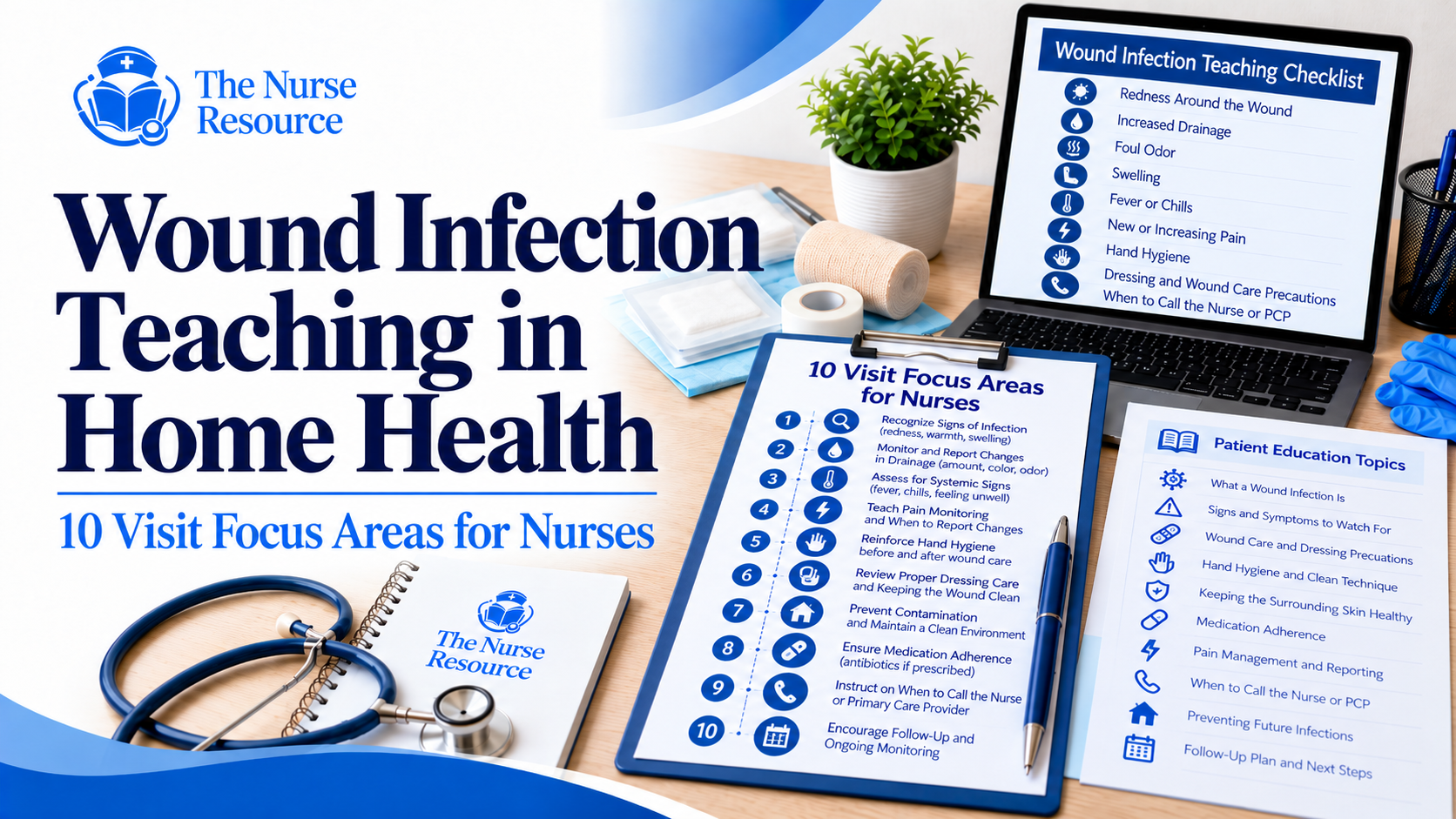
Early visits may focus on helping patient or PCG understand what wound and surrounding skin currently look like and which changes should be reported. Follow-up visits may focus on redness, drainage, odor, pain, dressing concerns, medication follow-through, or systemic symptoms. Later visits should evaluate whether patient or PCG can recognize concerning changes and follow reporting plan with less SN prompting.
This article is intentionally focused on wound infection recognition, prevention, reporting, and teaching progression.
For broader wound-care teaching across episode, including dressing protection, skin protection, pressure concerns, diabetes, circulation, nutrition, healing risks, and discharge preparation, see Wound Care Teaching in Home Health: What Nurses Should Cover Across the Episode.
A practical approach is:
Assess current wound and infection risk → Select current teaching focus → Reinforce patient-specific instructions → Evaluate patient or PCG understanding → Escalate concerns when indicated → Plan next teaching focus
Why Wound Infection Teaching Matters in Home Health
Much of wound monitoring occurs between SN visits.
Patient or PCG may be the first person to notice increased redness, drainage, odor, pain, swelling, or a change in overall condition. Delayed reporting can allow a wound problem to worsen before nurse or provider evaluates it.
Signs that may warrant provider evaluation include increasing redness, warmth, swelling, pain, drainage, foul odor, fever, or chills. These findings should be considered together with wound type, patient baseline, provider orders, and current clinical condition rather than used to independently diagnose infection. MedlinePlus
Home health teaching may be particularly important when patient:
- Has a new wound or recently changed wound-care plan.
- Recently returned home from Hospital.
- Has history of wound infection.
- Has diabetes or impaired sensation.
- Has limited vision, dexterity, cognition, or mobility.
- Depends on PCG for wound observation or dressing care.
- Has difficulty recognizing changes.
- Delays reporting symptoms.
- Has dressing contamination or supply problems.
- Has new wound-related medication or antibiotic orders.
SN should select teaching based on current assessment and patient-specific risk rather than automatically moving through a fixed script.
How to Use These 10 Visit Focus Areas
The 10 areas below are not a required sequence.
One topic may need reinforcement during several visits, while another patient may move quickly from basic infection-sign recognition to PCG teach-back and discharge preparation.
Teaching should follow:
- Current wound findings.
- Changes from prior visit.
- Provider orders.
- Plan of care.
- Patient or PCG ability.
- Infection risk.
- Medication changes.
- Barriers identified during prior teaching.
- Skilled nursing judgment.
Free Home Health Nurse Starter Pack
Get four practical printable tools for home health skilled nursing visits, including SN documentation review, patient/PCG teaching follow-through, escalation guidance, and an end-of-visit review sheet.
Free download. No credit card required.
1. Baseline Wound and Surrounding Skin Awareness
When This Focus May Be Helpful
This is often useful during early visits, after Hospital discharge, after a new wound develops, or when patient or PCG cannot describe what wound normally looks like.
SN Focus
Assess current wound and surrounding skin according to provider orders, plan of care, and agency policy.
Patient or PCG may need help understanding which findings are part of current baseline and which represent a change.
Teaching may reinforce observing for changes such as:
- Increased redness.
- New warmth.
- Increased swelling.
- New or increased drainage.
- New odor.
- Increasing pain or tenderness.
- Wound becoming larger, deeper, darker, or otherwise different.
- New skin breakdown around wound.
The goal is not to teach patient to diagnose wound infection.
Goal is to help patient or PCG recognize change from current condition and report it appropriately.
2. Redness, Warmth, and Swelling
Redness, warmth, and swelling around wound may be important when they are new, increasing, spreading, or different from prior findings.
MedlinePlus identifies increased redness, warmth, and swelling among wound changes that should be reported to health care provider. MedlinePlus
SN Focus
Consider:
- Current extent of redness.
- Whether surrounding skin appearance changed.
- New or increasing warmth.
- Increasing swelling.
- Pain or tenderness.
- Drainage.
- Fever or other systemic symptoms.
- Patient-specific wound history.
Teaching Focus
Reinforce reporting new or worsening changes rather than waiting until next scheduled SN visit.
Do not instruct patient to apply an unapproved cream, ointment, cleanser, or other wound product because redness develops.
Treatment changes should follow provider orders and plan of care.
3. Drainage Changes
Drainage teaching should focus on change, not simply presence of drainage.
Different wounds can normally produce different amounts and types of drainage.
MedlinePlus advises contacting provider when wound drainage increases, becomes thick, develops concerning color or appearance, or develops bad odor. MedlinePlus
SN Focus
Assess changes in:
- Amount.
- Appearance.
- Thickness.
- Odor.
- Dressing saturation.
- New bleeding.
- Surrounding skin condition.
Teaching Focus
Patient or PCG may need to report:
- Sudden increase in drainage.
- Repeated dressing saturation.
- New thick drainage.
- New concerning drainage appearance.
- Drainage accompanied by increased redness, warmth, swelling, pain, or odor.
Do not teach patient to diagnose infection based on drainage color alone.
4. Odor Changes
New or worsening wound odor can be concerning, particularly when it occurs with increased drainage, pain, redness, swelling, or wound deterioration.
MedlinePlus includes bad-smelling wound drainage among findings that warrant provider follow-up. MedlinePlus
SN Focus
Determine whether odor is:
- New.
- Stronger than previously documented.
- Associated with drainage changes.
- Associated with surrounding skin changes.
- Associated with increased pain.
- Associated with systemic symptoms.
Teaching Focus
Patient or PCG should report a new or worsening odor according to provider and agency instructions.
Avoid teaching that odor by itself confirms infection.
SN assessment and provider evaluation may be needed to determine clinical significance.
5. Pain or Tenderness Changes
Pain should be compared with patient baseline and expected wound condition.
Increasing or new wound pain or tenderness may warrant further assessment, especially when accompanied by redness, swelling, warmth, drainage, or other changes. MedlinePlus identifies increasing pain as one finding that should prompt provider contact. MedlinePlus
SN Focus
Assess:
- Current pain.
- Change from prior visit.
- Location.
- Tenderness around wound.
- Relationship to dressing or treatment.
- Other infection-related findings.
- Current pain medication plan if applicable.
Teaching Focus
Reinforce reporting pain that is new, increasing, different from usual, or associated with worsening wound findings.
Do not advise patient to independently increase pain medication or change wound treatment.
6. Fever, Chills, Weakness, Confusion, or Other Systemic Symptoms
Wound infection teaching should not focus only on wound itself.
A patient may develop more generalized symptoms as infection becomes more serious.
Possible concerns may include:
- Fever or chills.
- New or worsening weakness.
- Feeling unusually ill.
- New confusion.
- Reduced activity tolerance.
- Poor appetite.
- Shortness of breath.
- Rapid clinical decline.
CDC describes sepsis as a life-threatening medical emergency caused by body’s extreme response to infection. Possible signs can include confusion, fever or shivering, shortness of breath, extreme discomfort, and other signs of serious illness. CDC
SN Focus
Consider systemic symptoms together with:
- Wound findings.
- Vital Signs.
- Patient baseline.
- Medication profile.
- Other possible infection sources.
- Current provider instructions.
Teaching Focus
Patient or PCG should understand that worsening whole-body symptoms should not be ignored simply because wound itself appears unchanged.
Prompt reporting or emergency response may be necessary depending on severity.
7. Dressing Contamination and Infection Prevention
A dressing problem can create an infection-prevention concern even when wound itself has not obviously changed.
SN Focus
Assess whether dressing is:
- Loose.
- Wet.
- Soiled.
- Saturated.
- Contaminated.
- Removed unexpectedly.
- Difficult for patient or PCG to protect.
Teaching Focus
Reinforce following current wound-care orders for dressing protection and contacting home health agency when dressing is compromised and patient or PCG is unsure what to do.
Do not provide one universal instruction to remove, replace, reinforce, or leave every compromised dressing in place.
Response should follow wound orders, agency instructions, and patient-specific care plan.
8. Hand Hygiene and Clean Supply Handling
Hand hygiene is one of most important infection-prevention teaching areas when patient or PCG participates in wound care.
CDC recommends cleaning hands before and after changing wound dressings or bandages. CDC
Teaching Focus
When patient or PCG performs wound-related care according to plan of care, reinforce:
- Hand hygiene before handling clean supplies.
- Hand hygiene after wound or dressing care.
- Keeping clean supplies protected.
- Separating clean supplies from used or contaminated items.
- Avoiding reuse of single-use dressings or supplies.
- Following agency and provider instructions for disposal.
Do not assume PCG understands clean handling because dressing changes have been performed previously.
Observation or return demonstration may be appropriate when ability is uncertain.
9. Medication or Antibiotic Follow-Through When Ordered
Some patients with a wound infection may receive antibiotic or other wound-related medication orders.
Medication teaching should remain specific to current medication profile.
CDC advises patients prescribed antibiotics for infections such as MRSA to take them exactly as prescribed and contact provider regarding questions or side effects. CDC
SN Focus
Assess:
- Whether medication is available.
- Patient or PCG understanding of instructions.
- Missed doses.
- Refill concerns.
- Reported side effects.
- Medication confusion.
- Whether symptoms are improving, unchanged, or worsening.
Teaching Focus
Reinforce:
- Following provider and pharmacy instructions.
- Not independently starting leftover antibiotics.
- Not stopping, restarting, extending, increasing, decreasing, or otherwise changing medication without provider instruction.
- Reporting medication concerns or side effects.
- Reporting worsening wound findings despite treatment.
For missed-dose questions, patient should follow pharmacy or provider instructions rather than improvise a dose.
10. Patient and PCG Reporting, Teach-Back, Escalation, and Follow-Up
By later visits, teaching should increasingly evaluate whether patient or PCG can recognize changes and follow reporting plan without repeated prompting.
SN Focus
Determine whether patient or PCG knows:
- Which local wound changes should be reported.
- Which systemic symptoms are concerning.
- Who to contact.
- When home health agency should be called.
- When PCP or wound provider should be notified.
- Which symptoms may require 911.
- What follow-up appointments are scheduled.
- Whether current wound-care supplies and medications are available.
Limited Teach-Back Example
A simple public teach-back question may be:
“What wound changes would make you call your nurse or provider before next scheduled visit?”
Teach-back should be individualized to actual teaching and patient or PCG ability.
This free article intentionally does not include a large teach-back question bank or response phrase library.
Wound and Skin Teaching Pack
for Home Health Nurses
This free post focuses specifically on wound infection teaching progression.
Premium Library members who need deeper wound and skin support can use the Wound and Skin Teaching Pack for Home Health Nurses for more detailed patient teaching, PCG monitoring, wound and skin observation support, infection-warning guidance, documentation examples, and downloadable nurse resources.
Detailed copy-ready charting support remains in Premium Library rather than this public article.
How Wound Infection Teaching Can Progress Across Visits
Early Visits
Teaching may focus on:
- Current wound baseline.
- Surrounding skin.
- Basic local infection warning signs.
- Dressing protection.
- Hand hygiene.
- Who to contact if wound changes.
Follow-Up Visits
Teaching may shift toward:
- Drainage changes.
- Odor.
- Increasing pain or tenderness.
- Redness, warmth, and swelling trends.
- Dressing contamination.
- Antibiotic or medication follow-through when ordered.
- Patient or PCG ability to recognize changes.
Later Visits
Teaching may increasingly focus on:
- Reliable symptom recognition.
- PCG ability when assistance is needed.
- Teach-back.
- Prompt reporting.
- PCP versus emergency escalation.
- Supply and medication follow-through.
- Unresolved barriers.
- Continued need for reinforcement.
- Preparation for discharge when appropriate.
Teaching should move forward based on patient response, not simply because a certain number of visits has occurred.
Wound Infection Warning Signs Patients and PCGs Should Report
Follow patient-specific provider instructions and agency policy for concerns such as:
- Increasing redness.
- New or worsening warmth.
- Increased swelling.
- Increased pain or tenderness.
- Increased drainage.
- New thick or concerning drainage.
- New or worsening foul odor.
- New bleeding.
- Wound becoming larger or deeper.
- New dark or worsening tissue.
- Dressing repeatedly becoming saturated or contaminated.
- Fever or chills.
- Increased weakness.
- New confusion.
- Patient appearing more ill.
- Symptoms worsening despite treatment.
Authoritative wound-care resources identify redness, warmth, swelling, increased drainage, odor, worsening pain, fever, and chills among findings that should prompt provider follow-up. MedlinePlus
When to Notify PCP or Provider
Notify PCP, wound provider, surgeon, podiatry provider, or follow agency notification process for non-emergency concerns such as:
- New or increasing redness around wound.
- Increasing warmth or swelling.
- Increased wound pain or tenderness.
- Increased or changed drainage.
- New or worsening odor.
- Wound becoming larger, deeper, or otherwise worsening.
- New bleeding.
- Fever or chills.
- Increased weakness.
- New confusion or significant change in function.
- Dressing repeatedly becoming saturated, wet, loose, or contaminated.
- Medication or antibiotic concerns.
- Missed medication doses.
- Side effects.
- Patient or PCG unable to follow ordered wound-care plan safely.
- Symptoms that worsen or do not improve as expected.
Follow provider orders, wound-care orders, medication profile, plan of care, agency policy, and skilled nursing judgment.
When to Call 911
Call 911 or follow patient-specific emergency plan for severe or life-threatening symptoms such as:
- Severe shortness of breath.
- Severe or concerning chest pain.
- Fainting or loss of consciousness.
- Severe confusion or inability to respond normally.
- Uncontrolled bleeding.
- Severe allergic reaction symptoms.
- Rapidly worsening condition with signs of serious systemic illness.
- Any situation in which patient appears to be in immediate danger.
Skin and wound infections can contribute to sepsis. CDC identifies sepsis as a life-threatening medical emergency and advises rapid action when it is suspected. CDC
Do not delay emergency response to complete routine PCP notification.
Documentation Considerations
Wound infection documentation should show more than:
Wound infection teaching done.
At framework level, documentation should help show:
- Relevant current wound and surrounding skin findings.
- Why infection teaching was relevant that visit.
- Specific infection-related teaching provided.
- Patient or PCG response when assessed.
- Teach-back or return demonstration when appropriate.
- New or worsening findings.
- PCP or wound-provider communication when it actually occurred.
- Instructions or orders actually received.
- What requires follow-up.
A useful clinical connection is:
Current wound finding → infection-related teaching or nursing action → patient/PCG response → communication when indicated → follow-up
Do not document provider communication, patient response, wound findings, or interventions that did not occur.
Full EMR blocks, wound charting phrase banks, detailed patient/PCG response wording, and ongoing skilled need phrases remain Premium Library content.
Common Wound Infection Teaching Mistakes
Repeating Same Script Every Visit
Reinforcement can remain appropriate, but teaching should reflect current wound condition, patient response, and remaining barrier.
Diagnosing Infection From One Finding
Drainage, redness, odor, or pain should be assessed within wound type, baseline, surrounding findings, systemic symptoms, and provider plan.
Giving Universal Wound-Care Instructions
Do not assume every wound should be cleaned, covered, changed, packed, or treated same way.
Changing Treatment Without an Order
Teaching should reinforce existing wound-care orders rather than create a new treatment plan.
Giving Medication Adjustment Advice
Do not independently tell patient to start, stop, extend, hold, or change antibiotic or other wound-related medication.
Ignoring PCG Ability
If PCG performs wound-related care, SN should evaluate whether PCG can actually follow assigned instructions safely.
Focusing Only on Wound and Ignoring Systemic Symptoms
Weakness, confusion, fever, chills, respiratory symptoms, or rapid decline may be clinically important even when wound changes appear small.
Documenting Only “Patient Verbalized Understanding”
When ability matters, evaluate teach-back, observation, or return demonstration as appropriate.
How to Keep Wound Infection Teaching Skilled Across Visits
Wound infection teaching remains patient-specific when SN:
- Reviews current wound and surrounding skin findings.
- Compares findings with prior visit.
- Identifies current infection risk or concern.
- Selects teaching based on current need.
- Evaluates dressing and supply issues.
- Reviews medication follow-through when applicable.
- Observes patient or PCG technique when relevant.
- Uses teach-back when appropriate.
- Identifies barriers.
- Communicates concerning findings when indicated.
- Evaluates whether prior teaching changed patient or PCG follow-through.
- Adjusts next teaching focus based on response.
Repeated teaching may still be appropriate when patient or PCG has incomplete teach-back, unsafe technique, delayed reporting, medication confusion, a change in wound condition, or continued need for assistance.
Changing documentation wording alone does not make teaching skilled.
Related Free Resources
For the broader wound-care framework, read Wound Care Teaching in Home Health: What Nurses Should Cover Across the Episode. This is the main public wound pillar covering wound observation, dressing protection, pressure and skin protection, healing risks, patient/PCG participation, and progression across episode.
For broader infection-prevention teaching, see Infection Control Teaching for Home Health Nurses.
For patients with diabetes-related wound or foot risk, see Diabetes Teaching in Home Health: What Nurses Should Cover Across the Episode.
Related Agency Inservice Resources
Home health agencies that need staff-wide education can use the Wound Infection Signs and Reporting Inservice through Agency Inservice Library.
Agency inservice resources are designed for staff education and may include staff lesson material, sign-in documentation, post-test and answer key, staff attestation, competency review, and QAPI/staff education record support. The Nurse Resource
Agencies remain responsible for reviewing and adapting materials to agency policy, state requirements, accreditation standards, payer requirements, and applicable regulations.
Important Use Note
This post is for educational and home health teaching and documentation support only. It does not replace provider orders, wound-care orders, Wound Specialist or surgeon instructions, medication profile, pharmacy guidance, Hospital discharge instructions, patient-specific plan of care, agency policy, payer requirements, state regulations, Medicare guidance, accreditation standards, emergency protocols, or skilled nursing judgment.
Wound observation, infection monitoring, dressing care, cleansing, wound products, dressing changes, medication teaching, antibiotic use, provider notification, and emergency escalation must be individualized to patient condition, wound type and cause, provider orders, medication profile, plan of care, agency policy, payer requirements, and clinical judgment.
This content does not provide universal wound-care procedures, dressing-change instructions, wound-cleansing instructions, medication dosing advice, antibiotic-selection advice, medication-adjustment instructions, universal fever parameters, or emergency treatment instructions beyond calling 911 for severe or life-threatening symptoms and following patient-specific emergency plan.
Do not independently start, stop, hold, restart, extend, increase, decrease, or otherwise change wound treatment, antibiotic therapy, or other medication unless directed by an authorized provider.
Documentation should reflect only assessment findings, teaching, patient or PCG response, communication, orders, and interventions that actually occurred.
This content does not guarantee Medicare payment, claim approval, survey compliance, documentation compliance, wound healing, or regulatory compliance.
Sources Used
- MedlinePlus Medical Encyclopedia. Surgical Wound Care: Open. Reviewed January 1, 2026. Includes wound changes that should prompt provider contact, including increased redness, pain, swelling, drainage, odor, and fever. MedlinePlus
- MedlinePlus Medical Encyclopedia. Surgical Wound Care: Closed. Reviewed April 11, 2026. Includes wound and drainage changes that warrant provider follow-up. MedlinePlus
- MedlinePlus Medical Encyclopedia. Surgical Wound Infection: Treatment. Includes common infection findings such as drainage, odor, fever, chills, warmth, redness, and pain. MedlinePlus
- Centers for Disease Control and Prevention. About Hand Hygiene for Patients in Healthcare Settings. Includes hand hygiene before and after changing wound dressings or bandages. CDC
- Centers for Disease Control and Prevention. Preventing Methicillin-resistant Staphylococcus aureus (MRSA). Includes wound infection prevention and antibiotic follow-through principles. CDC
- Centers for Disease Control and Prevention. About Sepsis. Updated August 17, 2026. Describes sepsis as a life-threatening medical emergency and reviews possible systemic warning signs.