
Introduction
Diabetes teaching is rarely completed in one home health visit.
Patient needs may change across episode of care based on Blood Sugar patterns, medication changes, insulin use, recent Hospitalization, poor intake, illness, foot or skin concerns, ability to use monitoring equipment, PCG involvement, and progress with self-management.
Repeating the same generic Diabetes teaching at every SN visit does not clearly show what patient needed that day, what was reinforced, how patient or PCG responded, what barriers remain, or why continued teaching may still be appropriate.
Diabetes Teaching Variations and SN Documentation Support is designed to help home health nurses vary teaching across repeated visits while keeping documentation connected to actual assessment findings, patient-specific risks, provider orders, plan of care, patient / PCG response, and next-visit needs.
This resource expands on the broader Diabetes Teaching Resource Pack by focusing more deeply on visit-to-visit teaching variation and copy-friendly SN documentation support.
All examples must be individualized. A phrase by itself does not establish skilled need and should never be used to document care, findings, teaching, response, or provider communication that did not occur.
Get Diabetes Teaching and SN Documentation Support
Need more than another generic “SN instructed patient on Diabetes” note?
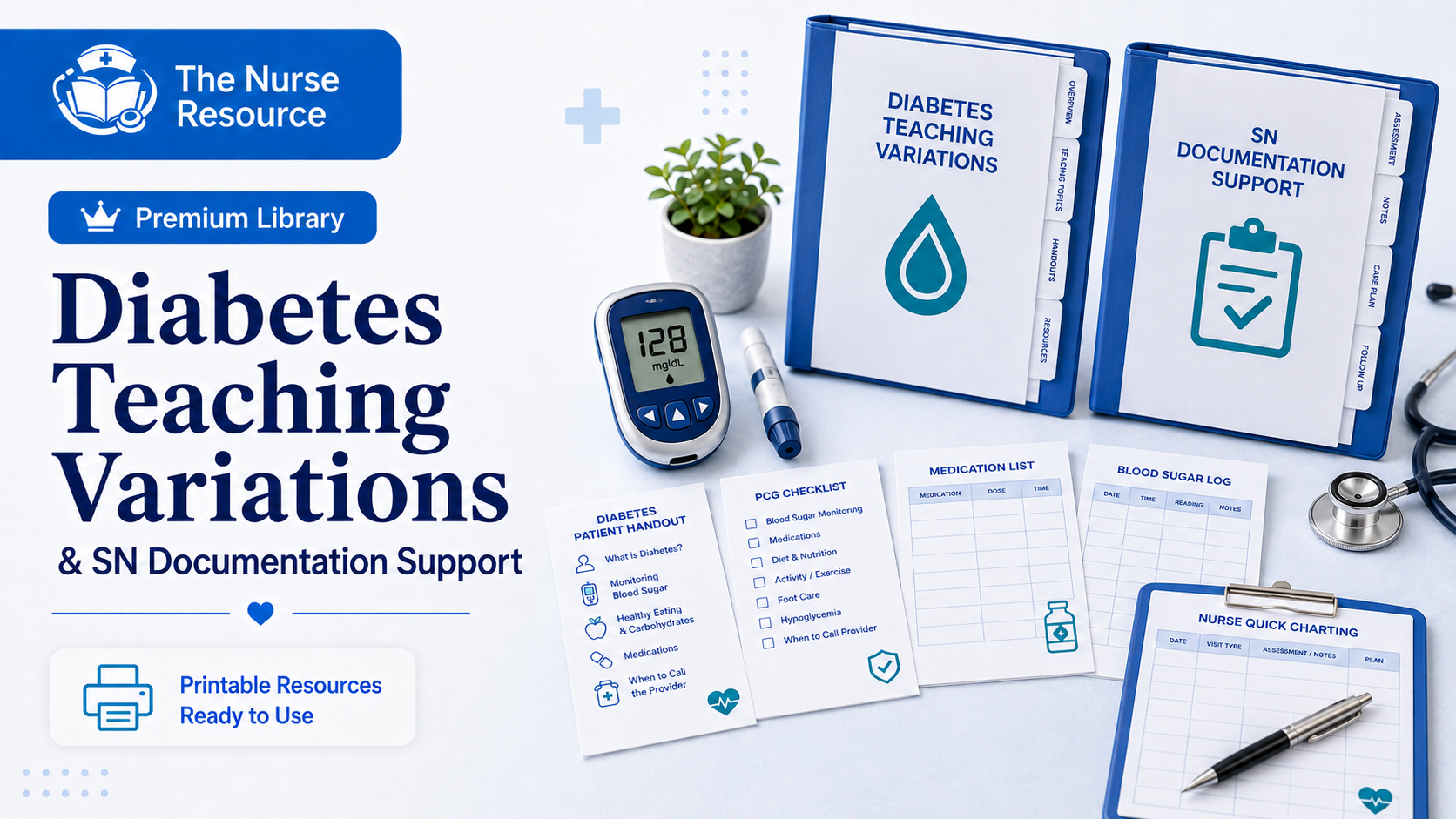
Diabetes Teaching Variations and SN Documentation Support gives Premium Library members practical support for varying Diabetes teaching across home health visits, including Blood Sugar monitoring, hypo/hyperglycemia symptoms, medication and insulin teaching, nutrition, foot care, complication awareness, patient and PCG education, copy-friendly SN documentation examples, response phrase banks, quick charting support, and printable member tools.
Premium Library members can access full online resource inside Premium Library.
What This Resource Helps With
This Premium resource helps home health nurses organize Diabetes teaching and documentation around:
- Blood Sugar monitoring and logging if ordered.
- Glucometer or monitoring-equipment use.
- Hypoglycemia recognition and reporting.
- Hyperglycemia recognition and reporting.
- Diabetes medication follow-through.
- Insulin safety when ordered.
- Meal consistency and patient-specific nutrition instructions.
- Hydration according to patient-specific care plan.
- Foot and skin monitoring.
- Wound and infection awareness when applicable.
- Illness, poor intake, vomiting, or diarrhea concerns.
- Patient-specific sick-day instructions.
- PCG involvement and safety support.
- Medication and supply refill planning.
- Teach-back and return demonstration.
- Patient and PCG response documentation.
- Barriers affecting Diabetes self-management.
- Abnormal finding documentation.
- PCP notification wording when notification actually occurs.
- Ongoing skilled need documentation.
- Next-visit planning.
- Discharge preparation.
Why This Resource Matters
Diabetes care at home involves more than checking a Blood Sugar reading.
Patient or PCG may be responsible for medications, insulin when ordered, monitoring equipment, testing supplies, meals, symptom recognition, foot and skin observation, medication refills, follow-up appointments, and communication with PCP or Diabetes care team.
Problems identified during home health visits may include:
- Difficulty using glucometer or prescribed monitoring system.
- Incomplete Blood Sugar log.
- Missing testing supplies.
- Repeated readings outside patient-specific parameters.
- Hypoglycemia or hyperglycemia symptoms.
- Medication confusion.
- Missed medication.
- Insulin confusion.
- Poor appetite or missed meals.
- Difficulty obtaining food or supplies.
- Vision or dexterity limitations.
- Memory problems.
- Foot or skin changes.
- Wound concerns.
- Illness affecting Diabetes self-management.
- PCG uncertainty.
- Delayed symptom reporting.
- Difficulty explaining when to notify PCP or call 911.
Strong SN documentation should reflect what actually occurred during visit rather than rely on the same general teaching paragraph each time.
Documentation may need to show:
- Why Diabetes-related skilled assessment or teaching was needed.
- What patient-specific issue was addressed.
- What SN assessed, taught, demonstrated, monitored, or reinforced.
- How patient or PCG responded.
- Whether teach-back or return demonstration was completed.
- What barriers remain.
- Whether abnormal findings were identified.
- Whether PCP or another provider was notified.
- What progress occurred.
- Why continued skilled assessment or teaching remains needed.
- What SN plans to reassess or teach next.
What’s Included
Premium Library members can access:
- Full Diabetes teaching variation framework.
- 10 visit-specific Diabetes teaching variations.
- Blood Sugar monitoring documentation support.
- Hypoglycemia and hyperglycemia teaching support.
- Diabetes medication documentation phrases.
- Insulin safety documentation support when applicable.
- Meal, nutrition, and hydration teaching support.
- Foot and skin teaching documentation.
- Sick-day and poor-intake teaching support.
- PCG teaching and monitoring support.
- Teach-back wording.
- Patient / PCG response phrase bank.
- Abnormal finding wording.
- PCP notification wording.
- Ongoing skilled need phrase bank.
- Weak vs stronger Diabetes documentation examples.
- Quick Diabetes Charting Builder.
- Next-visit focus wording.
- Member navigation and related resources.
- Future printable download access.
Detailed copy-ready member content is restricted to Premium Library and Agency Inservice Library members.
How Home Health Nurses Can Use This Resource
This resource is designed to support progression rather than simple rotation for sake of making notes look different.
A teaching topic should be selected because it matches patient need.
For example:
- Early visit may focus on whether patient can safely check Blood Sugar as ordered.
- Next visit may focus on recognizing symptoms of low Blood Sugar.
- Another visit may address medication confusion or insulin safety.
- A later visit may focus on foot and skin monitoring.
- Illness or poor intake may require a different teaching priority.
- PCG teaching may become important when patient cannot safely manage care independently.
- Later visits may focus on teach-back, remaining barriers, refill planning, and discharge readiness.
Teaching may appropriately repeat when patient still has a knowledge deficit or safety concern. What should change is assessment of progress, patient response, barriers, and reason reinforcement remains necessary.
Why Diabetes Teaching Should Progress Across Visits
Diabetes teaching should not become a sequence of identical notes.
A useful episode progression is:
Assess → Prioritize → Teach → Evaluate → Reinforce or Advance → Plan Next Visit
Assess
Review current condition, ordered Blood Sugar monitoring, symptoms, medication follow-through, nutrition or poor-intake concerns, feet and skin, PCG support, supplies, and barriers.
Prioritize
Choose teaching that addresses most relevant patient-specific risk or remaining knowledge deficit.
Teach
Provide focused education based on current assessment, provider instructions, medication profile, and plan of care.
Evaluate
Use discussion, teach-back, observation, or return demonstration when appropriate.
Reinforce or Advance
Repeat teaching when patient still needs reinforcement. Advance to another topic when patient demonstrates adequate understanding and another need becomes more important.
Plan Next Visit
Identify what should be reassessed, reinforced, demonstrated, or reviewed during next SN visit.
Related Free Teaching and Documentation Posts
Use these public resources for broader Diabetes and documentation guidance:
- Diabetes Teaching in Home Health: What Nurses Should Cover Across the Episode
- Diabetes Teaching Variations in Home Health: 10 Visit Focus Areas for Nurses
- How to Document Diabetes Teaching in Home Health: A Practical SN Framework
- How to Write a Home Health SN Visit Note for Skilled Nursing Documentation
- Medication Teaching Lookup for Home Health Nurses
Related Diabetes Medication Teaching Posts
Related Premium Library Resources
Premium Library members may also find these resources helpful:
- Diabetes Teaching Resource Pack for Home Health Nurses
- Medication Safety Resource Pack for Home Health Nurses
- Emergency Signs and Escalation Pack for Home Health Nurses
- Home Health SN Narrative Builder Pack
- Wound and Skin Teaching Pack for Home Health Nurses.
Diabetes Teaching Resource Pack provides broader patient / PCG teaching and printable support. This resource focuses more deeply on varying Diabetes teaching and strengthening SN documentation across repeated visits.
Sources Used
Clinical information and safety framing were reviewed using:
- NIDDK: Managing Diabetes
- NIDDK: Diabetes and Foot Problems
- CDC: Manage Blood Sugar
- CDC: Managing Sick Days
- MedlinePlus: Blood Glucose
The Nurse Resource source material reviewed during consolidation:
- Diabetes Teaching in Home Health: What Nurses Should Cover Across the Episode
- Blood Sugar Teaching Variations A-J: 10 Home Health Teachings With Teach-Back + EMR Copy-Paste
- The Ultimate Home Health Nurse’s Guide to Blood Sugar Monitoring & Diabetes Teaching: 10 Skilled Nursing Documentation Templates
Premium Library Access
Full Diabetes Teaching Variations and SN Documentation Support resource is available with Premium Library membership.
Membership Access: This resource is included with Premium Library membership and Agency Inservice Library membership.
Agency Inservice Library membership includes access to Premium Library resources. Premium Library resources remain subject to Premium Library individual-subscriber use terms and are not automatically licensed for agency-wide redistribution, shared staff distribution, or agency-wide staff inservice use. Agency Inservice Library materials are separate resources designed for agency staff education.
Premium members can access the full Diabetes teaching variation framework, Blood Sugar monitoring support, hypo/hyperglycemia teaching guidance, medication and insulin teaching support, nutrition and foot care teaching, patient and PCG education guidance, documentation examples, phrase banks, quick charting support, and companion downloadable resources available within this pack.
Public Important Use Note
This public preview is for educational and home health documentation support only.
Diabetes teaching and documentation must be individualized to patient condition, actual assessment findings, provider orders, medication profile, patient-specific Blood Sugar parameters, plan of care, agency policy, payer requirements, and skilled nursing judgment.
This resource does not provide universal Blood Sugar parameters, medication dosing advice, insulin adjustment instructions, universal sick-day medication instructions, or patient-specific treatment recommendations.
Do not start, stop, hold, skip, increase, decrease, or otherwise adjust medication or insulin unless directed by authorized provider.
Documentation examples do not automatically establish skilled need and should never be used to document teaching, findings, patient response, provider notification, or interventions that did not occur.