
Introduction
Hypertension teaching is a common skilled nursing need in home health because high Blood Pressure often causes no obvious symptoms. A patient may feel well and still need ongoing monitoring, medication management, follow-up, and risk reduction. [1],[2]
Teaching should not stop after one SN visit. Patient may initially need help understanding hypertension diagnosis and medication routine. Later visits may focus on Blood Pressure monitoring technique, adherence barriers, dizziness, fall risk, symptom reporting, PCG support, and preparation for managing care after home health discharge.
A strong home health teaching plan should connect hypertension education to patient-specific diagnosis, current Vital Signs, provider orders, medication profile, comorbid conditions, plan of care, prior teaching, patient or PCG response, and skilled nursing judgment.
Quick Summary
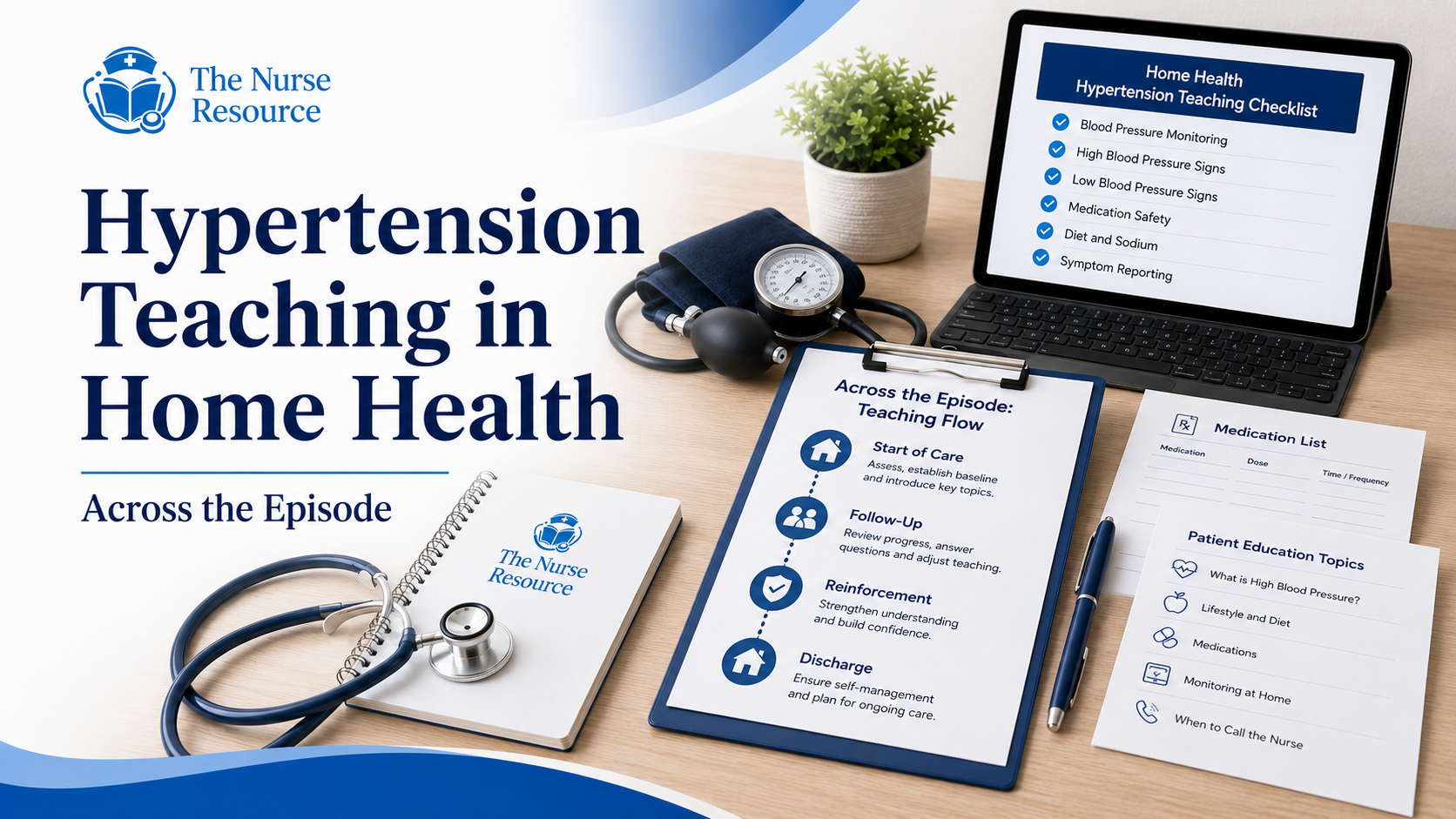
Across a home health episode, hypertension teaching may include:
- Patient-specific hypertension diagnosis and care plan.
- Blood Pressure monitoring if ordered.
- Correct home Blood Pressure technique when patient monitors at home.
- Blood Pressure log and pattern reporting.
- Medication safety and adherence.
- Symptoms that should be reported.
- Dizziness, weakness, and fall prevention.
- Diet, sodium, fluid, activity, and weight teaching only according to provider instructions.
- Comorbid conditions such as CHF, CKD, diabetes, stroke history, or cardiac disease when applicable.
- PCG involvement when needed.
- Refill planning.
- PCP or cardiology follow-up.
- Maintaining an updated medication list.
- Knowing when to notify PCP.
- Knowing when to call 911.
A practical approach across visits is:
Assess → Prioritize → Teach → Evaluate → Plan Next Visit
Free Home Health Nurse Starter Pack
Get four practical printable tools for home health skilled nursing visits, including SN documentation review, patient/PCG teaching follow-through, escalation guidance, and an end-of-visit review sheet.
Free download. No credit card required.
Why Hypertension Teaching Matters in Home Health
Hypertension can be easy for patients to underestimate because it typically does not cause symptoms. Over time, uncontrolled high Blood Pressure can contribute to serious health problems involving heart, brain, kidneys, and other organs. [1], [2]
Home health provides SN an opportunity to see how Blood Pressure care is actually being managed in home setting.
SN may identify concerns such as:
- Patient does not understand why medication is necessary when no symptoms are present.
- Blood Pressure monitor is missing, damaged, or difficult to use.
- Cuff does not fit correctly.
- Patient checks Blood Pressure using inconsistent technique.
- Readings are not recorded as instructed.
- Medication doses are missed.
- Old and current medication bottles are mixed together.
- Duplicate medications may be present.
- Refills are running out.
- Patient reports dizziness or weakness.
- Patient is at risk for falls.
- PCG is managing medications or Blood Pressure checks without adequate understanding.
- Follow-up appointments are being missed.
Home Blood Pressure monitoring can support hypertension management, but equipment and technique matter. AHA recommends an appropriately sized upper-arm cuff, placement on bare skin, a supported seated position, feet flat, arm supported at heart level, and quiet rest before measurement.
Home monitoring should support, not replace, ongoing care with PCP or other health care professionals. Patients should not stop Blood Pressure medications based only on home readings without provider direction. [1]
Hypertension Teaching Across the Episode
Hypertension teaching should develop as patient moves through home health episode.
Start of Care and Early Visits
Early visits should establish baseline understanding, identify immediate risks, and determine which areas require skilled teaching.
SN may focus on:
- Confirming patient understanding of hypertension diagnosis.
- Reviewing provider orders.
- Reviewing current medication profile.
- Assessing current Blood Pressure monitoring routine if ordered.
- Checking whether patient has working equipment and correct cuff.
- Reviewing Blood Pressure log when available.
- Observing home Blood Pressure technique when applicable.
- Reviewing patient-specific reporting instructions.
- Assessing dizziness, weakness, falls, or near falls.
- Identifying medication confusion, missed doses, duplicates, refill problems, or possible side effects.
- Identifying diet, sodium, fluid, activity, or weight instructions already included in provider instructions or plan of care.
- Determining whether PCG assistance is needed.
- Reviewing when to notify PCP and when to call 911.
Goal is not to complete every hypertension teaching topic during first visit. Goal is to identify highest patient-specific risks and develop an appropriate teaching sequence.
Middle of Episode Teaching
Middle visits should focus on reinforcement, safe follow-through, and barriers that remain unresolved.
SN may review:
- Whether patient is following ordered Blood Pressure monitoring routine.
- Whether patient can use monitor correctly.
- Whether readings are being recorded as instructed.
- Whether patient knows provider-specific reporting parameters.
- Medication adherence.
- Refill status.
- Recent medication changes.
- Dizziness or weakness.
- Falls or near falls.
- Diet or sodium instructions according to provider plan.
- Activity and safety recommendations according to plan of care.
- Patient or PCG teach-back.
- Continued barriers requiring provider communication or care coordination.
A patient who can correctly perform a Blood Pressure check but repeatedly misses medications has a different teaching need from a patient who takes medications correctly but cannot apply cuff or interpret provider reporting instructions.
Teaching should follow current need instead of repeating same lesson at every visit.
Later Episode and Discharge Preparation
Later visits should evaluate whether patient or PCG can continue hypertension care safely with less SN prompting.
Before discharge, evaluate whether patient or PCG understands:
- Hypertension diagnosis and reason for ongoing management.
- Ordered Blood Pressure monitoring routine.
- Correct monitoring technique when home checks are ordered.
- Provider-specific reporting parameters.
- Medication routine.
- Refill process.
- Symptoms that should be reported.
- Fall precautions when dizziness or weakness is present.
- PCP or cardiology follow-up plan.
- Importance of maintaining an updated medication list.
- When to notify PCP.
- When to call 911.
Unresolved concerns should be addressed through provider communication, care coordination, agency process, and discharge planning.
1. Understanding Patient-Specific Hypertension Diagnosis and Care Plan
Hypertension is another term for high Blood Pressure. Because high Blood Pressure is often asymptomatic, patient may not recognize why ongoing treatment and monitoring matter. [1], [2]
Teaching should begin with patient-specific situation rather than a generic hypertension lesson.
SN should consider:
- Primary diagnosis.
- Related diagnoses.
- Recent Hospitalization or change in condition.
- Current medications.
- Blood Pressure monitoring orders.
- Provider-specific reporting parameters.
- Symptoms patient has experienced.
- Diet or sodium instructions if ordered.
- Fluid instructions if ordered.
- Activity recommendations if ordered.
- Weight-monitoring instructions if applicable.
- Fall risk.
- Ability to manage care independently.
- PCG involvement.
Patient teaching should remain consistent with provider orders and plan of care.
2. Blood Pressure Monitoring if Ordered
If home Blood Pressure monitoring is ordered or instructed, assess whether patient or PCG can perform it safely and consistently.
Teaching may include:
- Using an appropriately sized cuff.
- Placing cuff on bare skin.
- Sitting with back supported.
- Keeping feet supported and uncrossed when possible.
- Supporting arm appropriately.
- Keeping cuff near heart level according to device instructions.
- Resting quietly before measurement.
- Avoiding talking or unnecessary movement during reading.
- Recording readings if instructed.
- Following provider-specific reporting parameters.
Improper positioning, cuff fit, talking, movement, and other technique problems can affect Blood Pressure measurement.
SN should also determine whether vision, cognition, weakness, tremor, poor dexterity, or mobility limitations affect patient’s ability to use equipment independently. [1]. [2], [3]
Do not assign universal Blood Pressure reporting parameters. Follow provider-specific instructions, plan of care, and agency policy.
3. Blood Pressure Log and Pattern Reporting
A Blood Pressure log may help patient and care team review readings over time when home monitoring is part of care plan. AHA describes a single Blood Pressure measurement as a snapshot and recommends sharing home readings with health care professional. [1], [2]
If instructed, teaching may include:
- Recording date and time.
- Recording Blood Pressure reading.
- Recording symptoms associated with reading.
- Reporting repeated readings outside provider-specific parameters.
- Bringing or sharing log with PCP or cardiology provider.
- Keeping log available for home health review.
SN should avoid teaching patient to make independent treatment decisions based solely on a reading.
Blood Pressure should be considered along with symptoms, medication use, recent changes, provider instructions, and clinical assessment.
4. Medication Safety and Adherence
Blood Pressure medication teaching should be based on current medication profile and provider orders.
SN may assess:
- Whether patient understands basic purpose of medication.
- Medication schedule.
- Missed doses.
- Refill status.
- Duplicate medications.
- Recent medication changes.
- Possible side effects.
- Dizziness or lightheadedness.
- Ability to read labels.
- Ability to organize medications.
- PCG support.
- Pharmacy access.
Medication adherence is important in hypertension management, and some Blood Pressure medicines may cause side effects such as dizziness or lightheadedness. Medication concerns should be reviewed with provider rather than managed through independent dose changes. [1], [2]
Do not independently advise patient to:
- Start a medication.
- Stop a medication.
- Hold a medication.
- Skip a medication.
- Take an extra dose.
- Change medication timing.
- Change medication dose.
Medication changes should come from PCP, cardiology provider, or another authorized prescriber.
5. Dizziness, Weakness, and Fall Prevention
Hypertension teaching should not focus only on elevated readings.
Dizziness, lightheadedness, weakness, or faintness may occur with low Blood Pressure, position changes, dehydration, illness, medications, or other conditions. Orthostatic Blood Pressure changes can contribute to lightheadedness and falls, particularly in older adults. [1], [2]
SN should assess:
- Dizziness or lightheadedness.
- Weakness.
- Falls or near falls.
- Symptoms with position changes.
- Unsafe transfers.
- Gait and balance.
- Assistive device use.
- Bathroom safety.
- Recent medication changes.
- Fluid instructions if applicable.
- PCG availability.
Teaching may reinforce slow position changes, sitting down if dizzy, using ordered assistive devices, and asking for assistance when unsafe.
Any patient-specific instructions should follow provider orders, therapy recommendations, plan of care, agency policy, and skilled nursing judgment.
6. Diet, Sodium, Fluids, Weight, and Activity Instructions
Lifestyle recommendations can be part of hypertension management, but home health teaching should remain individualized.
SN may reinforce:
- Provider-specific diet instructions.
- Sodium guidance already ordered or recommended.
- Fluid instructions if applicable.
- Weight monitoring if ordered.
- Activity recommendations according to provider or therapy guidance.
- Smoking cessation guidance when included in care plan.
- Follow-up with PCP for individualized management.
Healthy eating, physical activity, avoiding tobacco, and working with health care team are recognized parts of managing high Blood Pressure. [1], [2]
However, patients may also have CHF, CKD, diabetes, edema, or other conditions that affect diet, fluids, activity, and weight recommendations.
Do not assign universal sodium limits, fluid restrictions, weight-change parameters, or exercise plans unless specifically ordered or included in patient-specific care plan.
7. Comorbid Conditions That Affect Hypertension Teaching
Hypertension often overlaps with other chronic conditions, which can change teaching priorities.
CHF
Blood Pressure management may need to be considered alongside edema, shortness of breath, daily weight instructions, cardiac medications, and fluid or sodium orders.
CKD
High Blood Pressure and CKD are closely connected. Hypertension can contribute to kidney disease, while kidney disease can also make Blood Pressure management more complex. [1], [2]
Diabetes
Patients with diabetes may also have hypertension, increasing need to coordinate Blood Pressure management with Blood Sugar monitoring, medication safety, kidney protection, and cardiovascular risk reduction. [1]
Stroke or TIA History
Teaching may place greater emphasis on medication adherence, symptom recognition, and emergency awareness.
Cardiac Conditions
Coronary artery disease, Atrial Fibrillation, heart failure, and other cardiac diagnoses may affect medication regimen, monitoring needs, and provider reporting instructions.
Fall Risk
Dizziness, weakness, medications, impaired mobility, neuropathy, or low Blood Pressure-type symptoms may increase safety concerns.
SN should connect hypertension teaching to patient’s overall clinical picture rather than treating high Blood Pressure as an isolated diagnosis.
8. Symptom Reporting
High Blood Pressure itself often causes no symptoms, so SN should avoid teaching patients to judge Blood Pressure status based only on how they feel. [1], [2]
At same time, symptoms and changes in condition still matter.
Patient or PCG should follow provider-specific instructions for reporting concerns such as:
- New or worsening headache.
- Dizziness or lightheadedness.
- Weakness.
- Chest pain or pressure.
- Shortness of breath.
- New or worsening swelling.
- Sudden vision changes.
- Confusion.
- Falls or near falls.
- Repeated Blood Pressure readings outside provider-specific parameters.
- Medication side effects.
- Missed doses.
- Refill problems.
- Symptoms that are worsening or not improving as expected.
SN should assess symptoms in context of current condition, Vital Signs, medication profile, provider instructions, and plan of care.
9. PCG Involvement and Home Support
PCG involvement may be important when patient has:
- Memory impairment.
- Vision limitations.
- Poor dexterity.
- Difficulty using Blood Pressure monitor.
- Medication confusion.
- Poor teach-back.
- Mobility limitations.
- Fall risk.
- Difficulty recognizing symptoms.
- Difficulty obtaining medications.
- Trouble keeping appointments.
PCG may help with:
- Blood Pressure checks when instructed.
- Recording readings.
- Medication organization.
- Refill planning.
- Appointment reminders.
- Symptom observation.
- Reporting changes to PCP or home health agency.
PCG teaching should remain within patient-specific plan of care and appropriate scope of assistance.
10. Follow-Up Appointments, Refills, and Updated Medication List
Hypertension management continues after home health discharge.
SN may assess whether patient or PCG has:
- Updated medication list.
- Adequate medication supply.
- Blood Pressure monitor if ordered.
- Correct cuff and working equipment.
- Blood Pressure log if instructed.
- Pharmacy contact information.
- PCP appointments.
- Cardiology appointments when applicable.
- Transportation plan.
- Understanding of refill process.
- Clear provider reporting instructions.
Home Blood Pressure monitoring should complement regular health care follow-up rather than replace it. [1]
Hypertension Warning Signs Patients and PCGs Should Report
Follow provider-specific instructions and agency policy for concerns such as:
- Repeated Blood Pressure readings outside ordered parameters if monitoring is ordered.
- Dizziness.
- Lightheadedness.
- Weakness.
- New or worsening headache.
- Shortness of breath.
- New or worsening swelling.
- Medication side effects.
- Missed medication doses.
- Medication confusion.
- Refill problems.
- Falls or near falls.
- Symptoms that continue, worsen, or do not improve as expected.
Report changes according to patient-specific plan rather than relying on universal Blood Pressure thresholds.
When to Notify PCP
Notify PCP, cardiology provider, or follow agency notification process for non-emergency concerns such as:
- Repeated Blood Pressure readings outside provider-specific parameters if monitoring is ordered.
- New or worsening dizziness.
- Lightheadedness.
- Weakness.
- New, persistent, worsening, or concerning headache.
- Medication confusion.
- Missed doses.
- Possible duplicate medications.
- Refill problems.
- Medication side effects that continue or worsen.
- New or worsening swelling.
- New or worsening shortness of breath that is not an emergency.
- Fall or near fall.
- Difficulty using Blood Pressure monitor.
- Patient or PCG unable to follow care plan safely.
- Symptoms that worsen or do not improve as expected.
Follow provider-specific reporting parameters, agency policy, and patient-specific plan of care.
When to Call 911
Call 911 or follow agency emergency protocol for severe, sudden, or life-threatening symptoms, including:
- Severe, new, worsening, or concerning chest pain or chest pressure.
- Severe shortness of breath or trouble breathing.
- Sudden facial droop.
- Sudden arm or leg weakness, especially on one side.
- Difficulty speaking or understanding speech.
- Sudden severe confusion.
- Sudden significant vision change.
- Fainting or unresponsiveness.
- Severe weakness with difficulty responding.
- Severe allergic reaction symptoms.
- Symptoms that are rapidly worsening.
- Any situation in which patient appears to be in immediate danger.
AHA identifies chest pain, shortness of breath, weakness, vision changes, and difficulty speaking among symptoms that can accompany a hypertensive emergency and require 911 response.
Do not delay emergency response to complete a routine PCP call.
What Nurses Should Avoid
Teaching Hypertension Only Once
Hypertension education often requires reinforcement across multiple visits, especially when medications, monitoring, fall risk, or PCG assistance are involved.
Focusing Only on Blood Pressure Number
A Blood Pressure reading is only part of assessment.
SN should also consider:
- Symptoms.
- Monitoring technique.
- Medication use.
- Recent changes.
- Falls.
- Comorbid conditions.
- Provider instructions.
- Patient ability to manage care safely.
Documenting Only “Patient Verbalized Understanding”
This does not show what was taught, what patient could explain or demonstrate, or what barriers remain.
Giving Universal Blood Pressure Parameters
Provider-specific goals and reporting instructions may vary.
Follow provider orders, plan of care, and agency policy.
Giving Medication Adjustment Instructions
Do not independently advise patient to hold, stop, skip, take extra, or change a Blood Pressure medication.
Giving Universal Diet, Sodium, Fluid, or Activity Instructions
Teaching should reflect provider instructions and patient-specific diagnoses.
Ignoring Dizziness and Fall Risk
Weakness, dizziness, lightheadedness, or position-change symptoms may create an immediate home safety concern.
Ignoring PCG Needs
Patient may not be able to safely manage Blood Pressure monitoring or medications without assistance.
Missing Refill or Medication Access Barriers
A teaching plan is incomplete if patient understands medication but cannot obtain it.
Treating Hypertension as an Isolated Diagnosis
CHF, CKD, diabetes, stroke history, cardiac disease, edema, fall risk, and medication complexity may all affect teaching priorities.
Documentation Considerations
Strong SN documentation should show more than a general statement that hypertension teaching occurred.
Documentation should reflect:
- Why hypertension teaching required skilled nursing.
- Which specific hypertension topic was addressed.
- Whether ordered Blood Pressure monitoring was reviewed.
- Whether Blood Pressure technique or log was reviewed when applicable.
- Relevant symptoms or assessment findings.
- Patient or PCG response.
- Teach-back or demonstration when appropriate.
- Barriers affecting safe follow-through.
- Abnormal findings.
- PCP or provider notification when applicable.
- Progress toward plan-of-care goals.
- Why continued SN teaching or assessment remains needed when visits continue.
Documentation should progress along with patient teaching.
Early documentation may identify knowledge gaps or unsafe technique. Middle-episode documentation may reflect reinforcement and remaining barriers. Later documentation should help show whether patient or PCG can manage care more safely with less SN prompting.
Detailed SN charting phrases, patient and PCG response wording, ongoing skilled need support, weak versus stronger examples, and quick charting tools are available through related Premium Library resources.
How to Keep Hypertension Teaching Skilled Across Visits
Hypertension teaching remains patient-specific when SN:
- Reviews current condition and Vital Signs.
- Reviews ordered Blood Pressure monitoring.
- Connects teaching to diagnosis and current risk.
- Reviews medication changes.
- Identifies what patient or PCG already understands.
- Prioritizes one or two important teaching areas.
- Evaluates teach-back or safe performance.
- Identifies new or continued barriers.
- Reviews dizziness and fall concerns.
- Considers related diagnoses.
- Communicates abnormal findings when indicated.
- Adjusts teaching plan according to patient response.
- Evaluates progress toward plan-of-care goals.
Early Episode
Establish baseline understanding, medication safety, monitoring routine if ordered, symptom awareness, fall risk, and provider reporting plan.
Middle of Episode
Evaluate monitoring follow-through, Blood Pressure technique, medication adherence, refill status, dizziness, lifestyle instructions, PCG participation, and barriers requiring reinforcement or provider communication.
Later Episode
Confirm patient or PCG can follow ordered monitoring plan, manage medications and refills, recognize symptoms, attend follow-up appointments, report concerns appropriately, and call 911 for emergency symptoms.
This progression helps keep hypertension teaching focused on current skilled need instead of repeating same general information every visit.
Related Home Health Teaching Resources
You may also find these resources helpful:
- Blood Pressure Teaching Resource Pack for Home Health Nurses
- Medication Safety Resource Pack
- Emergency Signs and Escalation Pack
- Fall Prevention Teaching Pack for Home Health Nurses
- Home Health SN Narrative Builder Pack
Premium Library members can access the full resource content, documentation support, and downloadable tools inside each pack.
Related Teaching Resources
You may also find these resources helpful:
- Blood Pressure Teaching in Home Health: 10 Areas Nurses Should Cover Across the Episode
- Amlodipine Indication and Home Health Teaching
- Losartan Indication and Home Health Teaching
- Metoprolol Indication and Home Health Teaching
- Diltiazem Indication and Home Health Teaching
- Isosorbide Mononitrate Indication and Home Health Teaching
- Lisinopril Indication and Home Health Teaching
- Carvedilol Indication and Home Health Teaching
- Atrial Fibrillation Teaching in Home Health: What Nurses Should Cover Across the Episode
Premium Library members can access the full resource content, documentation support, and downloadable tools inside each pack.
Premium Library Support
For more detailed Blood Pressure teaching support, Premium Library members can access the Blood Pressure Teaching Resource Pack for Home Health Nurses, including a patient teaching handout, PCG Blood Pressure monitoring checklist, nurse quick charting support, documentation examples, and downloadable Blood Pressure teaching resources.
The Medication Safety Resource Pack provides additional support for medication organization, compliance, refill planning, side-effect awareness, and safer medication follow-through in home setting.
Important Use Note
This post is for educational and home health documentation support only. It does not replace provider orders, medication profile, pharmacy guidance, Hospital discharge instructions, hypertension care plan, patient-specific plan of care, agency policy, payer requirements, Medicare guidance, emergency protocols, or skilled nursing judgment.
Hypertension teaching, Blood Pressure monitoring, reporting instructions, diet and fluid instructions, medication teaching, and safety instructions should be individualized to patient condition, provider order, medication profile, plan of care, agency policy, and clinical judgment.
This content does not provide dosing advice, medication-adjustment instructions, universal Blood Pressure parameters, universal sodium limits, fluid-restriction instructions, activity prescriptions, or emergency treatment instructions beyond calling 911 for emergency symptoms and following patient-specific emergency plan.
This content does not guarantee payment, claim approval, survey compliance, or regulatory compliance.
Sources Used
- Centers for Disease Control and Prevention. About High Blood Pressure.
- Centers for Disease Control and Prevention. Measuring Your Blood Pressure.
- Centers for Disease Control and Prevention. Managing High Blood Pressure.
- American Heart Association. Home Blood Pressure Monitoring.
- American Heart Association. Home Blood Pressure Measurement Instructions.
- MedlinePlus. High Blood Pressure.
- MedlinePlus Medical Encyclopedia. High Blood Pressure in Adults.
- MedlinePlus Medical Encyclopedia. Blood Pressure Monitors for Home.