
Introduction
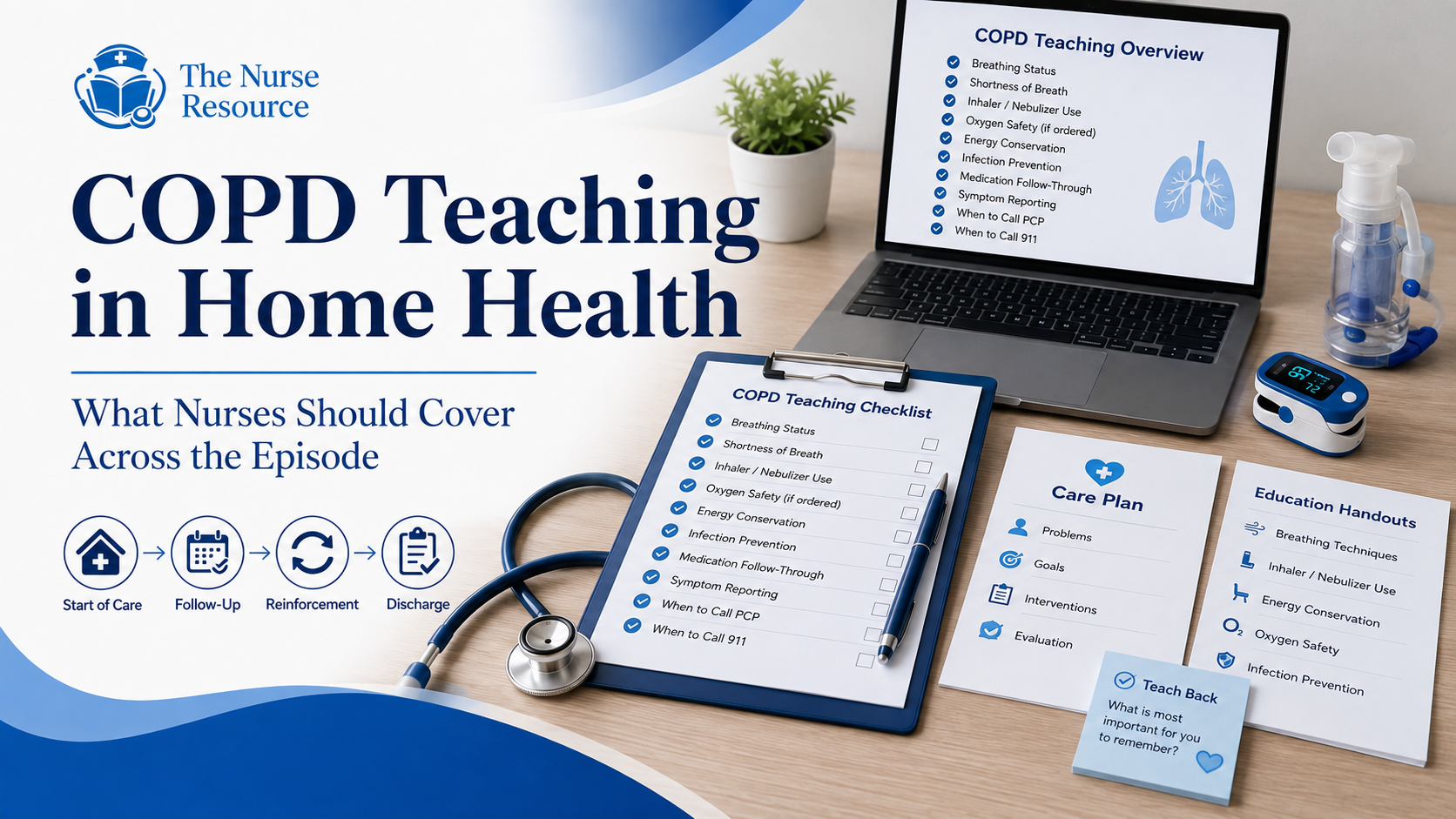
COPD teaching in home health should develop across the episode rather than repeat the same general information during every SN visit.
Early visits may focus on basic diagnosis understanding, baseline respiratory status, medications, equipment, and flare-up warning signs. Follow-up visits may address inhaler or nebulizer barriers, Oxygen safety, symptom changes, infection prevention, activity tolerance, and patient or PCG teach-back. Later visits should prepare patient and PCG to continue care safely after discharge.
Chronic Obstructive Pulmonary Disease, or COPD, refers to a group of progressive lung diseases that restrict airflow and make breathing more difficult. Common symptoms include shortness of breath, frequent coughing, wheezing, chest tightness, and increased mucus. 1, 2, 3
A strong COPD teaching plan should connect each visit to patient baseline, current respiratory symptoms, provider orders, medication profile, respiratory equipment, plan of care, previous teaching, patient or PCG response, and skilled nursing judgment. 1, 2, 3
Why COPD Teaching Matters in Home Health
COPD symptoms may vary from day to day. Patients and PCGs need to understand what is normal for patient and what represents a meaningful change.
COPD flare-ups may include increased shortness of breath, worsening cough, changes in mucus, wheezing, trouble sleeping, and increased fatigue. Recognizing changes early and following a provider-specific COPD action plan may help patient obtain appropriate care before symptoms become more severe.
Skilled teaching may be needed because patient:
- Recently returned home after Hospitalization.
- Has a new or poorly understood COPD diagnosis.
- Has several respiratory medications.
- Uses multiple inhalers or a nebulizer.
- Has difficulty operating respiratory equipment.
- Uses Oxygen at home.
- Does not recognize changes from baseline.
- Has frequent cough, mucus, wheezing, or shortness of breath.
- Has limited activity tolerance.
- Has dizziness, weakness, or fall risk.
- Has memory, vision, literacy, or dexterity limitations.
- Depends on PCG for medications, equipment, or symptom reporting.
- Has difficulty distinguishing when to notify PCP from when to call 911.
SN should not simply provide a general COPD handout at each visit. Teaching should respond to current findings, patient-specific risks, provider instructions, barriers, and progress across the episode.
What COPD Teaching Should Cover Across the Episode
COPD teaching should generally help patient or PCG understand:
- What COPD means at a basic level.
- What patient’s usual breathing pattern and symptoms look like.
- What changes may indicate a COPD flare-up.
- How respiratory medications and equipment should be used as ordered.
- How to reduce exposure to respiratory irritants.
- How to follow Oxygen safety precautions if Oxygen is ordered.
- When to notify PCP or home health agency.
- When to call 911.
- How to continue care after home health discharge.
Teaching does not need to cover every topic during every visit. SN should prioritize the most important current risks and build on previous patient or PCG response.
A simple approach is:
Assess → Prioritize → Teach → Evaluate → Plan Next Visit
Start of Care and Early Visits
Early visits should establish patient’s respiratory baseline and identify immediate safety concerns.
Confirm Basic Understanding of COPD
Assess what patient believes COPD means and whether patient understands reason for recent Hospitalization, referral, medication change, or Oxygen order.
Basic teaching may explain that COPD limits airflow and can make it harder to breathe, clear mucus, and complete usual activities. COPD commonly includes chronic bronchitis, emphysema, or features of both.
Keep education simple and connected to patient’s actual condition. Avoid overwhelming patient with detailed disease terminology that is not necessary for daily care.
Establish Baseline Breathing Pattern
SN should assess and document patient’s usual respiratory status, including:
- Shortness of breath at rest or with activity.
- Usual breathing effort.
- Ability to speak and complete usual activity.
- Cough pattern.
- Usual mucus amount, color, and thickness.
- Wheezing or chest tightness.
- Fatigue and weakness.
- Sleep pattern.
- Usual Oxygen use if ordered.
- Ordered Oxygen Saturation monitoring.
- Need for rest during ADLs.
- Patient’s usual rescue-medication use according to provider instructions.
Knowing patient’s baseline helps SN, patient, and PCG recognize when symptoms are changing.
Review Respiratory Medications
Review medication profile, discharge instructions, inhalers, nebulizer medications, steroids, antibiotics, and other respiratory medications according to agency policy.
Assess for:
- Missing medications.
- Possible duplicate medications.
- Expired or empty inhalers.
- Missed doses.
- Refill problems.
- Medication confusion.
- Difficulty opening or operating devices.
- Incorrect storage.
- Inability to read labels.
- Unclear rescue versus maintenance medication instructions.
- Symptoms or side effects that should be reported.
Quick-relief medications and maintenance medications serve different purposes. Patient-specific use, timing, and frequency must follow provider order, pharmacy label, medication profile, and provider-specific COPD action plan. 1, 2, 3
SN should not tell patient to start, stop, hold, increase, decrease, or otherwise change an inhaler, nebulizer treatment, steroid, antibiotic, or other respiratory medication without provider instruction.
Review Respiratory Equipment if Ordered
Equipment may include:
- Metered-dose inhaler.
- Dry-powder inhaler.
- Spacer.
- Nebulizer.
- Oxygen concentrator.
- Portable Oxygen tank.
- Nasal cannula.
- Pulse oximeter.
Assess whether patient or PCG can operate equipment safely and whether supplies are available, clean, working, and stored according to provider, manufacturer, respiratory supplier, and agency instructions.
Teach Basic Flare-Up Warning Signs
Early teaching should help patient identify symptoms that are worse than usual, including:
- Increased shortness of breath.
- Increased cough.
- Increased or changed mucus.
- Wheezing or noisy breathing.
- Chest tightness.
- Increased fatigue.
- Trouble sleeping because of breathing.
- Reduced ability to complete usual activity.
COPD flare-ups are characterized by symptoms becoming worse than patient’s normal day-to-day condition. 1, 2
Identify Patient-Specific Triggers and Barriers
Possible triggers and barriers include:
- Tobacco smoke.
- Secondhand smoke.
- Dust.
- Strong odors.
- Cleaning-product fumes.
- Air pollution.
- Respiratory infections.
- Weather changes.
- Medication confusion.
- Missing equipment or supplies.
- Poor memory.
- Limited PCG support.
- Difficulty obtaining medications.
- Transportation problems.
- Limited ability to contact PCP.
- Fear or anxiety related to shortness of breath.
Smoke, strong odors, dust, chemicals, fumes, and respiratory infections may worsen COPD symptoms for some patients. Trigger avoidance should be individualized to patient experience and provider guidance. 1, 2
Middle of Episode Teaching
Middle of episode teaching should move beyond basic information toward safe daily application.
Review Symptom Monitoring
Assess whether patient or PCG can compare current respiratory status with usual baseline.
Review changes in:
- Shortness of breath.
- Cough.
- Mucus amount, color, or thickness.
- Wheezing.
- Chest tightness.
- Fatigue.
- Sleep.
- Appetite.
- Activity tolerance.
- Mental status.
- Ordered Oxygen Saturation readings.
- Rescue-medication use according to provider instructions.
Patient should not be expected to independently diagnose or interpret a COPD flare-up. Teaching should focus on recognizing changes and following provider-specific reporting instructions.
Review Inhaler Use if Ordered
If inhalers are ordered, assess:
- Whether correct inhaler is being used.
- Whether patient understands basic purpose.
- Whether patient can operate device.
- Whether physical limitations affect use.
- Whether spacer is used when ordered.
- Whether patient can coordinate breathing and device activation.
- Whether medication supply is available.
- Whether refills are needed.
- Whether patient is following provider instructions.
Avoid turning free public teaching into a universal step-by-step inhaler procedure. Different devices require different techniques, and teaching should follow manufacturer instructions, pharmacy guidance, respiratory therapy recommendations, provider orders, and agency policy.
Review Nebulizer Use if Ordered
Assess:
- Whether patient understands which medication belongs in nebulizer.
- Whether treatment is used according to provider order.
- Whether device is assembled and operated correctly.
- Whether supplies are available.
- Whether equipment is cleaned and stored as instructed.
- Whether patient becomes dizzy, weak, confused, or increasingly short of breath during or after use.
- Whether PCG assistance is needed.
Do not provide a universal nebulizer frequency or advise extra treatments outside provider instructions or patient-specific COPD action plan.
Review Oxygen Safety if Ordered
If Oxygen is ordered, assess:
- Prescribed Oxygen flow rate.
- Whether patient uses Oxygen as ordered.
- Equipment condition.
- Tubing placement.
- Portable tank or concentrator safety.
- Smoking or open-flame hazards.
- Backup supply or power plan when applicable.
- Respiratory supplier contact information.
- PCG understanding.
- Fall risk from tubing or equipment.
Oxygen supports combustion and increases fire risk around smoking, flames, heat sources, and flammable products. Patients should follow provider and respiratory supplier instructions and should not change Oxygen flow rate without provider direction. [1], [2]
Basic safety reinforcement may include:
- No smoking near Oxygen.
- Keep Oxygen away from flames and heat sources.
- Store equipment according to supplier instructions.
- Keep tubing arranged to reduce tripping hazards.
- Maintain working smoke detectors.
- Follow electrical and equipment precautions.
- Do not change prescribed flow rate independently.
Review Pulse Oximeter Use if Ordered
If home pulse oximetry is ordered or instructed, assess:
- Whether patient has appropriate device.
- Whether patient can position device correctly.
- Whether readings are recorded as ordered.
- Whether provider-specific parameters are available.
- Whether symptoms are present with concerning readings.
- Whether patient understands who to contact.
Do not apply universal Oxygen Saturation parameters. Patient targets and reporting instructions should come from provider orders, pulmonology instructions, discharge instructions, plan of care, or agency policy. [1], [2]
Connect Symptoms to Escalation
Patient may recognize increased shortness of breath but still be unsure what to do.
Evaluate whether patient or PCG understands:
- Which changes should be reported to PCP.
- Which equipment concerns should be reported to home health agency or supplier.
- Which provider-specific COPD action plan instructions apply.
- Which symptoms require calling 911.
- How to reach after-hours support.
A provider-developed COPD action plan may identify what patient should do during usual symptoms, worsening symptoms, and emergency symptoms. SN should reinforce that individualized plan rather than create a separate medication or treatment plan.
Reinforce Infection Prevention
Respiratory infections may trigger COPD flare-ups and may lead to more serious breathing problems.
Teaching may include:
- Hand hygiene.
- Avoiding close contact with people who are ill when possible.
- Cleaning respiratory equipment as instructed.
- Reporting fever, chills, or new respiratory symptoms.
- Following provider recommendations for infection prevention.
- Discussing recommended vaccinations with PCP or pulmonology provider.
Vaccination education should be provider-directed. SN should not present vaccination as an independent order or assume every vaccine is appropriate for every patient. [1], [2]
Review Smoke and Irritant Exposure
Assess exposure to:
- Cigarette or cigar smoke.
- Secondhand smoke.
- Vaping or e-cigarette aerosol.
- Wood-burning smoke.
- Dust.
- Cleaning fumes.
- Perfume or air fresheners.
- Occupational chemicals.
- Outdoor air pollution.
Smoking cessation support may include reinforcing provider recommendations and connecting patient with agency-approved or community cessation resources. Avoid independently recommending a medication or nicotine product.
Address Activity Tolerance and Energy Conservation
COPD may make walking, bathing, dressing, cooking, and other daily activities more difficult. [1], [2]
SN should assess:
- Which activities increase shortness of breath.
- How long recovery takes.
- Whether patient rushes.
- Whether patient skips necessary care because of fatigue.
- Whether equipment or supplies are placed within reach.
- Whether therapy recommendations are being followed.
- Whether patient uses Oxygen during activity as ordered.
- Whether PCG assistance is needed.
Energy-conservation teaching should follow patient tolerance, provider instructions, therapy recommendations, and plan of care. It should not replace prescribed pulmonary rehabilitation or individualized activity guidance.
Assess Hydration and Mucus Concerns
Some patients may receive instructions related to fluid intake or mucus management.
SN should determine whether patient has provider-specific hydration instructions, fluid restrictions, cardiac or renal concerns, swallowing difficulty, or other conditions affecting intake.
Do not universally instruct patients to increase fluids. Hydration teaching should follow provider instructions and plan of care.
Assess Nutrition and Weight Concerns
COPD may be associated with poor appetite, fatigue during meals, weakness, or unplanned weight loss in some patients.
Notify PCP/provider according to agency policy for concerns such as:
- Persistent poor appetite.
- Reduced intake.
- Unplanned weight loss.
- Difficulty eating because of shortness of breath.
- Nausea.
- Weakness affecting meal preparation.
- Difficulty obtaining food.
Nutrition recommendations should be individualized and may require provider or dietitian guidance.
Check Teach-Back and Remaining Barriers
Assess whether patient or PCG can explain:
- Usual respiratory baseline.
- Warning signs to report.
- Medication purpose at a basic level.
- Difference between rescue and maintenance medications according to provider instructions.
- Safe use of inhaler, nebulizer, or Oxygen equipment.
- Provider-specific COPD action plan.
- When to notify PCP.
- When to call 911.
Teach-back should guide future visits. Poor understanding, equipment difficulty, medication confusion, or inability to recognize worsening symptoms may require continued skilled assessment and reinforcement.
Later Episode and Discharge Preparation
Discharge planning should begin before final SN visit.
Later teaching should focus on whether patient or PCG can continue COPD care safely with less SN prompting.
Confirm Daily Respiratory Routine
Determine whether patient or PCG can follow ordered plan for:
- Respiratory medications.
- Inhaler use.
- Nebulizer treatments.
- Oxygen use.
- Pulse oximeter monitoring.
- Equipment cleaning.
- Symptom monitoring.
- Activity and rest.
- Infection-prevention measures.
- Follow-up appointments.
- Medication and supply refills.
Confirm Warning-Sign Understanding
Patient or PCG should be able to identify changes such as:
- Increased shortness of breath.
- Worsening cough.
- Increased mucus.
- Change in mucus color or thickness.
- Increased wheezing.
- Chest tightness.
- Fever or chills.
- Increased fatigue.
- Reduced activity tolerance.
- Difficulty sleeping because of breathing.
- New confusion or sleepiness.
- Symptoms that are worsening or not improving.
Confirm Escalation Plan
Before discharge, confirm patient or PCG knows:
- PCP contact information.
- Pulmonology contact information when applicable.
- Home health agency number.
- After-hours or on-call process.
- Respiratory equipment supplier contact information.
- Provider-specific Oxygen Saturation parameters if monitoring is ordered.
- Provider-specific COPD action plan.
- When to call 911.
Confirm Medication and Supply Plan
Review whether patient has:
- Updated medication list.
- Current inhalers.
- Nebulizer medication and supplies.
- Oxygen supplies if ordered.
- Tubing and cannulas as instructed.
- Refill plan.
- Pharmacy information.
- Equipment supplier information.
- Scheduled provider appointments.
Identify Unresolved Discharge Barriers
Possible barriers include:
- Continued medication confusion.
- Incorrect inhaler or nebulizer use.
- Oxygen safety concerns.
- Missing equipment or supplies.
- Inability to recognize worsening symptoms.
- Poor teach-back.
- Repeated COPD flare-ups.
- Unsafe activity tolerance.
- Fall risk.
- Unavailable or unprepared PCG.
- Missed pulmonology or PCP appointments.
- Inability to obtain medications.
Unresolved concerns should be addressed through provider communication, care coordination, agency process, and discharge planning.
Key COPD Teaching Topics for Home Health Nurses
Basic COPD Understanding
Patient should understand that COPD is a long-term lung condition that restricts airflow and may cause shortness of breath, cough, mucus, wheezing, and reduced activity tolerance. COPD can be treated and managed, but symptoms and treatment needs vary between patients. [1], [2]
Baseline Breathing Pattern
Establish what is usual for patient, including breathing effort, cough, mucus, wheezing, sleep, activity tolerance, and prescribed Oxygen use.
Changes should be compared with patient baseline rather than judged only by one isolated symptom or reading.
Shortness of Breath Monitoring
Assess whether shortness of breath is:
- New or worsening.
- Present at rest.
- Worse with activity.
- Affecting speech.
- Interfering with sleep.
- Limiting ADLs.
- Associated with chest pain.
- Associated with confusion or blue-gray color.
Cough and Mucus Changes
Teach patient or PCG to report meaningful changes in:
- Cough frequency.
- Cough severity.
- Mucus amount.
- Mucus color.
- Mucus thickness.
- Ability to clear mucus.
- Blood-streaked mucus.
Increased cough and changes in mucus are recognized COPD flare-up warning signs. [1], [2]
Wheezing and Chest Tightness
New or worsening wheezing, noisy breathing, or chest tightness should be assessed in relation to patient baseline, medication use, provider action plan, and other symptoms.
Chest pain or severe breathing difficulty may require emergency evaluation.
Fatigue, Weakness, and Activity Tolerance
Assess whether patient is:
- Resting more than usual.
- Unable to complete usual activity.
- Needing more help with ADLs.
- Becoming short of breath during meals or conversation.
- Weak during transfers.
- Sleeping more.
- Unable to recover after activity as expected.
Medication Compliance
Reinforce:
- Taking medications as ordered.
- Understanding basic medication purpose.
- Keeping updated medication list.
- Requesting refills before medication runs out.
- Reporting missed doses.
- Reporting possible side effects.
- Following provider-specific rescue-medication instructions.
- Not changing medications independently.
Inhaler and Nebulizer Teaching
If ordered, assess technique, equipment, supplies, cleaning, adherence, physical ability, cognition, and PCG support.
Do not assume one technique or frequency applies to every device or medication.
Steroid and Antibiotic Safety
Steroids or antibiotics may be included in a provider-specific treatment plan for some COPD flare-ups. They should be taken only when ordered and according to provider instructions. [1], [2]
SN should not independently instruct patient to begin leftover antibiotics, restart an old steroid, or change a prescribed course.
Oxygen Safety
If Oxygen is ordered:
- Reinforce use according to prescription.
- Review fire and smoking precautions.
- Assess tubing-related fall risk.
- Review equipment storage and maintenance.
- Confirm supplier information.
- Confirm patient does not change flow rate independently.
Infection Prevention
Reinforce hand hygiene, equipment care, early reporting of infection symptoms, and provider-directed vaccination discussions.
Fall Prevention
Shortness of breath, weakness, dizziness, frequent bathroom trips, Oxygen tubing, and respiratory equipment may increase fall risk.
Assess:
- Falls or near falls.
- Clear pathways.
- Tubing placement.
- Bathroom access.
- Assistive device use.
- Footwear.
- Position-change dizziness.
- Need for PCG assistance.
PCG Involvement
PCG involvement may be appropriate when patient has:
- Memory impairment.
- Poor teach-back.
- Medication confusion.
- Difficulty using inhaler or nebulizer.
- Oxygen use.
- Limited activity tolerance.
- Fall risk.
- Difficulty reporting symptoms.
- Repeated flare-ups.
- Problems obtaining supplies.
COPD Warning Signs Patients and PCGs Should Report
Patient or PCG should follow provider instructions and agency policy for reporting:
- Increased shortness of breath compared with usual baseline.
- New or worsening cough.
- Increased mucus.
- Change in mucus amount, color, or thickness.
- Increased wheezing or noisy breathing.
- Chest tightness.
- Increased fatigue or weakness.
- Reduced ability to perform usual activity.
- Trouble sleeping because of breathing.
- Fever, chills, or other infection symptoms.
- Increased rescue-medication use according to provider instructions.
- Oxygen Saturation concerns according to patient-specific parameters if monitoring is ordered.
- Confusion, dizziness, or increased sleepiness.
- Poor appetite.
- Reduced fluid intake.
- Unplanned weight loss.
- Difficulty using inhaler, nebulizer, Oxygen equipment, or respiratory supplies.
- Symptoms that worsen or do not improve as expected.
These changes are consistent with commonly recognized signs of COPD flare-up or worsening respiratory status. [1], [2], [3]
When to Notify PCP
Notify PCP, pulmonology provider, or follow agency notification process for non-emergency concerns such as:
- Increased shortness of breath compared with baseline.
- Worsening cough.
- Increased or changed mucus.
- New or worsening wheezing.
- Fever, chills, or infection symptoms.
- Reduced activity tolerance.
- Increased fatigue or weakness.
- New dizziness or confusion.
- Medication side effects.
- Missed medication doses.
- Refill problems.
- Unclear inhaler or nebulizer instructions.
- Inhaler or nebulizer equipment problems.
- Oxygen equipment concerns.
- Oxygen Saturation outside patient-specific provider parameters if monitoring is ordered.
- Difficulty following provider-specific COPD action plan.
- Poor appetite or unplanned weight loss.
- Symptoms that continue, worsen, or do not improve as expected.
Follow provider orders, pulmonology instructions, patient-specific plan of care, agency policy, and skilled nursing judgment.
When to Call 911
Call 911 or follow agency emergency protocol for severe, sudden, or life-threatening symptoms, including:
- Severe shortness of breath.
- Serious difficulty breathing at rest.
- Inability to speak full sentences because of breathing distress.
- Severe chest pain or chest pressure.
- Blue or gray lips, face, or fingertips.
- Severe confusion or inability to respond normally.
- Fainting or loss of consciousness.
- Severe weakness with emergency concern.
- Coughing up a significant amount of blood.
- Severe allergic-type reaction.
- Symptoms that are rapidly worsening.
- Any situation in which patient appears to be in immediate danger.
Severe shortness of breath, chest pain, blue-gray color, confusion, and inability to complete usual activity are identified as emergency-level COPD concerns in COPD action-plan and flare-up resources. [1], [2]
Do not delay emergency response to complete a routine PCP call.
Common COPD Teaching Mistakes to Avoid
Repeating Same Topic Every Visit
Reinforcement may be necessary, but teaching should develop according to patient response, symptom changes, barriers, and current risk.
Documenting Only “COPD Teaching Done”
This does not show what was assessed, why teaching was needed, what patient understood, or what remains unsafe.
Giving Universal Oxygen Saturation Parameters
Oxygen Saturation goals and reporting parameters should come from provider orders, pulmonology instructions, discharge instructions, or plan of care.
Telling Patient to Adjust Oxygen Flow Rate
Oxygen is a prescribed treatment. Patient should not change flow rate without provider instruction.
Giving Medication Adjustment Advice
SN should not independently instruct patient to start, stop, hold, increase, decrease, or change inhalers, nebulizers, steroids, antibiotics, Oxygen, or other respiratory medications.
Failing to Assess Device Barriers
Patient may own an inhaler or nebulizer but still be unable to use it safely because of weakness, poor coordination, memory problems, vision limitations, or missing supplies.
Ignoring PCG Role
PCG involvement may be necessary when patient has poor teach-back, Oxygen use, medication confusion, equipment needs, or difficulty recognizing worsening symptoms.
Failing to Separate PCP Symptoms From 911 Symptoms
Patient and PCG need a clear escalation plan that distinguishes non-emergency changes from severe or life-threatening symptoms.
Failing to Document Patient Response
Teaching topic alone does not show progress. Documentation should reflect understanding, teach-back, observed barriers, and need for reinforcement without relying on generic wording.
Failing to Connect Teaching to Skilled Need
Continued SN teaching should relate to patient-specific knowledge deficit, symptom risk, medication concern, equipment safety, poor teach-back, change in condition, or need for skilled respiratory assessment.
How to Keep COPD Teaching Skilled Across Visits
COPD teaching remains patient-specific when SN:
- Reviews current breathing pattern and symptoms.
- Compares findings with patient baseline.
- Reviews ordered respiratory monitoring.
- Connects teaching to diagnosis and current risk.
- Assesses medication and equipment use.
- Selects one or two priority teaching areas.
- Evaluates teach-back or safe demonstration.
- Identifies barriers.
- Involves PCG when needed.
- Communicates concerning findings.
- Adjusts next-visit teaching plan.
- Evaluates progress toward plan-of-care goals.
- Identifies why continued skilled assessment or teaching remains necessary.
Early Episode
Establish baseline respiratory status, medication safety, equipment use, Oxygen precautions, flare-up awareness, and escalation plan.
Middle of Episode
Evaluate follow-through, review symptom changes, address inhaler or nebulizer barriers, reinforce Oxygen safety, review infection prevention, and increase patient or PCG participation.
Later Episode
Confirm patient or PCG can follow treatment plan, obtain medications and supplies, recognize warning signs, contact PCP, and call 911 for emergency symptoms.
This progression keeps COPD teaching connected to current patient needs instead of turning it into a repeated checklist.
Related Home Health Teaching Resources
You may also find these resources helpful:
- Albuterol Indication and Home Health Teaching
- Prednisone Indication and Home Health Teaching
- Medication Safety Resource Pack for Home Health Nurses
- Emergency Signs and Escalation Pack for Home Health Nurses
- Fall Prevention Teaching Pack for Home Health Nurses
- Home Health SN Narrative Builder Pack
Premium Library members can access the full resource content, documentation support, and downloadable tools inside each pack.
Premium Library
Premium Library members can access related copy-ready teaching and documentation support, including nurse quick charting tools, patient and PCG teaching resources, SN narrative support, phrase banks, and weak versus stronger documentation examples.
Important Use Note
This post is for education and home health teaching support only. It does not replace provider orders, pulmonology instructions, Hospital discharge instructions, medication profile, Oxygen orders, respiratory equipment instructions, patient-specific plan of care, agency policy, payer requirements, state regulations, Medicare guidance, accreditation standards, emergency protocols, or skilled nursing judgment.
This post does not provide medication-adjustment instructions, Oxygen flow-rate changes, universal Oxygen Saturation parameters, universal respiratory-rate parameters, universal inhaler or nebulizer frequencies, an independent COPD action plan, or emergency treatment instructions.
COPD teaching, respiratory monitoring, medication use, Oxygen use, provider notification, emergency escalation, and documentation must be individualized to patient condition, provider orders, medication profile, equipment instructions, plan of care, agency policy, applicable regulations, payer requirements, and clinical judgment.
This resource does not guarantee payment, claim approval, survey compliance, or regulatory compliance.
Sources Used
- Centers for Disease Control and Prevention: About COPD. Used for basic COPD definition, common symptoms, activity limitations, smoking risk, and environmental exposure information.
- American Lung Association: COPD Symptoms and Diagnosis. Used for common symptoms and importance of recognizing changes and working with provider on ongoing management.
- American Lung Association: Prevent a COPD Exacerbation or Flare Up. Used for flare-up warning signs, infection prevention, provider-directed vaccination discussion, and avoiding smoke, dust, fumes, and strong odors.
- American Lung Association: COPD Action Plan and Management Tools. Used for provider-specific action planning, symptom tracking, provider notification, and emergency warning signs.
- MedlinePlus: COPD Overview. Used for COPD definition, symptoms, treatment overview, respiratory infections, weakness, and weight-loss concerns. [1], [2]
- MedlinePlus: Chronic Obstructive Pulmonary Disease, Adults, Discharge. Used for discharge planning, activity considerations, Oxygen use, and provider-directed monitoring.
- MedlinePlus: COPD Flare-Ups. Used for flare-up warning signs, mucus changes, breathing difficulty, medication use according to provider instructions, and emergency concerns.
- MedlinePlus: Oxygen Safety. Used for home Oxygen fire prevention, smoking precautions, storage, and equipment safety.