
Overview
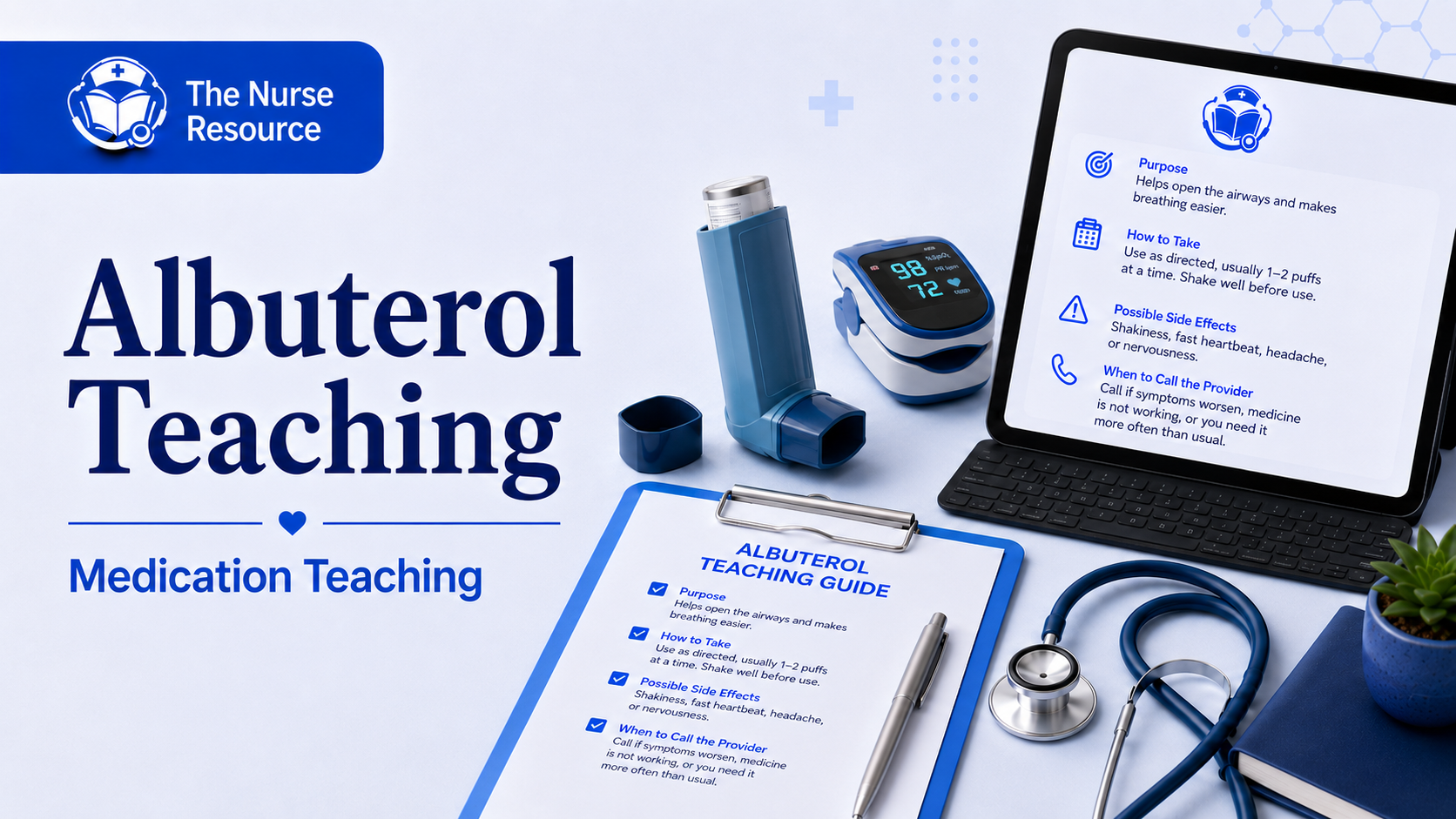
Albuterol, also called albuterol sulfate, is a short-acting bronchodilator and beta-agonist medication. Common brand names may include ProAir, Proventil, and Ventolin when listed on the medication profile or pharmacy label. Albuterol may be ordered as an inhaler or nebulizer medication to help open air passages and support breathing symptoms such as wheezing, shortness of breath, coughing, or chest tightness in certain patients with asthma, COPD, or bronchospasm. MedlinePlus describes albuterol as a bronchodilator that relaxes and opens air passages to make breathing easier.
For home health nurses, Albuterol indication and home health teaching often focuses on medication compliance, rescue inhaler or nebulizer use as ordered, correct inhaler or nebulizer technique according to provider/pharmacy instructions, medication availability, not exceeding prescribed use, reporting increased need for Albuterol, and knowing when to notify PCP or call 911.
DailyMed labeling for albuterol sulfate inhalation aerosol lists indications for treatment or prevention of bronchospasm in patients with reversible obstructive airway disease and prevention of exercise-induced bronchospasm. DailyMed also includes warnings related to paradoxical bronchospasm, deterioration of asthma, cardiovascular effects, and not exceeding recommended dose.
Albuterol may help relieve or prevent bronchospasm symptoms as ordered, but it does not cure underlying asthma, COPD, or other lung disease. Patient-specific use, frequency, device instructions, inhaler/nebulizer technique, rescue versus maintenance inhaler instructions, oxygen instructions if any, and escalation plan must follow provider order, medication profile, pharmacy label, inhaler/nebulizer instructions, asthma/COPD action plan if available, plan of care, agency policy, and skilled nursing judgment.
Medication Quick Information
| Item | Information |
|---|---|
| Generic name | Albuterol, albuterol sulfate |
| Common brand name(s) | ProAir, Proventil, Ventolin if listed |
| Drug classification | Short-acting bronchodilator / short-acting beta agonist |
| Common home health teaching focus | Medication compliance, rescue inhaler or nebulizer use as ordered, correct device technique according to provider/pharmacy instructions, medication availability, not exceeding prescribed use, symptom reporting, increased-use concerns, medication list review, and when to notify PCP or call 911 |
Free Home Health Nurse Starter Pack
Get four practical printable tools for home health skilled nursing visits, including SN documentation review, patient/PCG teaching follow-through, escalation guidance, and an end-of-visit review sheet.
Free download. No credit card required.
Common Indications for Albuterol
Common indications may include:
- Bronchospasm treatment or prevention
- Reversible obstructive airway disease
- Asthma symptom relief, when ordered
- COPD-related wheezing or shortness of breath support, when ordered
- Wheezing management
- Shortness of breath support
- Coughing or chest tightness related to airway disease, when ordered
- Exercise-induced bronchospasm prevention, when ordered
- Rescue inhaler therapy
- Nebulizer treatment support, when ordered
- Provider-ordered bronchodilator therapy
MedlinePlus lists albuterol as used to prevent and treat wheezing, difficulty breathing, chest tightness, and coughing caused by lung diseases such as asthma and COPD. It also notes albuterol inhalation aerosol may be used to prevent breathing difficulty during exercise when ordered.
Drug classification is not the same as patient-specific indication. For example, Albuterol may be classified as a short-acting bronchodilator or short-acting beta agonist, but patient-specific indication may be asthma symptom relief, COPD-related wheezing, shortness of breath support, bronchospasm prevention, rescue inhaler therapy, nebulizer treatment support, or another provider-ordered reason.
Short EMR Indication Options
Verify patient-specific reason before use. Examples below are possible short indication options. Select only the indication that matches patient diagnosis, provider order, medication profile, discharge instructions, pharmacy label, or clarified PCP/provider instruction.
| Patient diagnosis / reason | Short EMR indication option |
|---|---|
| Bronchospasm | Bronchospasm relief |
| Reversible obstructive airway disease | Obstructive airway support |
| Asthma symptoms | Asthma symptom relief |
| COPD-related wheezing | COPD wheezing support |
| COPD-related shortness of breath | COPD SOB support |
| Wheezing | Wheezing management |
| Shortness of breath | Shortness of breath support |
| Cough or chest tightness related to airway disease | Airway symptom support |
| Exercise-induced bronchospasm, when ordered | Exercise bronchospasm prevention |
| Rescue inhaler therapy | Rescue inhaler therapy |
| Nebulizer treatment, when ordered | Nebulizer treatment support |
| Provider-ordered bronchodilator therapy | Bronchodilator therapy |
Home Health Teaching Focus
For home health nursing, Albuterol teaching often focuses on correct inhaler or nebulizer technique according to provider/pharmacy instructions, medication availability, checking that inhaler or nebulizer medication is not expired, cleaning nebulizer equipment according to agency policy, manufacturer instructions, or provider instructions, and reporting increased need for Albuterol or symptoms not improving.
Patients may need reinforcement if they have a new Albuterol order, recent Hospital stay, asthma, COPD, shortness of breath, wheezing, coughing, chest tightness, poor inhaler technique, nebulizer equipment concerns, memory issues, weakness, limited hand strength, confusion between inhalers, expired medication, missing inhaler, refill problems, or PCG involvement.
Albuterol should not be treated as a replacement for controller or maintenance inhalers unless PCP/provider specifically instructs otherwise. DailyMed labeling includes warnings about deterioration of asthma and increased need for inhaled beta-agonists, and MedlinePlus advises patients to use albuterol exactly as directed.
Patient Teaching Points for Albuterol
Basic teaching may include:
- Use Albuterol exactly as ordered by PCP/provider and pharmacy label.
- Do not use more than prescribed or change how often it is used unless instructed by PCP/provider.
- Use inhaler or nebulizer technique according to provider, pharmacy, manufacturer, or agency instructions.
- Keep inhaler or nebulizer medication available, not expired, and refill before it runs out.
- Report increased need for Albuterol, symptoms not improving after use as ordered, or symptoms getting worse.
- Report shakiness, nervousness, headache, nausea, throat irritation, fast heartbeat, palpitations, chest pain, rash, swelling, or increased breathing difficulty.
- Do not stop maintenance/controller inhalers unless PCP/provider instructs you to.
- Clean nebulizer equipment according to agency policy, manufacturer instructions, or provider instructions.
- Ask PCP or pharmacist if confused about rescue inhaler, maintenance inhaler, nebulizer medication, spacer use, or device technique.
- Keep updated medication list available for PCP, pharmacy, home health agency, and Hospital visits.
Possible Side Effects or Concerns to Report
Possible side effects or concerns may include:
- shakiness or tremor
- nervousness
- headache
- nausea
- vomiting
- cough
- throat irritation
- dizziness or weakness
- fast, pounding, or irregular heartbeat
- palpitations
- chest pain
- rash, hives, itching, or swelling
- increased difficulty breathing after use
- symptoms not improving or worsening after use
- increased need for Albuterol compared with usual pattern
DailyMed labeling includes warnings related to paradoxical bronchospasm, cardiovascular effects, not exceeding recommended dose, immediate hypersensitivity reactions, and hypokalemia. MedlinePlus lists side effects such as nervousness, shakiness, dizziness, headache, nausea, vomiting, cough, and throat irritation, and lists serious symptoms such as fast/pounding heartbeat, chest pain, hives, rash, swelling, hoarseness, difficulty breathing, and difficulty swallowing.
When to Notify PCP
Call PCP or follow agency/provider instructions if patient has:
- increased need for Albuterol compared with usual pattern
- symptoms not improving after use as ordered
- worsening wheezing, cough, shortness of breath, or chest tightness
- fast, pounding, or irregular heartbeat
- palpitations
- chest discomfort that is not severe or life-threatening
- shakiness, nervousness, dizziness, weakness, or side effects that are concerning
- difficulty using inhaler or nebulizer correctly
- running out of inhaler/nebulizer medication or refill concerns
- damaged, expired, or missing medication/device
- confusion between rescue inhaler and maintenance/controller inhalers
- new OTC medication, supplement, or prescription medication use
- poor understanding of when to use Albuterol according to provider instructions
DailyMed patient counseling information includes frequency-of-use, priming and cleaning, dose counter, paradoxical bronchospasm, concomitant drug use, common adverse events, and general information on use. MedlinePlus also advises patients to tell doctor and pharmacist about prescription and nonprescription medications, vitamins, nutritional supplements, and herbal products.
When to Call 911
Call 911 or get emergency help right away for:
- severe shortness of breath
- trouble breathing
- severe wheezing or breathing distress not improving
- chest pain with serious symptoms
- bluish lips or face
- severe allergic-type reaction such as swelling of face, lips, tongue, or throat
- trouble swallowing
- fainting or loss of consciousness
- severe confusion or inability to respond normally
- symptoms that feel life-threatening
DailyMed warns that paradoxical bronchospasm can be life-threatening, and MedlinePlus emergency guidance says to call emergency services if a person has collapsed, had a seizure, has trouble breathing, or cannot be awakened.
Related Premium Library Resources
You may also find these resources helpful:
- Medication Safety Resource Pack for Home Health Nurses
- Emergency Signs and Escalation Pack for Home Health Nurses
- Respiratory Teaching Resource Pack
- COPD Teaching Resource Pack for Home Health Nurses
- Home Health SN Narrative Builder Pack
- Fall Prevention Teaching Pack for Home Health Nurses
Premium Library members can access the full resource content, documentation support, and downloadable tools inside each pack.
Important Use Note
This post is for education and home health teaching support only. It does not provide dosing advice, universal frequency instructions, universal number-of-puffs instructions, nebulizer frequency instructions, oxygen instructions, medication adjustment instructions, asthma action plan zones, or patient-specific medication profile instructions. It does not replace provider orders, pharmacy guidance, discharge instructions, medication profile, inhaler/nebulizer instructions, asthma/COPD action plan, agency policy, payer requirements, emergency protocols, or skilled nursing judgment.
Always verify patient-specific Albuterol use and indication with provider order, medication profile, discharge instructions, pharmacy label, inhaler/nebulizer instructions, plan of care, agency policy, and clinical judgment. Drug classification is not same as patient-specific indication. Rescue inhaler, nebulizer treatment, spacer use, controller/maintenance inhaler use, device cleaning, oxygen instructions if any, and emergency action plan must follow PCP/provider instructions and plan of care.
Sources Used for Medication Information
- DailyMed / FDA prescribing information for Albuterol Sulfate Inhalation Aerosol, including indications for bronchospasm and exercise-induced bronchospasm, warnings for paradoxical bronchospasm, deterioration of asthma, cardiovascular effects, not exceeding recommended dose, hypersensitivity reactions, and patient counseling information.
- FDA prescribing information for Albuterol Sulfate HFA Inhalation Aerosol, including warning that paradoxical bronchospasm may be life-threatening.
- MedlinePlus medication information for Albuterol Oral Inhalation, including common uses, bronchodilator classification, brand/product information, side effects, medication interaction reminders, and emergency guidance.
- Patient-specific use should always be verified with provider order, medication profile, discharge instructions, pharmacy label, agency policy, and clinical judgment.
Public Premium Teaser
Need copy-friendly Albuterol teaching and documentation support for home health notes?
The Premium Library section includes a home health teaching script, detailed patient/PCG teaching points, SN charting phrases, patient/PCG response phrases, ongoing skilled need wording, weak vs stronger documentation examples, and a quick charting template for Albuterol teaching.
Restricted Premium Library Section
Premium teaching and documentation support below is available for Premium Library and Agency Inservice Library members.