
Introduction
One of most important home health teaching needs is helping patients and PCGs understand what to do when condition changes.
A patient may recognize that something feels different but still be unsure whether to:
- Monitor and report change.
- Call home health agency.
- Notify PCP or another provider.
- Call 911.
That uncertainty can lead to delayed reporting, unnecessary waiting, or calling PCP first during a true emergency.
Emergency-sign teaching should therefore focus on more than memorizing a long list of symptoms. SN should help patient or PCG recognize change from baseline, consider severity, follow patient-specific escalation plan, communicate clearly, and confirm follow-up.
A practical framework is:
Recognize Change → Consider Severity → Follow Patient-Specific Escalation Plan → Communicate Clearly → Confirm Follow-Up
Quick Summary
Across a home health episode, emergency-sign teaching may include:
- Recognizing changes from patient baseline.
- Understanding difference between non-emergency, urgent, and emergency concerns.
- Knowing when home health agency should be called.
- Knowing when PCP or another provider should be notified.
- Knowing when 911 should be called immediately.
- Recognizing major emergency warning signs.
- Following patient-specific Blood Pressure, Blood Sugar, heart rate, Oxygen Saturation, or other reporting parameters when ordered.
- Communicating useful information when reporting a change.
- Including PCG when patient cannot safely recognize or report symptoms independently.
- Reinforcing escalation teaching when condition, medications, or risks change.
Exact response should always follow patient condition, provider-specific instructions, plan of care, agency emergency protocol, and skilled nursing judgment.

Why Emergency Signs Teaching Matters in Home Health
Home health patients often have multiple diagnoses and risks at same time.
A patient may have CHF, COPD, diabetes, Hypertension, Atrial Fibrillation, a wound, recent infection, medication changes, fall risk, or recent Hospitalization.
Symptoms can overlap, and patient or PCG may not know whether a change can wait until next visit.
Home health SN may identify barriers such as:
- Patient does not know agency after-hours number.
- PCG is unsure whether to call PCP or nurse.
- Patient delays reporting because symptoms seem minor.
- Patient assumes every abnormal Vital Sign requires 911.
- Severe symptoms are minimized because patient has experienced them before.
- Medication list is unavailable when change occurs.
- Cognitive impairment affects decision-making.
- PCG is unavailable or unsure what to do.
The goal is not to teach a universal triage algorithm.
The goal is to help patient and PCG understand their escalation plan and recognize situations that should not wait.
A key principle is:
If symptoms appear severe, sudden, or life-threatening, emergency response should not be delayed for a routine PCP or home health call.
Free Home Health Nurse Starter Pack
Get four practical printable tools for home health skilled nursing visits, including SN documentation review, patient/PCG teaching follow-through, escalation guidance, and an end-of-visit review sheet.
Free download. No credit card required.
Practical Home Health Escalation Framework
Non-Emergency Change
Some changes are not immediately life-threatening but should still be reported according to plan of care.
Examples may include:
- New mild symptom.
- Gradual increase in swelling.
- Medication refill problem.
- New side effect that is not severe.
- New wound or skin concern.
- Readings outside provider-specific parameters without emergency symptoms.
- Supply or equipment problem.
- Change patient or PCG is unsure how to manage.
Patient or PCG may need to call home health agency, PCP, or another provider according to patient-specific instructions.
Do not wait for next scheduled SN visit when current instructions say concern should be reported sooner.
Urgent Change
Some symptoms require prompt clinical review but do not clearly appear life-threatening.
Examples may include:
- Worsening shortness of breath that is not severe.
- New mild confusion or clear change from baseline.
- Repeated readings outside provider-specific parameters.
- Increasing wound redness, drainage, swelling, or pain.
- Fall without obvious emergency symptoms but with injury concern.
- Increasing weakness or reduced ability to function.
- Worsening infection symptoms.
- Medication reaction that is concerning but not causing severe airway or breathing symptoms.
Follow patient-specific plan for calling home health agency, PCP, or another provider promptly.
If symptoms become severe or rapidly worsen, call 911.
Emergency
Call 911 for severe, sudden, or life-threatening symptoms.
Do not call PCP first and wait for a return call when patient appears to be experiencing a medical emergency.
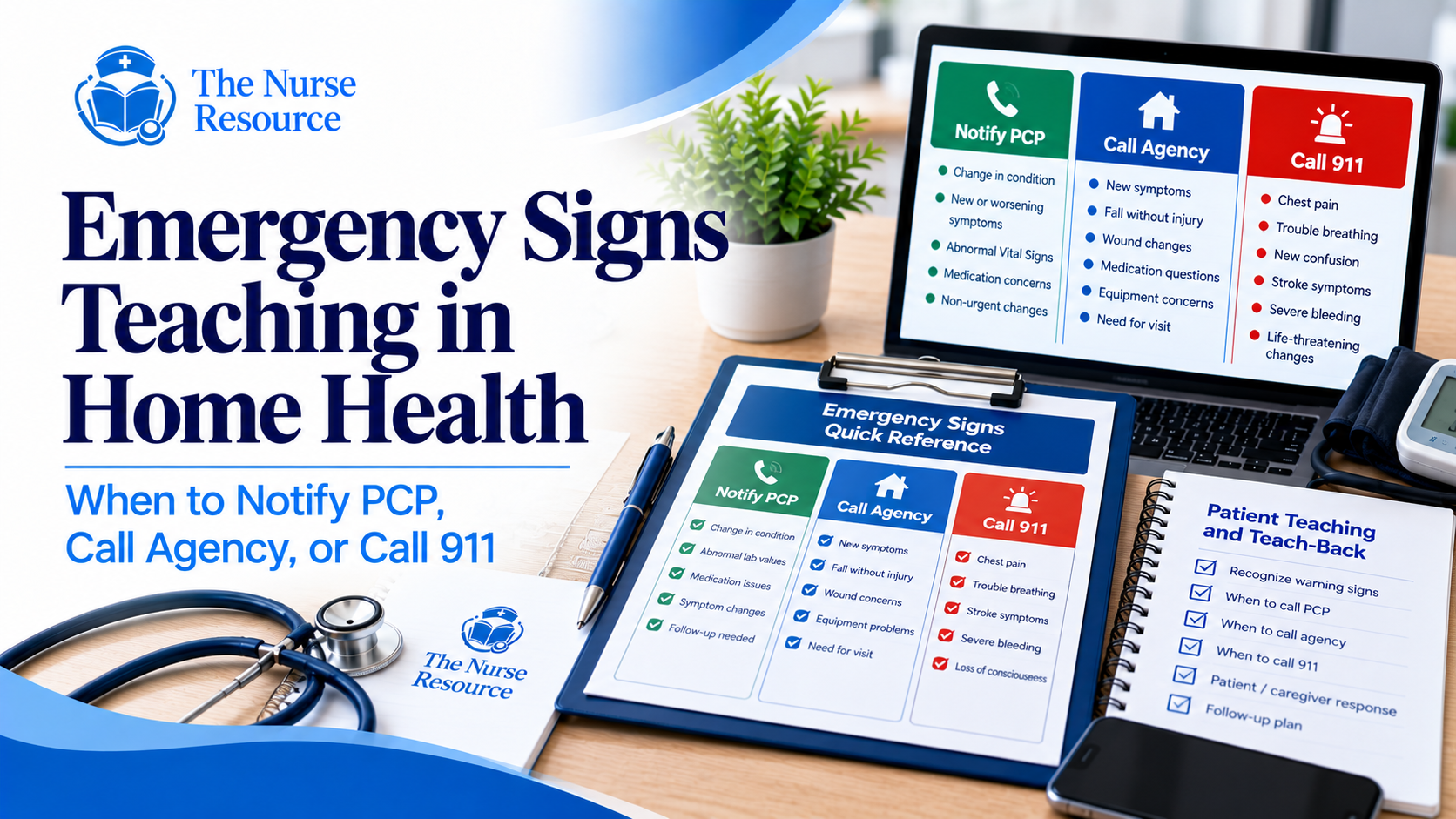
When to Call Home Health Agency
Home health agency can be an important point of contact for new or worsening concerns that are not immediately life-threatening.
Patient or PCG may need to call agency for concerns such as:
- New change from baseline.
- Worsening non-emergency symptom.
- Medication confusion.
- Missed medication or refill problem.
- New wound or skin concern.
- Dressing or supply problem.
- Respiratory equipment issue.
- Fall or near fall without severe emergency symptoms.
- Increased weakness.
- Difficulty following plan of care.
- Uncertainty about whether PCP notification is needed.
Patient and PCG should know:
- Agency daytime number.
- After-hours or on-call number.
- Which concerns should be reported promptly.
- That calling agency should never delay 911 during a true emergency.
When to Notify PCP or Provider
PCP or another treating provider may need notification when patient develops a non-emergency change requiring clinical review or possible adjustment of care plan.
Examples may include:
- Repeated readings outside patient-specific provider parameters.
- New or worsening symptoms that are not immediately life-threatening.
- Medication side effects or medication confusion.
- Missed doses or refill concerns.
- New or worsening edema.
- Increasing shortness of breath that is not severe.
- New wound or infection concerns.
- Increased pain.
- Poor intake.
- New dizziness or weakness.
- Fall or injury requiring provider follow-up.
- Symptoms that are not improving as expected.
Patient or PCG should follow provider-specific instructions and agency process regarding who makes provider notification.
Do not apply universal Blood Pressure, Blood Sugar, heart rate, Oxygen Saturation, respiratory rate, temperature, or other reporting thresholds.
When to Call 911
Call 911 for severe, sudden, or life-threatening symptoms. Follow agency emergency protocol as applicable without delaying emergency response:
- Severe or concerning chest pain or pressure.
- Severe trouble breathing.
- Stroke-like symptoms.
- Fainting or loss of consciousness.
- Unresponsiveness.
- Severe sudden confusion or inability to respond normally.
- Uncontrolled severe bleeding.
- Severe allergic-reaction symptoms.
- Seizure.
- Severe injury.
- Rapidly worsening condition.
- Any situation in which patient appears to be in immediate danger.
Do not delay emergency response to complete routine PCP or agency notification.
Common Emergency Signs to Reinforce
Emergency teaching should be individualized to patient diagnoses and risks. Nurses do not need to review every possible emergency sign during every visit.
Representative emergency categories include:
Stroke
Sudden facial droop, one-sided weakness or numbness, speech difficulty, significant vision change, or sudden balance problems require immediate emergency response.
Call 911.
CDC emphasizes rapid 911 activation for stroke symptoms because timely treatment matters.
Cardiac Emergency
Severe or concerning chest pain or pressure, collapse, or chest symptoms associated with severe shortness of breath, sweating, weakness, or other significant symptoms may represent an emergency.
Call 911.
Severe Breathing Difficulty
Severe trouble breathing, inability to speak normally because of respiratory distress, blue or gray lips or face, or rapidly worsening breathing requires emergency response.
Call 911.
Falls or Head Injury
Loss of consciousness, severe neurologic change, major injury, severe bleeding, or severe symptoms after a fall or head injury require emergency evaluation.
Patients taking anticoagulants or with provider-specific head-injury instructions may require additional evaluation even when severe symptoms are not immediately present.
Severe Allergic Reaction or Bleeding
Airway swelling, severe breathing difficulty related to an allergic reaction, fainting, or uncontrolled severe bleeding requires 911.
Rapid Decline
Severe confusion, unresponsiveness, seizure, severe weakness with inability to respond normally, or rapidly worsening illness may require emergency response.
These examples are not a complete emergency reference. Patient-specific diagnosis, medications, provider instructions, emergency plan, and agency protocol should guide teaching.
Detailed emergency-sign teaching support remains part of Premium Library resources.
Emergency Signs and Escalation Pack for Home Health Nurses
This free pillar teaches how to think through emergency-sign teaching and escalation across home health episode.
Premium Library members who need deeper repeat-use support can access the Emergency Signs and Escalation Pack for Home Health Nurses.
The pack includes more detailed support such as:
- Detailed emergency-sign teaching support.
- Patient teaching handout.
- PCG Emergency Signs Monitoring Checklist.
- Nurse Quick Charting Sheet.
- Detailed documentation examples.
- Patient and PCG response wording.
- Teach-back support.
- Ongoing skilled-need wording.
- Printable repeat-use tools.
These tools support patient education and documentation organization but do not replace patient-specific provider instructions, agency emergency protocol, or skilled nursing judgment.
What Information Should Be Communicated When Reporting a Change?
Clear communication helps agency nurse, PCP, or emergency personnel understand what is happening.
Useful information may include:
- What changed.
- When change began.
- Whether symptoms are improving, worsening, or unchanged.
- Relevant Vital Signs.
- Relevant Blood Pressure or Blood Sugar readings when monitoring is ordered.
- Relevant Oxygen Saturation when monitoring is ordered.
- Recent fall or injury.
- Recent Hospital discharge.
- Recent medication change.
- Provider-specific parameters.
- What patient or PCG has already done according to care plan.
- Who has already been contacted.
Patient or PCG does not need to gather every detail before calling 911.
Emergency response should never be delayed to complete a report.
Emergency Signs Teaching Across the Episode
Emergency teaching should develop across episode rather than repeat same generic symptom list during every SN visit.
Start of Care and Early Visits
Early teaching may focus on:
- Agency contact numbers.
- After-hours process.
- PCP contact information.
- Difference between agency, PCP, and 911.
- Patient-specific high-risk symptoms.
- Recent Hospital discharge concerns.
- Diagnosis-specific risks.
- Medication-related risks.
- PCG role.
SN should determine whether patient or PCG is likely to recognize worsening symptoms and seek help appropriately.
Middle of Episode
Follow-up teaching may focus on:
- Teach-back.
- Recent symptom changes.
- Falls or near falls.
- New medication or treatment.
- Patient-specific provider parameters.
- Changes in diagnosis-specific risk.
- Barriers identified during prior teaching.
- Whether PCG can recognize when escalation is needed.
- Whether emergency contacts remain readily available.
Teaching should change when patient risk changes.
Later Episode and Discharge Preparation
Later visits should evaluate whether patient or PCG can:
- Recognize major warning signs.
- Distinguish non-emergency from emergency concerns.
- Know when agency should be called.
- Know when PCP should be notified.
- Call 911 without unnecessary delay during emergency.
- Follow provider-specific reporting parameters.
- Keep medication list and emergency contacts available.
- Use after-hours resources appropriately.
Unresolved safety concerns should be addressed before discharge when possible.
How to Keep Emergency Signs Teaching Skilled Across Visits
Emergency teaching remains patient-specific when SN:
- Assesses current condition and risk.
- Reviews relevant recent symptoms.
- Considers recent Hospitalization or emergency visit.
- Reviews new medications or treatment changes.
- Identifies patient-specific emergency risks.
- Evaluates what patient or PCG already understands.
- Selects teaching based on current need.
- Uses teach-back when appropriate.
- Identifies delayed-reporting behavior.
- Includes PCG when needed.
- Reinforces after-hours plan.
- Updates teaching when condition changes.
Repeated teaching may remain appropriate when patient or PCG:
- Cannot distinguish PCP from 911 situations.
- Has incomplete teach-back.
- Has cognitive or memory limitations.
- Recently experienced a fall or change in condition.
- Has a new medication or diagnosis.
- Has history of delayed reporting.
- Has limited PCG support.
- Remains at risk for acute deterioration.
Changing wording alone does not make teaching skilled. Teaching should respond to actual patient-specific risk and learning need.
Related Free Resources
You may also find these free resources helpful:
- Pneumonia Teaching in Home Health: What Nurses Should Cover Across the Episode
- COPD Teaching in Home Health: What Nurses Should Cover Across the Episode
- Atrial Fibrillation Teaching in Home Health: What Nurses Should Cover Across the Episode
- Diabetes Teaching in Home Health: What Nurses Should Cover Across the Episode
- Medication Teaching Lookup for Home Health Nurses
Common Emergency Teaching Mistakes to Avoid
Calling PCP First During a True Emergency
Do not delay 911 for severe chest pain, stroke-like symptoms, severe breathing difficulty, unresponsiveness, uncontrolled severe bleeding, severe allergic reaction, or another apparent life-threatening emergency.
Using Universal Vital Sign Parameters
Blood Pressure, Blood Sugar, heart rate, Oxygen Saturation, temperature, and other reporting parameters should follow patient-specific provider instructions and agency policy.
Teaching Every Possible Emergency During One Visit
Prioritize risks most relevant to patient.
Teaching can progress across episode.
Failing to Explain Agency Role
Patients may know a symptom is concerning but still not understand when home health agency should be called.
Ignoring After-Hours Planning
Patient or PCG should know what to do when PCP office is closed or SN is not scheduled.
Giving Medication Adjustment Advice
Do not independently tell patient to start, stop, hold, skip, increase, decrease, or otherwise change medication because of a symptom unless directed by authorized provider.
Assuming PCG Understands Escalation Plan
When PCG provides significant support, include PCG in teaching and assess understanding.
Documenting Only “Emergency Teaching Done”
Documentation should show enough context to understand what risk was addressed and how patient or PCG responded.
Documentation Considerations
This public article teaches documentation principles only.
Documentation should generally reflect:
- Why emergency or escalation teaching was relevant.
- Specific risk or symptom category reviewed.
- Relevant assessment findings.
- Patient or PCG response.
- Teach-back when used.
- Barriers to timely escalation.
- New or worsening symptoms.
- Agency or PCP communication when it actually occurred.
- 911 activation when it actually occurred.
- Orders or instructions actually received.
- Follow-up or next teaching focus.
A useful clinical connection is:
Change in Condition → Relevant Assessment → Escalation Decision → Action Taken → Communication → Follow-Up
Do not document PCP notification, agency communication, 911 activation, patient response, orders, or instructions that did not actually occur.
Detailed charting phrases, patient and PCG response wording, teach-back support, ongoing skilled-need wording, and quick charting tools remain Premium Library content.
Agency Staff Education: Emergency Signs and Escalation
Home health agencies that need staff-wide education can use the November Agency Inservice:
Emergency Signs and Escalation in Home Health: When to Notify PCP, Call Agency, or Call 911
This separate agency resource is designed to support staff education on change-in-condition recognition, escalation decisions, provider communication, emergency response, competency review, and staff education documentation.
Agency Inservice Library packets may include staff lesson, sign-in sheet, post-test, answer key, staff attestation, competency checklist, and QAPI/staff education record support.
Agencies remain responsible for reviewing and adapting materials to their own policies, state requirements, accreditation standards, payer requirements, emergency procedures, and applicable regulations.
Important Use Note
This post is for educational and home health teaching and documentation support only. It does not replace provider orders, Hospital discharge instructions, patient-specific emergency plan, medication profile, agency emergency protocol, plan of care, payer requirements, state regulations, Medicare guidance, accreditation standards, EMS instructions, or skilled nursing judgment.
Emergency-sign teaching and escalation decisions must be individualized to patient condition, diagnosis, symptoms, provider-specific parameters, medications, recent clinical changes, provider orders, plan of care, agency policy, payer requirements, and clinical judgment.
This content does not provide universal Blood Pressure parameters, Blood Sugar parameters, heart-rate parameters, Oxygen Saturation parameters, respiratory-rate parameters, temperature parameters, medication-adjustment instructions, or emergency treatment instructions beyond calling 911 for severe or life-threatening symptoms and following patient-specific emergency plan.
Do not independently start, stop, hold, skip, increase, decrease, or otherwise change medication because of a symptom unless directed by an authorized provider.
When patient appears to have a true medical emergency, do not delay 911 activation to complete routine PCP or agency notification.
Documentation should reflect only assessment findings, teaching, patient or PCG response, provider or agency communication, emergency actions, orders, instructions, and follow-up that actually occurred.
This content does not guarantee Medicare payment, claim approval, survey compliance, documentation compliance, emergency outcome, or regulatory compliance.
Sources Used
- Centers for Disease Control and Prevention. Signs and Symptoms of Stroke
- Centers for Disease Control and Prevention. About Stroke
- American Heart Association. Heart Attack, Stroke and Cardiac Arrest Symptoms
- American Heart Association. Warning Signs of a Heart Attack
- American Heart Association. When to Call 911
- MedlinePlus. Head Injuries
- MedlinePlus. Anaphylaxis
- Centers for Disease Control and Prevention. About Sepsis

Emergency Signs and Escalation Pack
Help patients and PCGs understand urgent warning signs, when to call PCP or agency, when to call 911, and how nurses can document escalation teaching.


Premium Library
For home health nurses and agency leaders
Ready-to-use teaching packs, documentation tools, patient handouts, PCG checklists, nurse quick charting sheets, and premium downloads.
– Premium teaching packs
– Patient handouts
– Nurse quick charting sheets
– PCG monitoring checklists
– Skilled documentation examples
– Teach-back prompts
– Red flag guidance
– New resources added regularly
$9/month
Cancel anytime. New resources added regularly.