
Introduction
Respiratory medication teaching is a common skilled nursing need in home health, especially for patients with COPD, asthma, chronic respiratory symptoms, recent Hospitalization, new inhaler or nebulizer orders, medication changes, worsening shortness of breath, increased cough or wheezing, oxygen use if ordered, or difficulty following a respiratory medication plan.
Home health SNs often see medication-use concerns that may not be obvious during a short provider visit. Patients may have multiple inhalers, expired or discontinued inhalers, unclear medication roles, nebulizer equipment concerns, refill gaps, poor inhaler technique, PCG misunderstanding, or worsening symptoms despite prescribed treatment.
Respiratory inhalers should not automatically be treated as a strict rescue-versus-maintenance binary. Some patient-specific asthma regimens may use an ICS-formoterol inhaler for both maintenance and quick-relief therapy. SN must verify each inhaler’s role from current provider orders, medication profile, pharmacy instructions, device instructions, and patient-specific asthma or action plan. This resource does not provide dosing instructions or SMART / MART dosing instructions.
This resource is not intended to function as a pharmacology textbook or comprehensive drug-reference manual. It focuses on practical home health application:
Medication purpose → patient / PCG teaching → correct use / follow-through → symptom monitoring → medication concerns → PCP/provider notification → emergency escalation → SN documentation
Respiratory medication indication, device role, and patient-specific instructions must always be verified from the patient-specific medication profile, provider orders, diagnosis, plan of care, pharmacy instructions, Hospital discharge instructions when applicable, and available clinical information.
Access the Respiratory Medication Resource Pack
Premium Library members can access full documentation-quality review framework, detailed gap analysis, stronger-documentation review examples, abnormal finding and provider communication review support, documentation-quality checklists, and repeat-use member tools.
Who This Resource Helps
This resource is designed for:
- Home health SNs providing respiratory medication teaching.
- Nurses caring for patients with COPD, asthma, chronic cough, wheezing, shortness of breath, or respiratory medication changes.
- SNs supporting inhaler and nebulizer follow-through in the home.
- QA nurses reviewing respiratory medication documentation.
- Clinical supervisors coaching staff on skilled teaching documentation.
- Agency educators building practical home health respiratory teaching support.
- Home health agencies seeking consistent respiratory medication teaching language.
What Is Included
Premium Library members can access:
- Respiratory Medication Teaching Framework.
- Rescue / short-acting bronchodilator teaching support.
- Anticholinergic / bronchodilator therapy teaching support.
- Maintenance inhaler teaching considerations.
- Corticosteroid therapy teaching support.
- Nebulizer medication and equipment follow-through guidance.
- Inhaler teaching and technique considerations.
- Respiratory symptom monitoring support.
- Medication reconciliation and follow-through concerns.
- PCP/provider and agency notification guidance.
- Emergency escalation guidance.
- Scenario-based SN documentation examples.
- Patient / PCG response phrase bank.
- Abnormal finding and provider notification wording.
- Ongoing skilled need phrase bank.
- Weak vs stronger respiratory medication documentation examples.
- Quick Respiratory Medication Charting Framework.
- Next-visit focus support.
- Member downloadable plan.
Detailed copy-friendly documentation wording, scenario examples, phrase banks, quick charting support, and future printable member tools are included inside restricted Premium Library content.
Why Respiratory Medication Teaching Matters in Home Health
Respiratory medication safety and follow-through become especially important during transitions from Hospital to home, after medication changes, and when patients use more than one inhaler, nebulizer medication, or respiratory treatment.
Home health SN may identify concerns such as:
- Patient unsure which respiratory medication is current.
- Patient unsure which inhaler is intended for which purpose.
- Patient using inhaler based on device color instead of current medication list.
- Rescue inhaler unavailable or empty.
- Controller or maintenance inhaler not being used as ordered.
- Duplicate inhalers in home.
- Old or discontinued inhaler still being used.
- Nebulizer medication missing or expired.
- Nebulizer equipment not cleaned or stored correctly.
- Patient unable to demonstrate inhaler technique.
- Patient unable to coordinate inhaler use.
- Patient not using spacer when prescribed or instructed.
- Patient not rinsing mouth after inhaled corticosteroid therapy when instructed.
- Patient taking prednisone differently from current order.
- New medication not obtained after Hospital discharge.
- Medication list does not match medication containers in home.
- PCG unsure how to support respiratory medication routine.
- Increased reliance on quick-relief medication compared with usual pattern.
- New or worsening shortness of breath, cough, wheezing, fatigue, or activity intolerance.
- Respiratory symptoms not improving despite ordered treatment.
- Patient unsure when to call PCP/provider, agency, or 911.
Strong SN documentation should show more than “respiratory meds reviewed.” Documentation should reflect what medication-related concern was assessed, what SN taught or reinforced, what patient or PCG understood, what technique or follow-through barrier remains, whether abnormal findings were identified, whether PCP/provider notification occurred when needed, and why continued skilled teaching or assessment remains necessary.
Brief Respiratory Medication Teaching Framework
A practical public framework is:
Verify → Assess → Teach → Observe Technique → Monitor Symptoms → Escalate if Needed → Plan Next Visit
Verify
Confirm medication name, purpose, device type, current order, medication role, and patient-specific instructions.
Assess
Review symptoms, Vital Signs if indicated, medication availability, refill status, inhaler or nebulizer technique, patient / PCG understanding, barriers, and actual follow-through.
Teach
Focus on medication purpose, correct use according to device and provider instructions, safe follow-through, symptom reporting, refill planning, and avoiding independent medication changes.
Observe Technique
When appropriate, assess whether patient or PCG can prepare, use, clean, store, and follow prescribed respiratory medication routine safely.
Monitor Symptoms
Review shortness of breath, cough, wheezing, sputum changes when clinically relevant, activity tolerance, fatigue, oxygen use if ordered, and changes from baseline.
Escalate if Needed
Report medication discrepancies, medication-use barriers, worsening symptoms, or abnormal findings according to provider orders, patient-specific instructions, plan of care, agency policy, and skilled nursing judgment.
Plan Next Visit
Identify what medication issue, technique concern, symptom pattern, PCG training need, or teach-back should be reassessed.
Premium Library Access
Need practical respiratory medication teaching support for home health nursing visits?
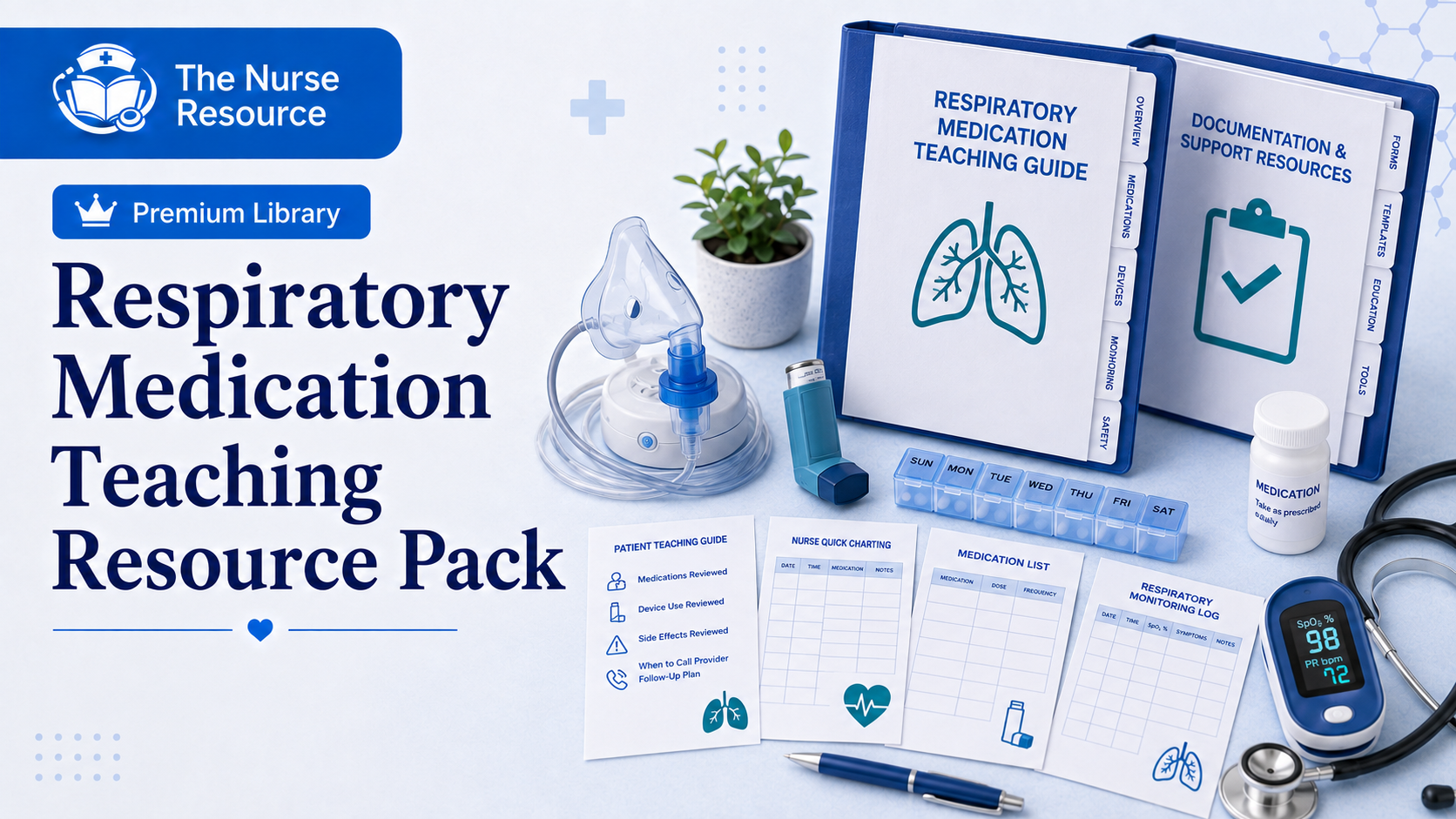
Respiratory Medication Teaching Resource Pack gives Premium Library members practical teaching guidance, medication group support, inhaler and nebulizer teaching considerations, symptom reporting guidance, medication reconciliation support, copy-friendly SN documentation examples, response phrase banks, quick charting support, and planned printable member tools.
Related Free Resources
Continue learning with:
- COPD Teaching in Home Health: What Nurses Should Cover Across the Episode
- CHF Teaching in Home Health: What Nurses Should Cover Across the Episode
- Atrial Fibrillation Teaching in Home Health: What Nurses Should Cover Across the Episode
- Emergency Signs: When to Call the Provider vs Call 911
- How to Write a Home Health SN Visit Note for Skilled Nursing Documentation
- Medication Teaching Lookup for Home Health Nurses
Related Premium Resources
Premium Library members may also find these helpful:
- Cardiac Medication Teaching Resource Pack for Home Health Nurses
- Medication Safety Resource Pack for Home Health Nurses
- CHF Teaching Resource Pack for Home Health Nurses
- COPD Teaching Resource Pack for Home Health Nurses
- Emergency Signs and Escalation Pack for Home Health Nurses
- Home Health SN Narrative Builder Pack
- Fall Prevention Teaching Pack for Home Health Nurses
These resources can be used together when respiratory medication care also involves CHF symptoms, oxygen use if ordered, fall risk, Blood Pressure concerns, emergency symptom teaching, or more detailed SN narrative support.
Public Sources Used
Clinical framing for this resource was reviewed using:
- MedlinePlus. Albuterol Oral Inhalation. https://medlineplus.gov/druginfo/meds/a682145.html
- MedlinePlus. Ipratropium Oral Inhalation. https://medlineplus.gov/druginfo/meds/a695021.html
- MedlinePlus. Albuterol and Ipratropium Oral Inhalation. https://medlineplus.gov/druginfo/meds/a601063.html
- MedlinePlus. Tiotropium Oral Inhalation. https://medlineplus.gov/druginfo/meds/a604018.html
- MedlinePlus. Prednisone. https://medlineplus.gov/druginfo/meds/a601102.html
- MedlinePlus. How to Use Metered-Dose Inhalers. https://www.medlineplus.gov/druginfo/meds/a601172.html
- MedlinePlus. How to Use a Nebulizer. https://medlineplus.gov/ency/patientinstructions/000006.htm
- NHLBI. Asthma Treatment and Action Plan. https://www.nhlbi.nih.gov/health/asthma/treatment-action-plan
- NHLBI. 2020 Focused Updates to the Asthma Management Guidelines: Clinician’s Guide. https://www.nhlbi.nih.gov/resources/clinician-guide-2020-focused-updates-asthma-management-guidelines
- Global Initiative for Asthma. Global Strategy for Asthma Management and Prevention. https://ginasthma.org/
- CDC. Living with Asthma. https://www.cdc.gov/asthma/living-with/
- AHRQ. Medications at Transitions and Clinical Handoffs Toolkit for Medication Reconciliation. https://www.ahrq.gov/patient-safety/settings/hospital/match/index.html
- CMS. Home Health Quality Measures. https://www.cms.gov/medicare/quality/home-health/home-health-quality-measures
Full medication-specific references are listed in the restricted member section.
Premium Library Access
Full Respiratory Medication Resource Pack is available with Premium Library membership.
Membership Access: This resource is included with Premium Library membership and Agency Inservice Library membership.
Agency Inservice Library membership includes access to Premium Library resources. Premium Library resources remain subject to Premium Library individual-subscriber use terms and are not automatically licensed for agency-wide redistribution, shared staff distribution, or agency-wide staff inservice use. Agency Inservice Library materials are separate resources designed for agency staff education.
Premium members can access full documentation-quality review tools, detailed gap analysis, selected stronger-documentation review examples, abnormal finding and communication support, self-review tools, member navigation, and companion documentation resources available within this pack.
Public Important Use Note
This public preview is for educational and home health documentation support only.
Medication indication and instructions must be verified from the patient-specific medication profile, provider orders, pharmacy guidance, Hospital discharge instructions, diagnosis, plan of care, and agency-approved clinical records. A respiratory medication may have more than one possible indication or device-specific instruction.
Respiratory medication teaching and documentation should be individualized to patient condition, actual findings, provider orders, medication profile, plan of care, agency policy, payer requirements, and skilled nursing judgment.
This resource does not provide medication dosing advice, universal Oxygen Saturation parameters, universal respiratory-rate parameters, universal peak-flow parameters, universal laboratory parameters, universal inhaler sequencing instructions, SMART / MART dosing instructions, or instructions to independently start, stop, hold, skip, increase, decrease, repeat, substitute, or otherwise change medication.
Documentation examples do not automatically establish skilled need.