
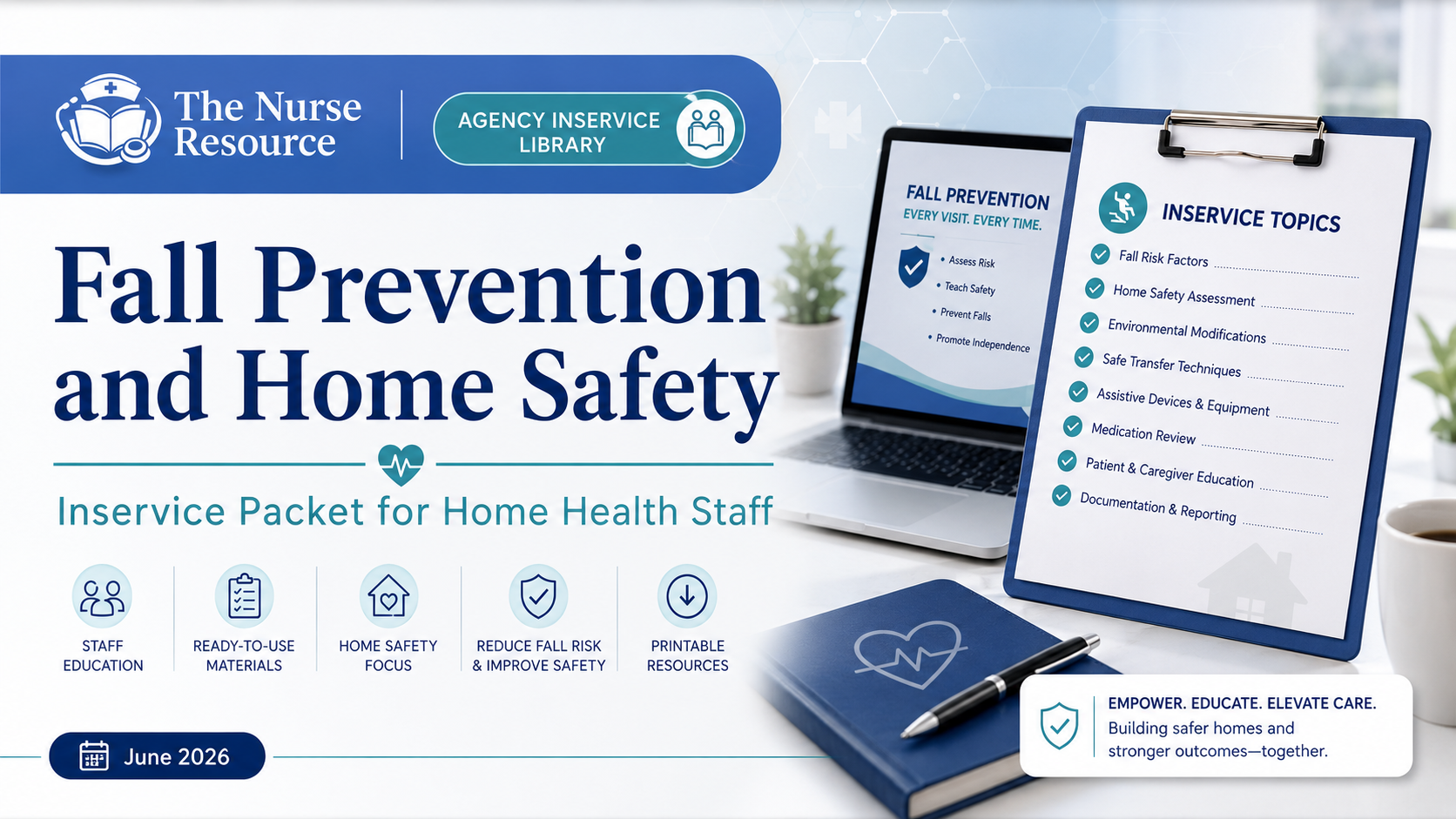
June 2026 Agency Inservice Library
Inservice Overview
This agency-ready inservice packet is designed to support home health staff education on fall prevention, home safety, safe mobility, transfer precautions, assistive device use, fall reporting, and staff responsibilities when caring for patients at risk for falls.
Falls can lead to injury, hospitalization, decline in function, and loss of independence. Home health staff play an important role in identifying fall risks, reinforcing safety teaching, reporting changes, and supporting safe care in the home setting.
This packet may be used for internal staff education, staff meeting discussion, self-study review, competency reinforcement, and QAPI-related staff education records.
Who This Packet Is For
This packet is designed for:
- Home health agency owners.
- Administrators.
- DCS / DON.
- QA nurses.
- Clinical supervisors.
- Staff educators.
- Field nurses.
- Therapists, if applicable.
- Home health aides.
- Caregivers or direct care staff involved in patient care.
What’s Included
This Fall Prevention and Home Safety Inservice Packet includes:
- Staff Inservice Lesson
Education on fall risk factors, home safety concerns, safe transfers, assistive device use, dizziness precautions, medication-related fall risk, and fall reporting. - Staff Sign-In Sheet
Printable attendance record for staff education tracking. - Post-Test
Staff knowledge check after reviewing the inservice lesson. - Answer Key
Reference key for agency educator, supervisor, or staff education file. - Staff Attestation Form
Staff confirmation that the inservice was reviewed and understood. - Fall Prevention Competency Checklist
Supervisor or educator checklist for reinforcing fall prevention practices. - QAPI / Staff Education Record Template
Optional record for agency staff education tracking and QAPI-related documentation.
Learning Objectives
After reviewing this inservice, staff should be able to:
- Identify common fall risk factors in the home health setting.
- Recognize environmental hazards that may increase fall risk.
- Reinforce patient and PCG teaching related to fall prevention.
- Understand basic safe transfer and mobility precautions.
- Recognize when fall risks, falls, or near falls should be reported.
- Understand when urgent or emergency escalation may be needed.
- Support agency fall prevention efforts through timely reporting and documentation.
Key Staff Education Topics
1. Fall Risk Awareness
Patients may be at higher risk for falls due to weakness, poor balance, dizziness, unsafe footwear, medication side effects, impaired vision, confusion, pain, recent hospitalization, recent fall, or use of assistive devices.
Staff should remain alert for changes in patient condition that may increase fall risk during home visits.
Examples of concerns to report include:
- New or worsening weakness.
- Dizziness or lightheadedness.
- Unsteady gait.
- Poor balance.
- Fall or near fall.
- New confusion.
- Increased pain affecting mobility.
- Patient not using assistive device as instructed.
- Unsafe home environment.
- PCG unable to assist safely.
2. Home Safety and Environmental Hazards
Home safety is an important part of fall prevention. Staff should observe for hazards that may increase risk during walking, transfers, toileting, bathing, or nighttime movement.
Common home safety concerns include:
- Cluttered walkways.
- Loose rugs.
- Electrical cords in walking paths.
- Poor lighting.
- Wet or slippery floors.
- Unsafe stairs or uneven surfaces.
- Frequently used items placed out of reach.
- Lack of grab bars or ordered safety equipment.
- Pets or objects in walking areas.
- Patient rushing to bathroom.
Staff should report unsafe conditions according to agency policy and reinforce safety teaching within their role.
3. Safe Transfers and Mobility Support
Falls often occur during transfers, especially when getting out of bed, standing from a chair, using toilet, bathing, or walking while weak or dizzy.
Staff should reinforce patient-specific instructions and follow the care plan.
General safety reminders include:
- Encourage patient to rise slowly.
- Allow patient to sit at edge of bed before standing if needed.
- Remind patient to pause before walking.
- Ensure assistive device is within reach if ordered.
- Avoid rushing during transfers.
- Lock wheelchair brakes if applicable.
- Ask for assistance when patient is weak, dizzy, or unsafe.
- Follow therapy and agency instructions for transfer safety.
Staff should not perform unsafe transfers beyond their training, role, or agency policy.
4. Assistive Device Use
Patients may use walkers, canes, wheelchairs, grab bars, shower chairs, raised toilet seats, or other Durable Medical Equipment to support safe mobility.
Staff should reinforce proper use according to patient’s care plan and therapy instructions.
Concerns to report include:
- Patient not using walker or cane as instructed.
- Walker, cane, or wheelchair appears unsafe or damaged.
- Patient furniture walks instead of using ordered device.
- Patient reports device is too tall, too short, unstable, or difficult to use.
- Patient has difficulty using device safely.
- PCG is unsure how to assist safely.
5. Dizziness, Weakness, and Position Changes
Dizziness, lightheadedness, or weakness can increase risk for falls. Staff should encourage patients to move slowly and report symptoms early.
Staff should report:
- Repeated dizziness.
- Worsening weakness.
- Feeling faint.
- New balance problems.
- Shortness of breath with activity.
- Medication side effects causing drowsiness, dizziness, confusion, or weakness.
- Blood Pressure or Blood Sugar concerns if applicable.
If patient has severe symptoms, sudden change in condition, chest pain, severe shortness of breath, stroke-like symptoms, loss of consciousness, or is unsafe, emergency response may be needed.
6. Fall and Near-Fall Reporting
Falls and near falls should be reported according to agency policy. A near fall may still indicate increased risk, even if patient did not hit ground or sustain visible injury.
Staff should report:
- Any fall.
- Any near fall.
- Fall with pain.
- Fall with head injury.
- Fall with bruising, swelling, bleeding, or suspected fracture.
- Fall with new confusion.
- Fall with worsening weakness.
- Patient unable to get up safely after fall.
- Repeated falls or near falls.
- Unsafe home condition contributing to fall risk.
Timely reporting helps agency staff assess patient condition, notify appropriate providers, update care planning, and prevent further harm.
7. Patient and PCG Teaching Reinforcement
Staff should reinforce fall prevention teaching within their role and according to agency policy.
Teaching reminders may include:
- Keep pathways clear.
- Use assistive device as ordered.
- Wear safe footwear.
- Avoid rushing to bathroom.
- Use good lighting.
- Ask for help when weak or dizzy.
- Report falls and near falls.
- Report new weakness, dizziness, or balance problems.
- Follow therapy, nursing, provider, and care plan instructions.
PCG involvement may be important when patient has poor safety awareness, weakness, cognitive changes, or difficulty following instructions.
When to Notify Supervisor, Nurse, PCP, or Agency
Staff should follow agency policy for reporting concerns. Report promptly if patient has:
- Fall or near fall.
- Repeated dizziness.
- Worsening weakness.
- New or worsening balance problem.
- New pain after fall or near fall.
- Increased trouble walking.
- Trouble using walker, cane, wheelchair, or other equipment.
- Medication side effects affecting safety.
- Unsafe home setup affecting mobility.
- PCG unable to assist safely.
- Patient not following fall prevention precautions.
- Repeated need for safety reinforcement.
When Emergency Help May Be Needed
Call 911 or follow agency emergency protocol for:
- Fall with head injury.
- Fall with loss of consciousness.
- Suspected fracture.
- Severe pain after fall.
- New confusion after fall.
- Chest pain.
- Severe shortness of breath.
- Sudden weakness, facial droop, or trouble speaking.
- Unresponsiveness.
- Seizure activity.
- Uncontrolled bleeding.
- Inability to get up safely after fall.
- Patient appears severely ill or rapidly worsening.
Staff should follow agency policy and emergency procedures.
Staff Responsibilities
Staff are expected to:
- Follow agency policy and patient care plan.
- Observe for fall risks during visits.
- Reinforce safety teaching within their role.
- Report falls, near falls, and unsafe conditions promptly.
- Document according to agency standards and role.
- Notify appropriate supervisor or clinician when concerns are identified.
- Avoid unsafe care practices outside assigned role or training.
- Support patient safety through consistent communication.
How Agencies Can Use This Packet
Agencies may use this packet for internal staff education, staff meeting discussion, self-study review, competency reinforcement, QAPI-related education, and staff training documentation.
The agency is responsible for reviewing, adapting, presenting, supervising, documenting, and filing staff education according to agency policy and applicable requirements.
Download Packet
Use the download buttons below to access the inservice materials.

00 Full Packet – Fall Prevention and Home Safety Inservice Packet00 Fall Prevention and Home Safety Inservice Packet

01 Staff Inservice Lesson – Fall Prevention and Home Safety

02 Staff Sign-In Sheet – Fall Prevention and Home Safety

03 Post-Test – Fall Prevention and Home Safety

04 Answer Key – Fall Prevention and Home Safety

05 Staff Attestation Form – Fall Prevention and Home Safety

06 Fall Prevention Competency Checklist

07 QAPI Staff Education Record Template – Fall Prevention and Home Safety
Download Fall Prevention Inservice Packet Bundle
Related Premium Library Resource
For patient-facing fall prevention teaching tools, PCG checklists, nurse quick charting support, and downloadable patient education resources, visit the Fall Prevention Teaching Pack in the Premium Library.
[View Fall Prevention Teaching Pack]
Agency-Use License
Agency Inservice resources are intended for internal staff education use by the purchasing agency only. Resources may be printed or distributed internally to that agency’s own staff for training purposes.
Resources may not be resold, posted publicly, shared with outside agencies, uploaded to public websites, or rebranded as another company’s product without written permission from The Nurse Resource.
Important Disclaimer
This resource is for educational and staff training support use only. Agencies are responsible for reviewing and adapting materials to agency policies, state requirements, accreditation standards, payer requirements, and applicable regulations.
This resource does not guarantee compliance, survey readiness, or payment approval.
Coming Next in the Agency Inservice Library
Planned upcoming inservice packets include:
- Infection Control and Hand Hygiene Inservice Packet.
- Medication Safety Inservice Packet.
- Documentation Compliance Inservice Packet.
- Wound Infection Signs and Reporting Inservice Packet.
- Emergency Preparedness / When to Call 911 Inservice Packet.
- Patient Rights, Abuse/Neglect, and Safety Reporting Inservice Packet.
New agency-ready inservice resources are planned monthly.
Ready to access the full Agency Inservice Library?
Get agency-ready inservice packets, staff education tools, post-tests, answer keys, competency checklists, attestation forms, and QAPI/staff education record templates for home health agency staff education.
Agency Inservice Library
FOR HOME HEALTH AGENCIES
Ready-to-use monthly inservice packets for internal staff education, training documentation, and QAPI support.
– Monthly inservice packets
– Staff lesson PDFs
– Sign-in sheets
– Post-tests and answer keys
– Staff attestation forms
– Competency checklists
– QAPI/staff education record templates
– Premium Library access included ($9/month value)
$29/month
Cancel anytime. New inservice resources are planned monthly.
Free Resource Library
Free sample tools and preview resources for home health nurses and agency staff.
Coming Soon
Free