
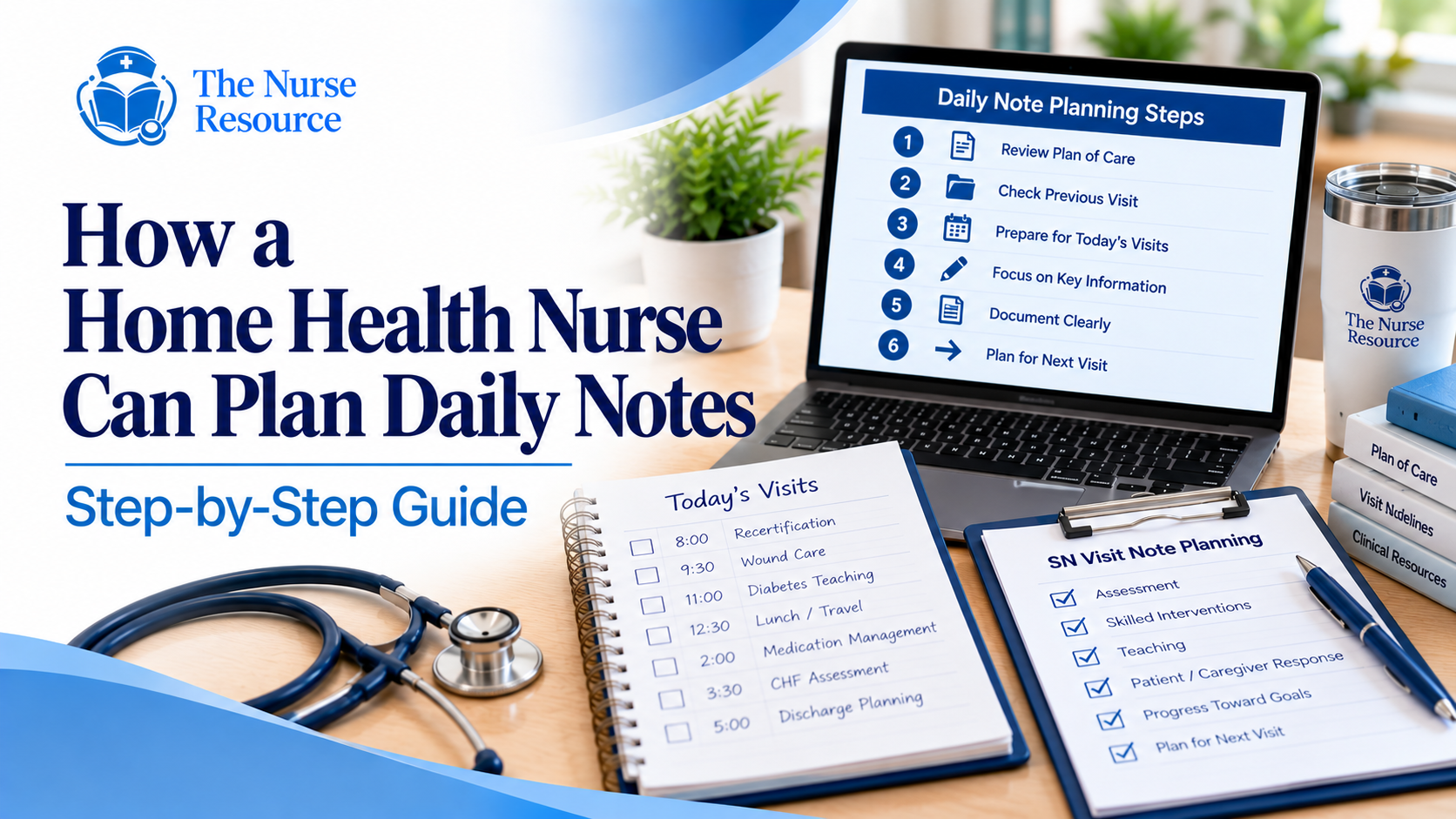
Home health nursing is part clinical care, part logistics, and part education. The nurses who feel most in control aren’t “doing more”—they’re following a repeatable daily workflow: plan, assess, intervene, teach, document, and communicate.
Below is a practical, step-by-step guide for planning your day, completing visits efficiently, and writing strong daily visit notes that hold up for Medicare, Accreditation Commission for Health Care (ACHC) , The Joint Commission audits
Plan Your Home Health Nursing Day (Before You Leave)
Step 1: Review your schedule and map your route
- Group visits by location (reduce drive time).
- Confirm start times and any time-sensitive needs (wound care, labs, INR, insulin teaching).
Free Home Health Nurse Starter Pack
Get four practical printable tools for home health skilled nursing visits, including SN documentation review, patient/PCG teaching follow-through, escalation guidance, and an end-of-visit review sheet.
Free download. No credit card required.
Step 2: Pre-chart each patient (5–7 minutes each)
Review:
- Diagnosis and current plan of care (POC)
- Orders (wound care, labs, vitals parameters, O2, frequency)
- Medication list + recent changes
- Most recent visit note (what changed, what needs follow-up)
- Any alerts: fall risk, anticoagulants, oxygen safety, infection risk
Tip: Write a quick “visit goal” for each patient (1 sentence).
Example: Assess SOB/edema, reinforce CHF diet/weight log, evaluate med adherence, document response to diuretic change.
Step 3: Pack smarter (avoid return trips)
Bring:
- Wound supplies (plus 1 extra dressing set)
- PPE, hand sanitizer, disinfectant wipes
- BP cuff, pulse ox, thermometer
- Glucometer supplies if needed
- Education materials (disease-specific handouts)
- Sharps container/portable disposal plan
Step 4: Safety and readiness check
- Confirm address/phone number
- Confirm home entry instructions
- Plan for pets, smoking, unsafe environment, or prior concerns
During the Visit: A Repeatable Workflow That Saves Time
Step 1: Start with a focused introduction
- Identify patient and explain purpose of visit
- Ask: “Any changes since the last visit?”
Step 2: Perform a quick safety scan
- Fall hazards, oxygen safety, smoke exposure
- Medication storage, cleanliness for wound care
- Patient appearance (distress, pain, confusion, fatigue)
Step 3: Do the skilled assessment (head-to-toe as appropriate)
Always document what matches the diagnosis and orders. Common focus areas:
- Respiratory: SOB, lung sounds, O2 sat, cough/sputum, inhaler use
- Cardiac: BP, HR/rhythm, edema, weight changes, chest pain, dizziness
- Diabetes: BG log review, diet, foot check, wound healing status
- Wounds: size, drainage, odor, periwound, pain, infection signs
- Neuro/safety: mentation, fall risk, gait/assist devices
- GI/GU: appetite, nausea/vomiting/diarrhea, constipation, urinary symptoms
Step 4: Complete ordered skilled interventions
Examples:
- Wound care per order
- Medication reconciliation + education
- Diabetic teaching and BG review
- CHF education and daily weights
- COPD inhaler technique/energy conservation
- Lab draw coordination / follow-up scheduling
Step 5: Teach, verify understanding, and document response
Use a simple structure:
- Teach (what and why)
- Demonstrate (if applicable)
- Teach-back (“Show me how you’ll do it.”)
- Document patient/PCG response
Related Home Health Teaching Resources
You may also find these resources helpful:
- Medication Safety Resource Pack for Home Health Nurses
- Wound and Skin Teaching Pack for Home Health Nurses
- Emergency Signs and Escalation Pack for Home Health Nurses
- Home Health SN Narrative Builder Pack
- How to Build a Home Health Skilled Nursing Teaching Plan Across the Episode
Premium Library members can access the full resource content, documentation support, and downloadable tools inside each pack.
How to Document Home Health Daily Notes (Step-by-Step)
Your daily note should show:
- Why skilled nursing was needed
- What you assessed and did
- Patient response
- Education provided
- Plan + follow-up + communication
Step 1: Start with the reason for visit (skilled need)
Examples:
- “Skilled nursing visit completed for cardiopulmonary assessment and medication management due to CHF.”
- “SN visit for wound assessment/care and diabetic teaching to promote healing and prevent infection.”
Step 2: Document relevant assessment findings (objective not vague)
Include:
- Vitals (BP, HR, RR, temp, O2 sat, pain score)
- Focused assessment tied to diagnosis
- Changes from baseline (better/worse/no change)
Avoid weak phrases like “stable” alone. Write what you saw:
- “Lungs clear bilaterally, O2 sat 94% RA, denies SOB at rest.”
- “2+ pitting edema BLE, weight increased 3 lbs since last visit per log.”
Step 3: Document interventions completed (what you did)
- Wound care performed per order (include dressing type)
- Medication reconciliation completed; discrepancies addressed
- Home safety/fall prevention reinforced
- Coordinated care (calls to MD, labs, referrals)
Step 4: Document education (specific topics + patient/PCG response)
Strong education documentation includes:
- Topic + rationale
- What you taught
- Patient/PCG response (teach-back/verbalized understanding/return demo)
- Barriers (hearing, cognition, literacy) and how you addressed them
Step 5: Document patient response and tolerance
- “Tolerated procedure without distress.”
- “Denies dizziness post-transfer; gait steady with walker.”
Step 6: End with plan and next visit focus
- “Next SN visit to reassess edema, review weight log, reinforce low sodium diet, and evaluate medication adherence.”
Step 7: Document communication and escalation (if needed)
- MD notified of abnormal findings
- Orders received
- Patient instructed on ER/911 precautions
What’s Important to Include in a Daily Note (Audit-Proof Checklist)
✅ Skilled need clearly stated
✅ Objective assessment findings (not just “WNL”)
✅ Interventions performed (ordered care completed)
✅ Education provided with teach-back/response
✅ Changes in condition and actions taken
✅ Safety concerns addressed (falls, meds, oxygen, infection)
✅ Care coordination (PCP/specialists, labs, referrals)
✅ Next steps / plan
Explore More Home Health Nursing Practice Guides
Looking for more practical guidance on visit planning, skilled nursing workflow, communication, and documentation? Explore our
Home Health Nursing Practice Guides
What to Teach the Patient or Caregiver (High-Value Education Topics)
Choose education based on diagnosis and risk:
Medication safety and adherence
- Purpose and schedule
- Side effects to report
- High-risk meds (anticoagulants, insulin, opioids)
- When to call PCP vs. when to call 911
Disease-specific teaching (examples)
CHF
- Daily weights, low sodium diet, fluid guidelines
- Report: weight gain, SOB, swelling, chest pain
COPD
- Inhaler technique, rescue inhaler use, breathing exercises
- Avoid irritants, smoking cessation, energy conservation
Diabetes
- BG monitoring, diet consistency, foot care
- Wound healing link, infection signs, hypo/hyperglycemia actions
Wound care
- Keep dressing clean/dry, hand hygiene
- Signs of infection and when to report
Safety and fall prevention
- Safe transfers, assist devices, clutter removal
- Dizziness precautions, slow position changes
When to seek urgent/emergency care
- Chest pain, severe SOB, stroke signs, uncontrolled bleeding, confusion, O2 sat drop (per parameters)
Sample “Daily Skilled Nursing Note” Template
Skilled Nursing Visit Note:
SN visit completed for (reason/diagnosis). Vitals: BP __, HR __, RR __, T __, O2 sat __, pain __/10. Focused assessment: (relevant findings).
Interventions: SN performed (wound care/med rec/teaching/assessment) per POC/orders. (Details: dressing type, technique, supplies, tolerance.)
Education: SN instructed patient/PCG on (topics) including (why). Patient/PCG verbalized understanding / demonstrated teach-back / return demonstrated.
Response: Patient tolerated visit/interventions well; no acute distress noted. (Changes/concerns and actions taken.)
Plan: Continue POC. Next visit to (next focus). Patient/PCG instructed to report (red flags) to PCP and call 911 for emergency symptoms.
Leave a Reply