
Introduction
Wound and skin documentation in home health should show more than that SN looked at wound, changed dressing, or provided teaching.
A strong note should help someone reviewing record understand:
- What SN found.
- Why finding mattered.
- What ordered wound care or skilled intervention was actually performed.
- What patient or PCG was taught.
- How patient or PCG responded.
- Whether a concerning change required PCP or wound-provider communication.
- What still needs follow-up.
- What SN plans to reassess next.
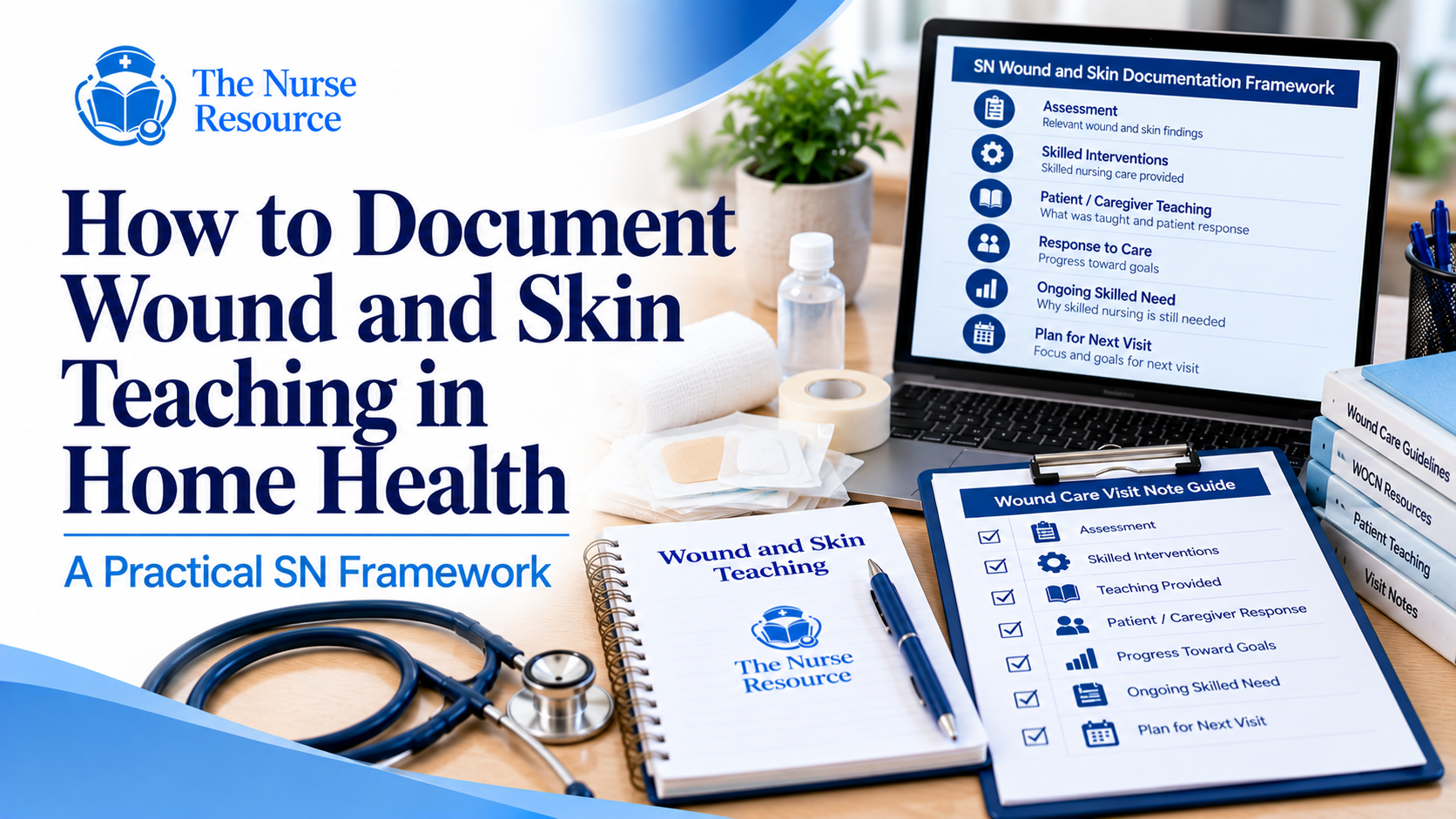
A practical framework is:
Assessment Finding → Skilled Nursing Intervention/Teaching → Patient/PCG Response → Provider Communication or Follow-Up When Needed → Next Visit Focus
This article teaches that documentation framework.
It is different from Wound Care Teaching in Home Health: What Nurses Should Cover Across the Episode, which focuses on what nurses should teach across wound-care episode.
It is also different from Wound Infection Teaching in Home Health: 10 Visit Focus Areas for Nurses, which focuses specifically on wound infection recognition, reporting, and teaching progression.
This public article does not provide a large wound charting phrase bank or full set of EMR templates. Those more detailed copy-friendly tools remain Premium Library content.
Why Wound Documentation Needs to Show Clinical Connection
Wound documentation can become weak when each part of visit is charted separately without showing how findings, intervention, teaching, and follow-up connect.
For example:
Wound assessed. Dressing changed. Teaching done. Patient verbalized understanding.
Those statements may describe things that occurred, but they give limited information about clinical reasoning.
A reviewer still may not know:
- What wound or skin finding was important.
- Whether wound changed from prior visit.
- What ordered treatment was performed.
- What patient needed to learn.
- Whether patient or PCG could safely follow instructions.
- Whether abnormal finding required provider communication.
- What needs follow-up next visit.
Federal home health clinical-record requirements state that the clinical record must include interventions and patient responses to those interventions, as well as plan-of-care goals and patient progress. Home health plans of care must also be individualized and include patient and caregiver education and training.
Strong wound documentation should therefore tell a connected clinical story rather than read like a list of unrelated tasks.
The Wound and Skin Documentation Framework
A useful way to think through wound documentation is:
1. Assessment Finding
What did SN actually observe, measure, or identify?
2. Skilled Nursing Intervention or Teaching
What ordered wound care, skilled assessment, monitoring, teaching, or coordination did SN actually perform?
3. Patient or PCG Response
What did patient or PCG understand, demonstrate, report, or continue to have difficulty with?
4. Provider Communication or Follow-Up When Needed
Did a clinically significant change require PCP, surgeon, podiatry, or wound-provider communication?
5. Next Visit Focus
What wound, skin, teaching, treatment-response, or safety issue needs reassessment?
This is a thinking framework, not a required EMR template.
Free Home Health Nurse Starter Pack
Get four practical printable tools for home health skilled nursing visits, including SN documentation review, patient/PCG teaching follow-through, escalation guidance, and an end-of-visit review sheet.
Free download. No credit card required.
1. Document Relevant Wound and Skin Assessment Findings
Wound documentation should identify findings that matter to current plan of care and skilled nursing decision-making.
Depending on wound and agency requirements, relevant findings may include:
- Wound location.
- Wound measurements when required.
- Wound appearance.
- Drainage amount or change.
- Drainage characteristics when clinically relevant.
- Odor.
- Surrounding redness.
- Warmth.
- Swelling.
- Pain or tenderness.
- Skin condition around wound.
- Wound edges.
- New skin breakdown.
- Pressure-related areas.
- Dressing condition.
- Signs suggesting improvement, deterioration, or complication.
- Patient-reported changes between visits.
Document what was actually assessed.
Do not add findings simply because they commonly appear in a wound template.
Show Change When It Matters
One useful question is:
What is different from prior visit?
Examples of meaningful change may include:
- Less drainage.
- More drainage.
- New redness.
- Increased pain.
- New odor.
- New skin breakdown.
- Dressing repeatedly becoming saturated.
- Wound measurements changing.
- Surrounding skin improving.
- Patient developing difficulty following wound-care plan.
Documentation across visits should help show progression, not merely repeat same wound description.
2. Document Ordered Wound Care Actually Performed
If SN performs wound care, documentation should reflect care actually completed according to provider order and plan of care.
Depending on order, this may involve:
- Removal of existing dressing.
- Wound cleansing.
- Application of ordered wound products.
- Packing when ordered.
- Application of ordered dressing.
- Securement.
- Skin protection.
- Pressure or off-loading interventions when ordered.
- Other ordered wound-care procedures.
Public documentation guidance should not create a universal wound-care sequence.
Different wounds require different treatments.
Document according to:
- Current provider order.
- Plan of care.
- Agency policy.
- Wound type.
- Product instructions when applicable.
- Skilled nursing judgment.
Do not chart treatment that was not performed.
Do not make an independent wound-care change simply to create a stronger note.
3. Connect Teaching to Current Wound or Skin Need
Teaching is clearer when documentation explains why particular education was needed.
Wound and skin teaching may address topics such as:
- Wound observation.
- Surrounding skin changes.
- Dressing protection.
- Hand hygiene.
- Infection warning signs.
- Pressure relief when applicable.
- Skin protection.
- Wound-care supplies.
- Medication follow-through.
- Blood Sugar monitoring if ordered for patient with diabetes.
- PCG assistance.
- Symptoms to report.
- When to contact home health agency or PCP.
Avoid documenting every possible wound topic at every visit.
Instead, document teaching that was relevant to current assessment.
For example, if patient repeatedly removes dressing, dressing protection may be more relevant than repeating a broad infection lesson.
If PCG is beginning to assist with ordered wound care, clean technique and supply handling may be higher priority.
If wound develops increased redness or drainage, symptom recognition and timely reporting may become focus.
For broader clinical teaching progression, see Wound Care Teaching in Home Health: What Nurses Should Cover Across the Episode.
4. Document Patient or PCG Response
Teaching documentation should include how patient or PCG responded when response was assessed.
“Patient verbalized understanding” may be accurate, but it does not always show whether patient can safely apply teaching.
Patient or PCG response may involve:
- Correct teach-back.
- Partial teach-back.
- Need for cueing.
- Ability to identify wound changes to report.
- Correct return demonstration when appropriate.
- Difficulty performing ordered care.
- Inability to reach wound.
- Difficulty maintaining clean technique.
- Medication confusion.
- PCG participation.
- PCG inability to perform assigned care safely.
- Refusal or reluctance.
- Continued need for reinforcement.
Only document what actually occurred.
Limited Teach-Back Example
A brief framework-level example:
Patient able to identify increased redness and drainage as changes to report but required reinforcement regarding dressing contamination.
This is enough to demonstrate documentation principle without creating a response phrase bank.
Detailed patient and PCG response wording remains Premium Library content.
5. Document Abnormal or Worsening Findings Clearly
When wound or surrounding skin changes, documentation should make finding easy to follow.
Possible concerns may include:
- Increased redness.
- New warmth.
- Increased swelling.
- Increased drainage.
- New concerning drainage.
- Foul odor.
- Increased pain or tenderness.
- New bleeding.
- Wound becoming larger or deeper.
- New skin breakdown.
- New systemic symptoms such as fever, chills, weakness, or confusion.
MedlinePlus wound-care guidance identifies worsening redness, swelling, pain, abnormal drainage, foul odor, fever, chills, and wound deterioration among findings that may require provider evaluation.
Documentation should not simply state:
Wound worse.
Instead, identify actual change that was assessed.
Avoid diagnosing wound infection based on a single finding unless diagnosis has been established by authorized provider.
Related Free Resources
For broad wound-care teaching across episode:
Wound Care Teaching in Home Health: What Nurses Should Cover Across the Episode
This is main public wound teaching pillar and covers wound observation, dressing protection, skin protection, pressure concerns, healing risks, patient/PCG participation, and teaching progression.
For infection-specific teaching:
Wound Infection Teaching in Home Health: 10 Visit Focus Areas for Nurses
This supporting post focuses on wound infection recognition, drainage, redness, odor, pain, systemic symptoms, reporting, and escalation.
6. Document PCP or Wound-Provider Communication When It Actually Occurs
When abnormal finding requires provider communication, note should allow reviewer to follow what happened.
A useful clinical sequence is:
Finding → Relevant assessment → Provider communication → Orders or instructions received → Patient/PCG follow-up → Next reassessment
Depending on situation, documentation may include:
- What finding prompted communication.
- Who was contacted.
- Relevant clinical information reported.
- Orders received.
- Instructions received.
- Changes to plan of care.
- Patient or PCG teaching based on new instructions.
- Follow-up plan.
Do not invent:
- PCP notification.
- Wound-provider notification.
- New orders.
- Provider instructions.
- Patient response.
Only document communication that actually occurred.
42 CFR §484.60 requires HHA to promptly alert relevant physician(s) or allowed practitioner(s) to changes in patient condition or needs that suggest outcomes are not being achieved or plan of care should be altered.
7. Document Progress Across Visits
Wound documentation should help show whether care is moving in a clinically meaningful direction.
Progress may include:
- Wound measurements improving.
- Drainage decreasing.
- Surrounding skin improving.
- Pain decreasing.
- Dressing remaining intact.
- Patient following wound-protection instructions more consistently.
- PCG demonstrating improved technique.
- Patient recognizing warning signs more accurately.
- Supplies becoming available after prior problem.
Not every wound improves every visit.
Documentation may also show:
- No meaningful change.
- Delayed healing.
- New barrier.
- Worsening wound.
- New infection concern.
- Increased pain.
- Repeated dressing problems.
- Continued patient or PCG difficulty.
- Need for provider reassessment.
Do not change wording simply to make notes appear different.
Document actual progress, lack of progress, or new concerns.
8. Document Barriers That Affect Wound Care
Home health wound care often depends on factors outside wound itself.
Relevant barriers may include:
- Patient cannot reach wound.
- Poor vision.
- Tremor or poor dexterity.
- Cognitive impairment.
- PCG unavailable.
- PCG unable to perform ordered care safely.
- Missing supplies.
- Supply delivery problems.
- Patient repeatedly removes dressing.
- Pressure or mobility limitations.
- Incontinence or moisture exposure.
- Blood Sugar concerns.
- Medication confusion.
- Poor intake.
- Transportation problems affecting wound-clinic follow-up.
These barriers may directly affect wound care, teaching progression, safety, and discharge planning.
If barrier influences skilled care, document it.
9. Document Continued Skilled Involvement Only When Supported
A wound diagnosis alone does not automatically explain why SN must continue.
Continued skilled involvement should be supported by patient-specific need.
Examples may include:
- Need for ordered skilled wound care.
- Continued skilled wound assessment.
- Wound change requiring monitoring.
- New treatment order requiring follow-up.
- Infection concern.
- Delayed healing or skin deterioration.
- Patient unable to safely perform ordered care.
- PCG still requiring instruction.
- Continued knowledge deficit affecting safety.
- Need to evaluate treatment response.
- Ongoing provider communication or coordination.
Avoid relying only on a closing sentence such as:
Continued SN needed for wound care.
The stronger approach is for assessment, intervention, response, and follow-up documented throughout note to make continued need understandable.
Full ongoing skilled need phrase banks remain Premium Library content.
10. Document a Logical Next Visit Focus
Next visit should connect to what happened today.
Possible next-visit focus may include:
- Reassess drainage.
- Reassess surrounding redness.
- Reevaluate pain.
- Check response to updated wound order.
- Review whether dressing remained intact.
- Observe patient or PCG wound-care technique.
- Follow up on provider communication.
- Reevaluate new skin breakdown.
- Review wound-clinic follow-up.
- Reassess infection signs.
- Reevaluate teaching retention.
Next-visit planning helps documentation show continuity across episode.
It should not simply be added as generic wording unrelated to current visit.
Wound and Skin Teaching Pack
for Home Health Nurses
This free article teaches how to think through wound and skin documentation.
Premium Library members who need deeper copy-friendly support can access the
The pack includes more detailed support for:
- Wound and skin patient teaching.
- PCG monitoring.
- Wound and surrounding skin observation.
- Infection warning signs.
- Dressing protection.
- Skin-breakdown prevention.
- Patient and PCG response wording.
- Nurse quick charting support.
- Ongoing skilled need support.
- Downloadable wound and skin resources.
These tools support documentation organization but do not replace patient-
A Limited Weak vs Stronger Example
This public article includes only one brief example.
Weak
Wound assessed. Dressing changed. Teaching done. Patient verbalized understanding.
Stronger
Increased drainage noted compared with prior visit. Ordered wound care completed. SN reinforced reporting of increased drainage, redness, odor, or worsening pain. Patient correctly identified redness and drainage as changes to report but required reinforcement regarding dressing protection.
Why is this stronger?
It connects:
- Current finding.
- Ordered intervention.
- Focused teaching.
- Patient response.
- Remaining teaching need.
It still does not provide a full wound documentation template.
Detailed documentation examples and copy-friendly wording remain in Premium Library.
When Abnormal Findings Need Follow-Up
Follow provider orders, wound-provider instructions, agency policy, and skilled nursing judgment for findings such as:
- Increased redness.
- New warmth.
- Increased swelling.
- Increased drainage.
- Concerning change in drainage.
- Foul odor.
- Increased pain.
- New bleeding.
- Wound becoming larger or deeper.
- New skin breakdown.
- Fever or chills.
- New weakness or confusion.
- Wound not progressing as expected.
- Dressing repeatedly becoming saturated or contaminated.
Documentation should accurately show assessment and follow-up that actually occurred.
Documenting Emergency Escalation
For severe or life-threatening symptoms, documentation should reflect emergency action actually taken.
Examples may include:
- Uncontrolled bleeding.
- Severe shortness of breath.
- Severe confusion or unresponsiveness.
- Severe allergic reaction symptoms.
- Rapidly worsening condition with signs of severe systemic illness.
- Any situation in which patient appears to be in immediate danger.
If 911 is activated, document relevant findings and emergency response according to agency policy.
Do not delay emergency care to complete routine PCP notification.
Common Wound Documentation Mistakes
Documenting “Wound Checked”
This does not show what SN actually assessed.
Documenting Only Dressing Change
A dressing task alone may not explain clinical findings, skilled judgment, teaching, or response.
Copying Same Wound Narrative Across Visits
Repeated identical wording may hide meaningful change or continued barrier.
Documenting Every Possible Teaching Topic
Chart teaching that actually occurred and was relevant to current patient need.
Using “Patient Verbalized Understanding” Without Context
When clinically relevant, show what patient or PCG could actually explain or demonstrate.
Missing Abnormal-Finding Follow-Up
If wound worsened and provider was contacted, clinical sequence should be understandable.
Documenting Provider Notification That Did Not Occur
Never add communication simply to strengthen note.
Stating Continued Skilled Need Without Supporting It
Current assessment and care should support ongoing skilled involvement.
Giving Universal Wound-Care Instructions
Documentation should reflect patient-specific provider orders, not a generic wound-treatment routine.
How to Keep Wound Documentation Patient-Specific
Before completing wound or skin note, consider:
- What mattered clinically today?
- What changed from prior visit?
- What ordered care was actually performed?
- What teaching was actually needed?
- How did patient or PCG respond?
- Was technique observed?
- Was a barrier identified?
- Was a concerning change present?
- Was provider communication needed?
- What orders or instructions were actually received?
- What remains unresolved?
- What should SN reassess next visit?
This approach helps documentation follow patient rather than a template.
Related Agency Inservice Resources
Home health agencies needing staff-wide wound infection education can use the Wound Infection Signs and Reporting Inservice through the Agency Inservice Library.
The agency resource is designed to support staff education on wound infection recognition, early reporting, competency review, and QAPI/staff education documentation.
Agencies remain responsible for reviewing and adapting materials to agency policy, state requirements, accreditation standards, payer requirements, and applicable regulations.
Important Use Note
This post is for educational and home health documentation support only. It does not replace provider orders, wound-care orders, Wound Specialist or surgeon instructions, medication profile, Hospital discharge instructions, patient-specific plan of care, agency policy, payer requirements, state regulations, Medicare guidance, accreditation standards, emergency protocols, or skilled nursing judgment.
Wound assessment, measurements, cleansing, dressing selection, dressing changes, packing, compression, pressure relief, off-loading, medications, antibiotics, provider notification, and follow-up must be individualized to patient condition, wound type and cause, provider orders, plan of care, agency policy, payer requirements, and clinical judgment.
Documentation must reflect only assessment findings, wound care, teaching, patient or PCG response, provider communication, orders, and interventions that actually occurred.
No phrase, template, example, checklist, or documentation style automatically establishes skilled need, medical necessity, Medicare coverage, payment eligibility, claim approval, survey compliance, documentation compliance, or regulatory compliance.
Sources Used
- Electronic Code of Federal Regulations. 42 CFR §484.110, Clinical Records
- Electronic Code of Federal Regulations. 42 CFR §484.60, Care Planning, Coordination of Services, and Quality of Care
- Centers for Medicare & Medicaid Services. Medicare Benefit Policy Manual, Chapter 7: Home Health Services
- MedlinePlus Medical Encyclopedia. Surgical Wound Care: Open
- MedlinePlus Medical Encyclopedia. Surgical Wound Care: Closed
- MedlinePlus Medical Encyclopedia. Wound Care Centers
- Centers for Disease Control and Prevention. About Hand Hygiene for Patients in Healthcare Settings