
November 2026 Agency Inservice Library
Inservice Overview
Home health staff may be the first to recognize a meaningful change in patient condition. Knowing how to respond can involve different levels of escalation depending on patient symptoms, change from baseline, provider orders, plan of care, agency procedures, and urgency.
This agency-ready inservice packet supports home health staff education on recognizing changes in condition and selecting an appropriate level of escalation during care in home setting.
The packet focuses on practical decisions: when a non-emergency concern should be reported to agency or PCP, when an urgent change requires prompt nursing assessment and provider communication, and when a possible medical emergency requires immediate emergency response or a call to 911.
Public Preview
This inservice helps reinforce a practical escalation framework for home health staff.
Staff education includes:
- Recognizing meaningful changes from patient baseline.
- Distinguishing non-emergency concerns, urgent changes, and possible medical emergencies.
- Knowing when to notify agency, supervising nurse, or PCP.
- Recognizing when emergency response or 911 may be needed.
- Using patient-specific provider orders, plan of care, agency procedures, scope of practice, and clinical judgment.
- Reporting abnormal Blood Pressure, Blood Sugar, Vital Signs, or other findings in patient-specific context.
- Recognizing medication-related concerns.
- Responding appropriately to falls and possible injuries.
- Communicating changes clearly during escalation.
- Documenting findings, notifications, instructions, actions, and follow-up.
- Reinforcing patient and PCG emergency-response teaching.
- Connecting escalation concerns to QAPI review and staff education.
The inservice organizes concerns into three general levels:
- Non-emergency concern requiring agency or PCP notification according to agency process.
- Urgent change requiring prompt nursing assessment, agency escalation, and provider communication.
- Possible medical emergency requiring immediate emergency response or 911 without delaying care while waiting for a routine callback.
This framework is not based on one universal set of numeric thresholds. Patient-specific orders, symptoms, trends, plan of care, agency policy, and clinical judgment should guide escalation.
What’s Included in the Full Packet
Agency Inservice Library members receive the complete November staff education packet.
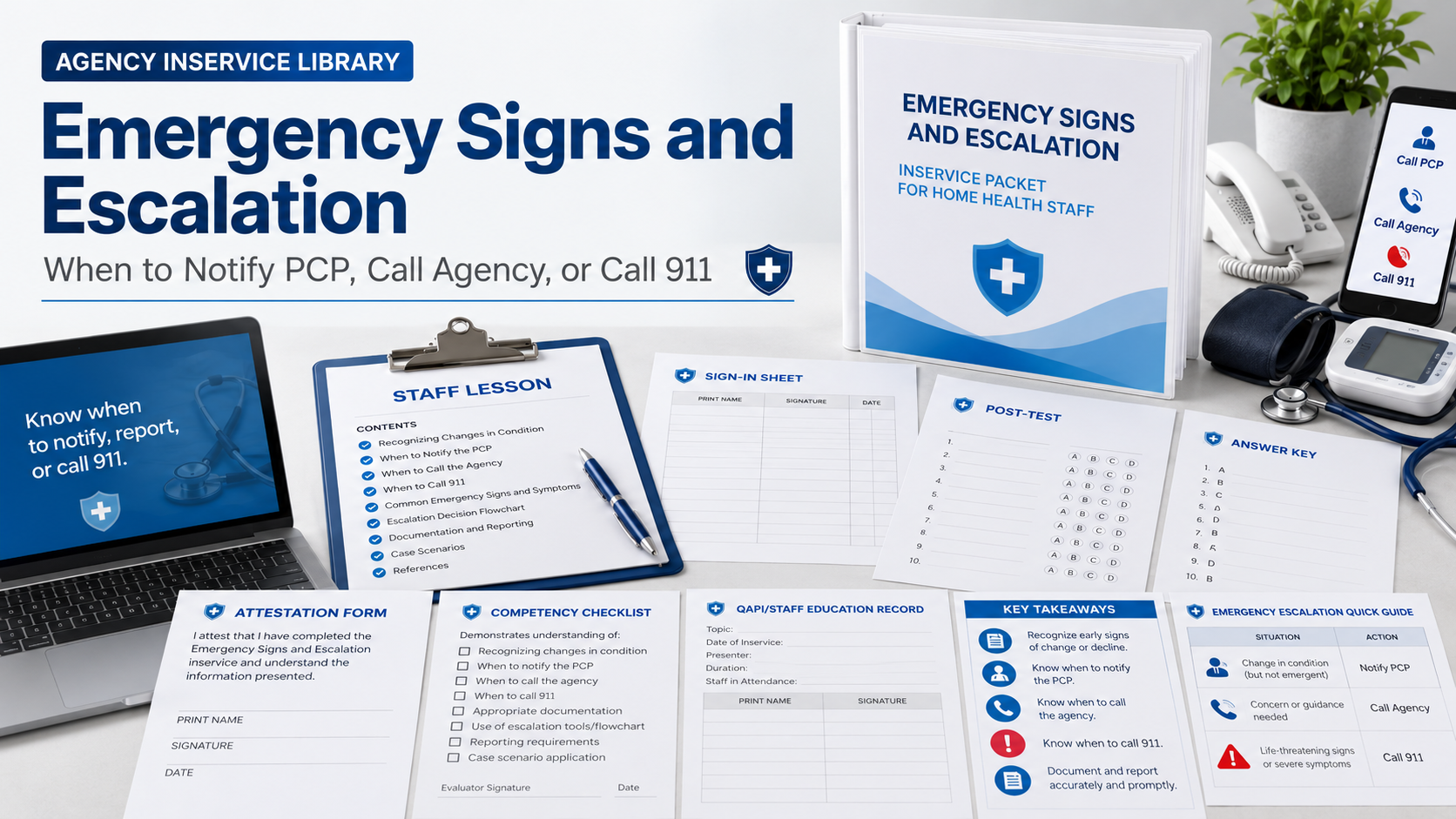
00 Full Packet – Emergency Signs and Escalation in Home Health Inservice Packet
Combined November inservice packet for agency staff education and training records.
01 Staff Inservice Lesson – Emergency Signs and Escalation in Home Health
Staff education covering change from baseline, escalation levels, PCP and agency notification, emergency warning signs, communication, documentation, patient/PCG teaching, and QAPI follow-up.
02 Staff Sign-In Sheet – Emergency Signs and Escalation in Home Health
Printable attendance sheet for internal agency education records.
03 Post-Test – Emergency Signs and Escalation in Home Health
Ten-question knowledge review focused on practical home health escalation scenarios.
04 Answer Key – Emergency Signs and Escalation in Home Health
Answer reference for agency educator, supervisor, or staff education file.
05 Staff Attestation Form – Emergency Signs and Escalation in Home Health
Staff acknowledgement of escalation responsibilities, emergency-response expectations, and agency-process requirements.
06 Emergency Signs and Escalation Competency Checklist
Supervisor or educator review tool addressing change recognition, appropriate escalation, emergency warning signs, communication, documentation, and patient/PCG teaching.
07 QAPI Staff Education Record Template – Emergency Signs and Escalation in Home Health
Optional record for staff education tracking, competency completion, delayed-escalation review, emergency-response follow-up, communication concerns, and QAPI documentation.
The finalized packet contains the staff lesson, sign-in sheet, post-test, answer key, attestation form, Emergency Signs and Escalation Competency Checklist, and QAPI / Staff Education Record Template.
Who This Inservice Is For
This inservice may support education for:
- Administrators.
- DCS / DON.
- QA nurses.
- Clinical supervisors.
- Staff educators.
- Field nurses.
- Therapists, when applicable.
- Home Health Aides within assigned observation and reporting responsibilities.
- Office or clinical staff involved in escalation communication or staff education.
The finalized packet is designed for staff involved in observing, reporting, or responding to changes in patient condition and may be used for internal education, self-study, competency reinforcement, escalation-process education, emergency-response review, and QAPI-related education.
Why This Topic Matters
Home health care occurs in patient homes where staff may encounter changes before another clinician or provider is immediately available.
A finding that is new, worsening, repeated, unexpected, or different from patient baseline may require follow-up even when patient does not appear to be in immediate danger.
Goal is not for staff to diagnose a condition. Staff should recognize concerns within assigned role, communicate them promptly, and activate appropriate response without unnecessary delay.
A non-emergency concern still may need reporting. Examples may involve new weakness, repeated dizziness, abnormal findings based on patient-specific parameters, medication concerns, swelling, skin or wound changes, changes in activity tolerance, or a fall without apparent serious injury. 00 Full Packet – Emergency Sign…
Urgent changes require more immediate clinical follow-up and may include worsening confusion, marked weakness, concerning measurements with symptoms, medication-related symptoms, worsening wound or infection concerns, worsening shortness of breath, or a fall with uncertain injury. If condition progresses to emergency warning signs, emergency response should not be delayed. 00 Full Packet – Emergency Sign…
Possible medical emergencies may include chest pressure, severe breathing difficulty, stroke warning signs, seizure, unresponsiveness, severe bleeding, severe allergic reaction symptoms, serious injury, or a rapidly worsening life-threatening condition.
Suggested Agency Use
Agencies may use this packet for:
- Monthly staff inservice education.
- New staff orientation.
- Escalation-process review.
- Emergency-response refresher education.
- Staff competency reinforcement.
- Case review after delayed escalation.
- Emergency department or Hospital transfer review.
- Fall or injury follow-up education.
- Communication improvement.
- Documentation improvement.
- Patient and PCG emergency teaching reinforcement.
- QAPI-focused staff education.
The QAPI template specifically supports review of delayed escalation, emergency-response events, falls or transfers, communication or documentation gaps, competency completion, and follow-up actions.
Download Packet
Agency Inservice Library members may access the November Emergency Signs and Escalation materials below

00 Full Packet – Emergency Signs and Escalation in Home Health Inservice Packet
Download Individual Resources

01 Staff Inservice Lesson – Emergency Signs and Escalation in Home Health

02 Staff Sign-In Sheet – Emergency Signs and Escalation in Home Health

03 Post-Test – Emergency Signs and Escalation in Home Health

04 Answer Key – Emergency Signs and Escalation in Home Health

05 Staff Attestation Form – Emergency Signs and Escalation in Home Health

06 Emergency Signs and Escalation Competency Checklist

07 QAPI Staff Education Record Template – Emergency Signs and Escalation in Home Health

08 Staff Quick Reference
Download Complete Inservice Bundle
Includes Full Packet and all individual Emergency Signs and Escalation resources.
Related Free Resource
Free Home Health Nurse Starter Pack
The Free Home Health Nurse Starter Pack includes:
When to Notify PCP/Provider vs Call 911: Home Health Quick Reference
This free reference supports nurses with a practical framework for recognizing when findings may require PCP or agency notification and when emergency response should not be delayed.
Related Premium Library Resource
Emergency Signs and Escalation Pack for Home Health Nurses
For patient and PCG teaching resources and skilled nursing documentation support, see the related Premium Library resource.
This pack includes:
- Emergency signs and escalation teaching support.
- When to notify PCP or home health agency.
- When to call 911.
- Patient and PCG teaching reminders.
- Teach-back prompts.
- Safety planning support.
- Emergency symptom reporting guidance.
- SN documentation examples.
- Nurse quick charting support.
- Printable patient and PCG tools.
The Premium Library pack focuses on individual nurse teaching and documentation support, while the Agency Inservice packet supports organized staff education and agency training records.
Agency Inservice Library Access
The complete inservice packet is available to active Agency Inservice Library members once published.
Agency Inservice Library: $29/month
Membership includes access to monthly agency inservice packets and the Premium Library, subject to applicable resource-use terms.
Premium Library membership is $9/month and does not include Agency Inservice Library packets.
Agency Inservice materials are intended for internal staff education by the purchasing agency. Premium Library resources have separate use terms and are not automatically licensed for agency-wide distribution.
Important Use Note
This resource is for educational and staff training support use only. Agencies are responsible for reviewing and adapting materials to agency policies, state requirements, accreditation standards, payer requirements, and applicable regulations.
This resource does not replace patient-specific provider orders, plan of care, emergency protocols, applicable regulations, or professional clinical judgment.
Staff education should reflect assigned roles, scope of practice, patient condition, and agency reporting procedures. Emergency response instructions must be individualized to patient circumstances and should not rely on universal Blood Pressure, Blood Sugar, or Vital Signs thresholds.
This resource does not guarantee compliance, survey readiness, Medicare payment, claim approval, or regulatory approval.