
Introduction
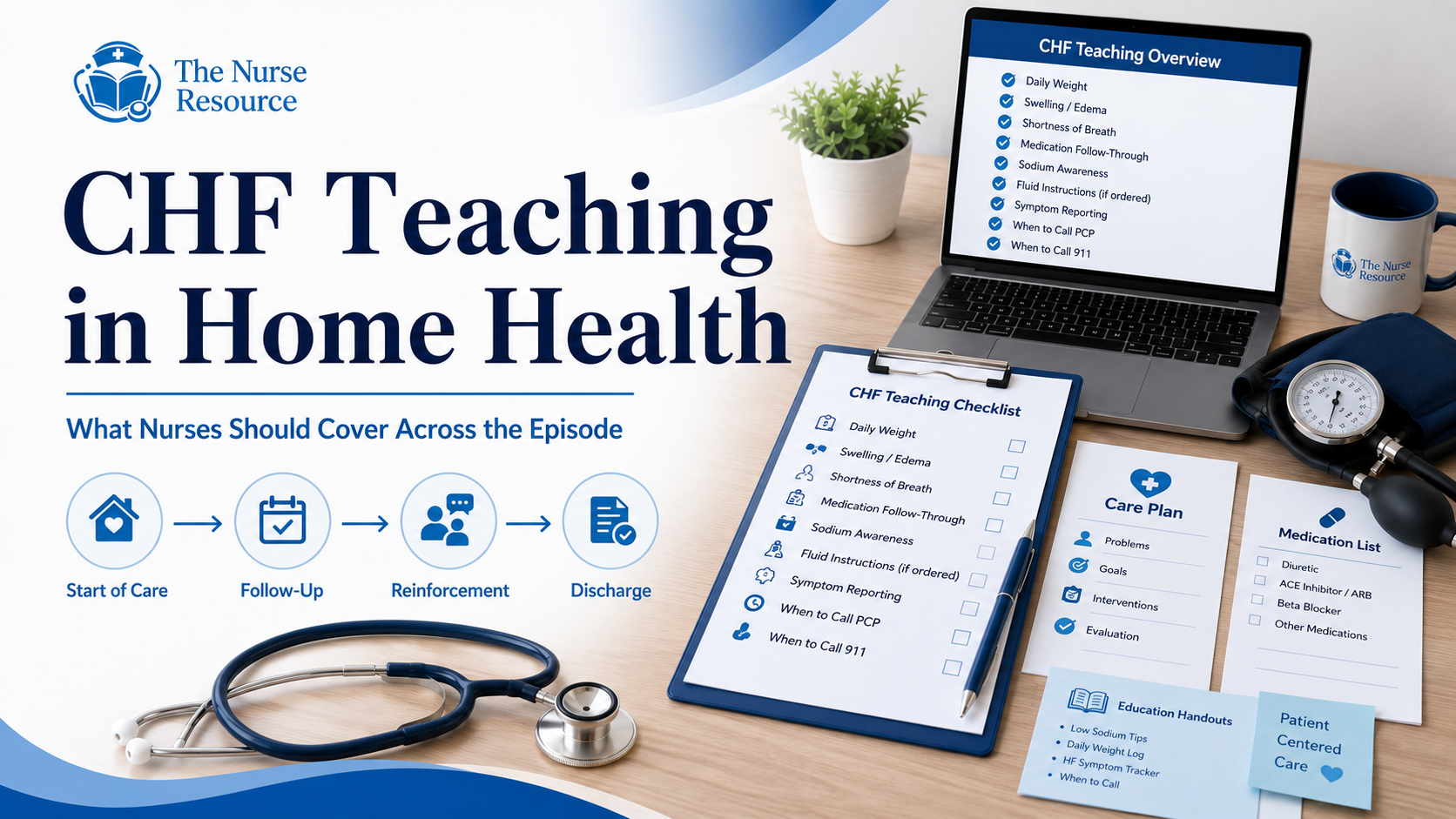
Congestive heart failure (CHF) teaching in home health should develop across the episode rather than repeat the same general information during every SN visit.
During early visits, patient may need basic teaching about heart failure, medications, daily monitoring, and warning signs. Follow-up visits may focus on teach-back, symptom trends, medication follow-through, barriers, PCG involvement, and preparation for discharge.
Heart failure is a condition in which heart does not pump or fill as effectively as it should. This can contribute to fluid buildup, shortness of breath, swelling, fatigue, weakness, cough, and reduced activity tolerance.
A strong teaching plan connects each visit to patient condition, provider orders, medication profile, plan of care, prior teaching, patient or PCG response, and current skilled need.
Why CHF Teaching Matters in Home Health
CHF management often depends on patient or PCG ability to recognize changes and report them before they become severe.
Home monitoring may include weight, Blood Pressure, heart rate, symptoms, edema, activity tolerance, and other provider-ordered measurements. Recognizing changes early may help care team respond before symptoms become more serious.
Skilled teaching may be needed because patient:
- Recently returned home after Hospitalization.
- Has a new or poorly understood CHF diagnosis.
- Takes several cardiac medications.
- Has a new or changed diuretic order.
- Does not understand daily weight instructions.
- Cannot identify symptoms that should be reported.
- Has medication confusion or missed doses.
- Has dizziness, weakness, or fall risk.
- Has memory, vision, literacy, or dexterity limitations.
- Depends on PCG for medications or monitoring.
- Has worsening edema or reduced activity tolerance.
- Cannot distinguish between notifying PCP and calling 911.
Skilled nursing judgment is needed to connect teaching with assessment findings, clinical risk, provider instructions, patient response, and risk for worsening condition or Hospitalization.
What CHF Teaching Should Cover Across the Episode
CHF teaching should help patient or PCG understand:
- What CHF means at a basic level.
- What should be monitored at home.
- Which symptoms may indicate worsening condition.
- How medications fit into care plan.
- When to notify PCP or home health agency.
- When to call 911.
- Which diet or fluid instructions were specifically ordered.
- How to continue care safely after home health discharge.
SN does not need to cover every subject during every visit. Teaching should be paced according to patient condition, current risks, visit frequency, prior response, and plan of care.
A simple approach is:
Assess → Prioritize → Teach → Evaluate → Plan Next Visit
Free Home Health Nurse Starter Pack
Get four practical printable tools for home health skilled nursing visits, including SN documentation review, patient/PCG teaching follow-through, escalation guidance, and an end-of-visit review sheet.
Free download. No credit card required.
Start of Care and Early Visits
Early visits should establish a safe foundation for CHF care.
Confirm Basic Understanding of CHF
Assess what patient believes CHF means and whether patient understands reason for referral, recent Hospitalization, or medication changes.
Basic teaching may explain that CHF affects how well heart moves blood through body and may contribute to fluid buildup, shortness of breath, swelling, fatigue, and reduced tolerance for activity.
Avoid overwhelming patient with complex cardiac terminology. Focus on information patient or PCG needs for safe daily care.
Review Medication Profile
Review current medication profile, discharge instructions, medication containers, and medication organizer according to agency policy.
Assess for:
- Missing medications.
- Possible duplicate medications.
- Discontinued medications still present.
- Missed doses.
- Refill problems.
- Medication confusion.
- Difficulty reading labels.
- Inability to follow medication schedule.
- Symptoms that may be related to medication use.
Reinforce taking medications exactly as ordered. Patient should not stop, hold, restart, increase, decrease, or otherwise change diuretics or cardiac medications without provider instruction.
Establish Daily Weight Routine if Ordered
If daily weights are ordered or instructed, assess whether patient has:
- A working scale.
- A safe place to use it.
- Ability to stand safely.
- Understanding of when to weigh.
- A method for recording results.
- Patient-specific reporting parameters.
- PCG assistance when needed.
Consistent weighing under similar daily conditions may help identify weight changes that could be related to fluid buildup.
Do not substitute a universal weight-gain threshold for patient-specific provider instructions or agency policy.
Review Edema and Breathing Symptoms
Assess baseline findings such as:
- Swelling in feet, ankles, legs, hands, or abdomen.
- Shortness of breath at rest or with activity.
- Ability to lie flat.
- Number of pillows normally used.
- Nighttime breathing difficulty.
- Cough or wheezing.
- Fatigue and weakness.
- Usual activity tolerance.
- Oxygen use if ordered.
Knowing patient baseline helps SN recognize meaningful changes during later visits.
Identify Patient-Specific Barriers
Common barriers may include:
- Poor memory.
- Hearing or vision impairment.
- Limited health literacy.
- Language needs.
- Lack of scale or Blood Pressure monitor.
- Inability to stand safely.
- Medication cost.
- Transportation problems.
- Limited food access.
- Inconsistent PCG support.
- Fear of reporting symptoms.
- Uncertainty about who to call.
Early identification allows teaching plan to be adjusted before discharge planning begins.
Middle of Episode Teaching
Middle of episode should move beyond basic information toward daily application and safer self-management.
Review Monitoring Follow-Through
Determine whether patient or PCG is consistently completing ordered monitoring.
Review:
- Daily weight record if ordered.
- Blood Pressure or heart rate log if ordered.
- Symptom changes.
- Edema pattern.
- Medication follow-through.
- Missed appointments.
- Refill concerns.
- Diet or fluid instruction confusion.
- Falls or near falls.
- Ability to report concerning changes.
Do not focus only on whether readings were recorded. Assess whether patient or PCG understands what findings should be reported.
Connect Symptoms to Escalation
Patient may recognize a symptom but still not know what to do next.
Evaluate whether patient or PCG understands:
- Which changes should be reported to PCP.
- Which concerns should be reported to home health agency.
- Which symptoms require calling 911.
- Which provider parameters apply to weight, Blood Pressure, heart rate, or other ordered measurements.
- How to reach after-hours or on-call support.
Reinforce Sodium and Fluid Instructions Only as Ordered
Sodium may contribute to fluid retention in some patients with heart failure. Some patients may also receive a fluid restriction.
Exact sodium and fluid instructions should come from provider, cardiology team, discharge instructions, or patient-specific plan of care.
SN may assess:
- Whether patient received diet instructions.
- Understanding of high-sodium foods.
- Use of canned, prepared, frozen, or restaurant foods.
- Ability to read food labels.
- Who prepares meals.
- Whether a fluid restriction was ordered.
- Confusion about what counts as fluid.
- Barriers to following instructions.
Do not assign a universal sodium limit or fluid amount.
Evaluate Medication Understanding
Patient or PCG should gradually develop a clearer understanding of:
- Medication purpose at an appropriate level.
- Medication schedule.
- Refill process.
- Symptoms or concerns to report.
- Need to maintain an updated medication list.
- Importance of not changing treatment independently.
Diuretics may be ordered to help remove extra fluid. Teaching may include basic purpose, medication compliance, increased urination, bathroom safety, and concerns that should be reported.
Timing, dose, laboratory monitoring, and medication adjustments remain provider-directed.
Check Teach-Back and Remaining Barriers
Instead of asking only whether patient understands, determine whether patient or PCG can explain:
- Daily CHF routine.
- Symptoms being monitored.
- Provider reporting plan.
- Medication safety.
- Ordered diet or fluid instructions.
- Difference between notifying PCP and calling 911.
Teach-back should guide future visits. Incomplete understanding, unsafe follow-through, or repeated barriers may require additional assessment and reinforcement.
Later Episode and Discharge Preparation
Discharge teaching should begin before final SN visit.
Later-episode teaching should focus on whether patient or PCG can continue care safely with less SN prompting.
Confirm Daily Routine
Determine whether patient or PCG can follow ordered plan for:
- Daily weight.
- Blood Pressure or heart rate monitoring.
- Medication schedule.
- Edema observation.
- Breathing symptom monitoring.
- Diet and fluid instructions.
- Follow-up appointments.
- Medication refills.
- Oxygen or other equipment if ordered.
Confirm Warning-Sign Understanding
Patient or PCG should be able to explain important changes to report, including:
- Worsening shortness of breath.
- Increased swelling.
- Rapid weight gain according to provider parameters.
- Worsening cough or wheezing.
- Increased fatigue or weakness.
- Dizziness or confusion.
- Reduced activity tolerance.
- Increased nighttime breathing difficulty.
- Greater difficulty breathing while lying flat.
Confirm Escalation Plan
Before discharge, confirm patient or PCG knows:
- PCP contact information.
- Cardiology contact information when applicable.
- Home health agency number.
- After-hours or on-call process.
- Provider-specific reporting parameters.
- When to call 911.
- Dates of follow-up appointments.
Review Medication and Appointment Plan
Confirm updated medication list is available and patient or PCG understands how to request refills and attend scheduled PCP or cardiology appointments.
Identify Unresolved Discharge Barriers
Possible barriers include:
- Repeated medication confusion.
- Inability to complete ordered monitoring.
- Missing equipment.
- Continued poor teach-back.
- Unsafe ambulation to scale or bathroom.
- Repeated abnormal symptoms.
- Unresolved diet or fluid confusion.
- Unavailable PCG.
- Missed follow-up appointments.
- Inability to obtain medications.
Unresolved concerns should be addressed through provider communication, care coordination, discharge planning, and agency process.
Key CHF Teaching Topics for Home Health Nurses
CHF Diagnosis Understanding
Teach at a level appropriate to patient cognition and health literacy.
Patient should understand that heart failure can affect circulation and contribute to fluid buildup, breathing difficulty, swelling, fatigue, and reduced activity tolerance.
Daily Weight Tracking
If ordered or instructed:
- Assess ability to weigh safely.
- Encourage a consistent routine.
- Confirm use of same scale when possible.
- Confirm readings are recorded.
- Review provider reporting parameters.
- Involve PCG if patient cannot complete task safely.
Do not create a universal weight-gain reporting threshold.
Edema Monitoring
Teach patient or PCG to observe for new or worsening swelling in areas identified by care team, including:
- Feet.
- Ankles.
- Legs.
- Hands.
- Abdomen.
Changes such as tighter shoes, clothing, or rings may also be relevant.
Shortness of Breath Monitoring
Assess whether shortness of breath is:
- New or worsening.
- Present with activity.
- Present at rest.
- Worse while lying flat.
- Waking patient at night.
- Associated with cough or wheezing.
- Limiting usual activity.
- Accompanied by chest discomfort or severe weakness.
Cough and Wheezing
Persistent or worsening cough and wheezing may need provider notification, especially when accompanied by increased shortness of breath, edema, weight changes, or reduced activity tolerance.
Fatigue, Weakness, and Activity Tolerance
Assess changes from patient baseline.
Patient may report:
- Needing more rest.
- Inability to complete usual activities.
- Increased assistance with ADLs.
- Weakness during transfers.
- Reduced walking distance.
- Unusual exhaustion.
- Dizziness or faintness.
Medication Compliance
Reinforce:
- Taking medications as ordered.
- Keeping an updated medication list.
- Planning refills.
- Reporting missed doses.
- Reporting possible side effects.
- Asking PCP or pharmacist about unclear instructions.
- Not changing medications independently.
Diuretic Teaching
When a diuretic is ordered, teaching may include:
- Basic purpose of medication.
- Importance of taking it as ordered.
- Increased urination.
- Safe access to bathroom.
- Dizziness, weakness, or other concerns to report.
- Importance of ordered laboratory and provider follow-up.
Do not tell patient to increase, decrease, hold, stop, or restart a diuretic without provider instruction.
Blood Pressure and Heart Rate Monitoring
If ordered:
- Assess equipment and technique.
- Review monitoring schedule.
- Confirm readings are recorded.
- Review patient-specific parameters.
- Assess symptoms with abnormal findings.
- Report concerns according to provider instructions.
Do not interpret an isolated Blood Pressure or heart rate reading without considering patient symptoms, baseline, provider parameters, plan of care, and clinical judgment.
Sodium Instructions
Teach sodium restriction only according to provider or cardiology instructions.
SN may reinforce recognizing high-sodium foods and following individualized diet instructions. Avoid assigning a universal daily sodium amount.
Fluid Instructions
Teach fluid restriction only when specifically ordered or instructed.
Confirm patient understands whether a restriction exists, what counts as fluid, and how to follow provider guidance. Do not assign a universal fluid amount.
PCG Involvement
PCG involvement may be appropriate when patient has:
- Memory impairment.
- Poor teach-back.
- Medication confusion.
- Vision or dexterity problems.
- Inability to weigh safely.
- Fall risk.
- Worsening symptoms.
- Limited ability to report concerns.
PCG may help monitor symptoms, support medication follow-through, assist with ordered monitoring, and report changes early.
Fall Prevention
CHF symptoms and treatments may contribute to weakness, dizziness, frequent bathroom trips, or reduced activity tolerance.
SN should assess:
- Recent falls or near falls.
- Dizziness with position changes.
- Bathroom access.
- Lighting and clear pathways.
- Assistive device use.
- Footwear.
- Need for PCG assistance.
- Medication-related safety concerns.
CHF Warning Signs Patients and PCGs Should Report
Patient or PCG should follow provider instructions and agency policy for reporting:
- Increased shortness of breath.
- New shortness of breath at rest.
- Increased swelling in feet, ankles, legs, hands, or abdomen.
- Rapid weight gain according to provider instructions.
- Worsening cough or wheezing.
- Increased fatigue or weakness.
- Dizziness or faintness.
- New or worsening confusion.
- Reduced ability to perform usual activity.
- Chest discomfort.
- Decreased appetite or nausea.
- Clothing or shoes becoming tighter.
- Needing more pillows to breathe comfortably.
- Increased nighttime breathing difficulty.
- Blood Pressure or heart rate outside patient-specific parameters.
- Symptoms that are worsening or not improving.
When to Notify PCP
Notify PCP, cardiology provider, or follow agency notification process for non-emergency concerns such as:
- Weight gain meeting patient-specific provider parameters.
- Increased edema.
- Worsening shortness of breath with activity.
- New difficulty breathing while lying flat.
- Worsening cough or wheezing.
- Increased fatigue or weakness.
- Reduced activity tolerance.
- Dizziness or lightheadedness.
- New or worsening confusion.
- Decreased appetite or nausea.
- Medication side effects.
- Missed doses.
- Refill problems.
- Medication confusion.
- Blood Pressure or heart rate outside provider parameters.
- Uncertainty about sodium or fluid instructions.
- Symptoms that continue, worsen, or do not improve as expected.
Follow provider orders, patient-specific plan of care, agency policy, and skilled nursing judgment.
When to Call 911
Call 911 or follow agency emergency protocol for severe, sudden, or life-threatening symptoms, including:
- Severe shortness of breath or serious trouble breathing.
- Severe chest pain or chest pressure.
- Fainting or loss of consciousness.
- Severe confusion or inability to respond normally.
- Blue or gray lips or face.
- Severe weakness with emergency concern.
- Sudden stroke-like symptoms.
- Symptoms that are rapidly worsening.
- Any situation in which patient appears to be in immediate danger.
Do not delay emergency response to complete a routine PCP call.
Common CHF Teaching Mistakes to Avoid
Repeating Same Topic Every Visit
Reinforcement may be necessary, but teaching should progress based on patient response, current findings, barriers, and remaining skilled need.
Documenting Only “CHF Teaching Done”
This does not show what was assessed, why teaching was needed, what patient understood, or what remains unsafe.
Giving Universal Sodium Limits
Sodium instructions should follow provider or cardiology guidance. Patient needs may vary based on condition, kidney function, medications, laboratory findings, and treatment plan.
Giving Universal Fluid Restrictions
Not every patient has same fluid instructions. Confirm provider order before teaching a specific amount.
Using Universal Weight-Gain Parameters
Use patient-specific provider instructions or agency-approved parameters. Do not assume one threshold applies to every patient.
Giving Medication Adjustment Advice
SN should not independently tell patient to hold, stop, increase, decrease, or restart a diuretic or cardiac medication.
Ignoring PCG Role
When patient has memory problems, medication confusion, poor teach-back, or physical limitations, PCG involvement may be necessary for safe follow-through.
Failing to Separate PCP Symptoms From 911 Symptoms
Patients and PCGs need a clear escalation plan that distinguishes concerning changes from emergency symptoms.
Failing to Document Patient Response
Teaching topic alone does not show progress. Documentation should reflect understanding, teach-back, barriers, need for cueing, or need for reinforcement without relying on generic wording.
Failing to Connect Teaching to Skilled Need
Continued SN teaching should relate to patient-specific risk, knowledge deficit, medication concern, symptom change, poor teach-back, inability to follow plan, or need for skilled assessment.
How to Keep CHF Teaching Skilled Across Visits
CHF teaching remains patient-specific when SN:
- Reviews current symptoms and ordered monitoring.
- Compares findings with patient baseline.
- Connects teaching to diagnosis and current risk.
- Identifies what patient or PCG already understands.
- Selects one or two priority teaching areas.
- Evaluates teach-back or safe application.
- Identifies barriers.
- Communicates concerning findings.
- Adjusts next visit plan.
- Evaluates progress toward plan-of-care goals.
- Identifies why continued SN assessment or teaching remains needed.
Early Episode
Establish baseline understanding, medication safety, monitoring routine, symptom awareness, and escalation plan.
Middle of Episode
Evaluate follow-through, review trends, address barriers, reinforce provider instructions, and increase patient or PCG participation.
Later Episode
Confirm independence or reliable PCG support, reinforce follow-up plan, review warning signs, and prepare for safe discharge.
This structure keeps teaching connected to current patient needs rather than turning it into a repeated checklist.
Related Home Health Teaching Resources
You may also find these resources helpful:
- Furosemide Indication and Home Health Teaching
- Spironolactone Indication and Home Health Teaching
- Metoprolol Indication and Home Health Teaching
- Blood Pressure Teaching Resource Pack for Home Health Nurses
- Medication Safety Resource Pack for Home Health Nurses
- Emergency Signs and Escalation Pack for Home Health Nurses
- Home Health SN Narrative Builder Pack
Premium Library members can access the full resource content, documentation support, and downloadable tools inside each pack.
Premium Library
Need More CHF Teaching and Documentation Support?
Premium Library members can access related copy-ready teaching and documentation support, including nurse quick charting tools, patient and PCG teaching resources, SN narrative support, phrase banks, and weak vs stronger documentation examples.
Important Use Note
This post is for education and home health teaching support only. It does not replace provider orders, cardiology instructions, Hospital discharge instructions, medication profile, patient-specific plan of care, agency policy, payer requirements, state regulations, Medicare guidance, accreditation standards, emergency protocols, or skilled nursing judgment.
This post does not provide medication adjustment instructions, universal sodium limits, universal fluid restrictions, universal weight-gain parameters, or emergency treatment instructions.
CHF teaching, monitoring, provider notification, emergency escalation, and documentation must be individualized to patient condition, provider orders, medication profile, plan of care, agency policy, applicable regulations, payer requirements, and clinical judgment.
This resource does not guarantee payment, claim approval, survey compliance, or regulatory compliance.
Sources Used
- American Heart Association. Heart Failure Signs and Symptoms.
- American Heart Association. Physical Changes to Report for Heart Failure.
- MedlinePlus. Heart Failure.
- MedlinePlus Medical Encyclopedia. Heart Failure Discharge Instructions.
- MedlinePlus Medical Encyclopedia. Heart Failure Home Monitoring.
- MedlinePlus Medical Encyclopedia. Heart Failure, Fluids, and Diuretics.