
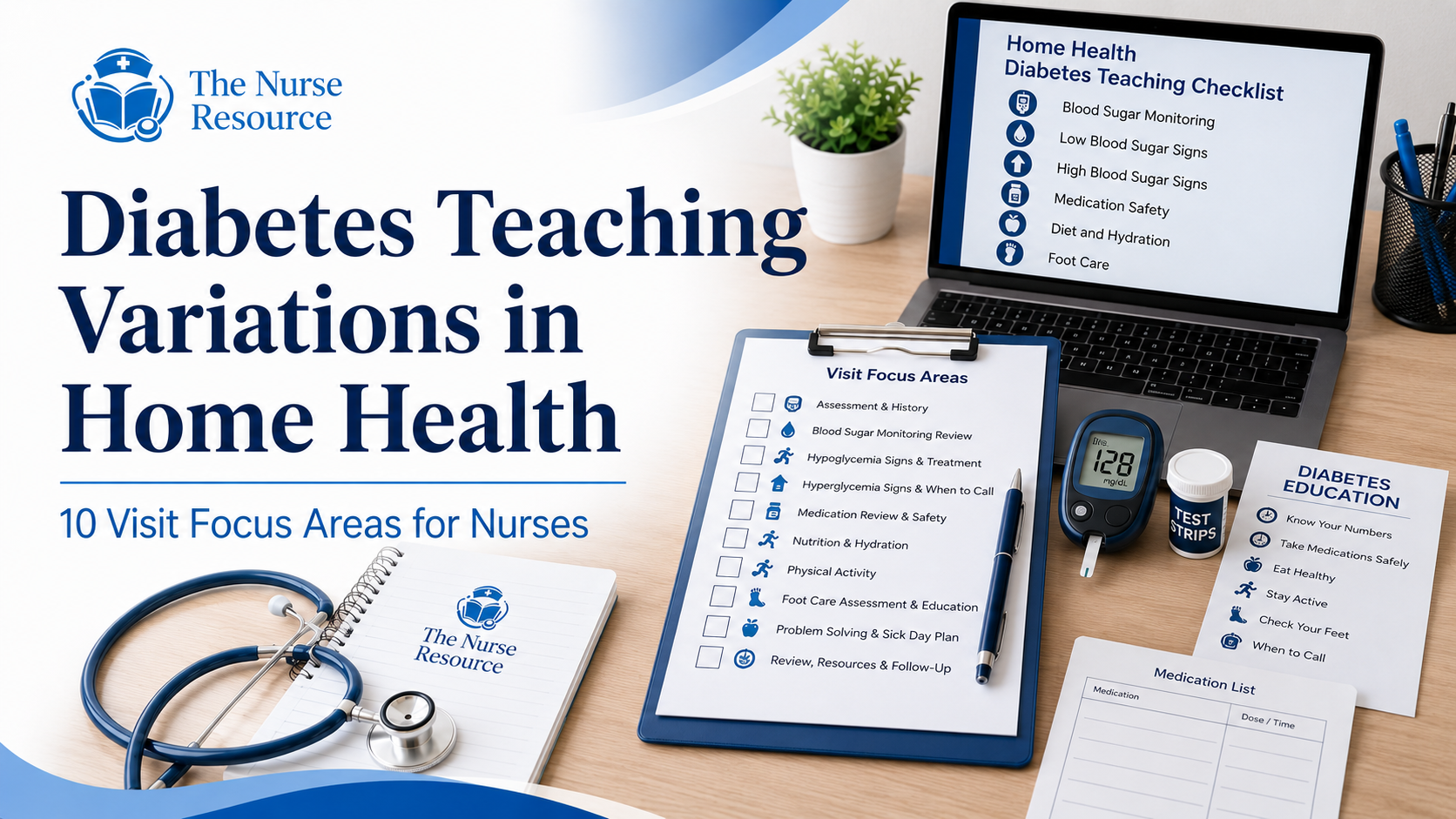
Introduction
Diabetes teaching is rarely completed during one home health visit.
Patient needs can change throughout episode of care based on Blood Sugar patterns, medication changes, insulin use, recent Hospitalization, poor intake, illness, foot or skin concerns, ability to use monitoring equipment, PCG involvement, and progress with self-management.
That means SN teaching should not simply repeat the same general Diabetes lesson at every visit.
A stronger approach is to select teaching based on what patient needs now, evaluate how patient or PCG responds, reinforce areas that remain unsafe or unclear, and advance to other teaching areas when appropriate.
For a broader episode-based framework, see Diabetes Teaching in Home Health: What Nurses Should Cover Across the Episode. For more detailed visit-specific teaching and documentation support, Premium Library members can access Diabetes Teaching Variations and SN Documentation Support for Home Health Nurses.
Why Diabetes Teaching Should Vary Across Home Health Visits
Diabetes care at home involves more than checking a Blood Sugar number.
Depending on patient-specific plan, patient or PCG may need to manage medications, insulin, testing equipment, supplies, meals, symptoms, foot and skin care, follow-up appointments, and communication with PCP or diabetes care team.
Blood Sugar monitoring needs also vary. Some patients may check frequently, while others may have a different monitoring plan. Frequency and reporting parameters should follow provider instructions rather than a universal schedule.
Teaching may appropriately repeat when patient still has:
- Knowledge deficit.
- Incomplete teach-back.
- Unsafe monitoring technique.
- Medication confusion.
- Difficulty recognizing symptoms.
- Poor follow-through.
- New change in condition.
- Missing supplies.
- Foot or skin concern.
- PCG support need.
- Continued safety risk.
What should change from visit to visit is not necessarily teaching topic. What should change is SN assessment of current need, patient or PCG response, barriers, progress, and next teaching priority.
Simple Episode Progression Framework
A practical diabetes teaching sequence is:
Assess → Prioritize → Teach → Evaluate → Reinforce or Advance → Plan Next Visit
Early Episode
Early visits may focus on:
- Understanding current diabetes care plan.
- Blood Sugar monitoring if ordered.
- Medication and insulin safety.
- Hypoglycemia and hyperglycemia awareness.
- Immediate supply or equipment concerns.
- Foot and skin risks.
- PCG involvement.
- Provider reporting instructions.
Middle of Episode
Follow-up visits may focus on:
- Monitoring follow-through.
- Blood Sugar logs if ordered.
- Medication adherence.
- Meal or poor-intake concerns.
- Teach-back.
- Foot and skin monitoring.
- Illness or infection concerns.
- Barriers identified during prior visits.
Later Episode
Later visits may focus on:
- Greater patient or PCG independence.
- Remaining knowledge gaps.
- Refill and supply planning.
- Follow-up appointments.
- Warning-sign recognition.
- PCP versus 911 escalation.
- Discharge readiness.
This progression should remain flexible. A new illness, wound, medication change, repeated abnormal Blood Sugar, Hospital visit, or change in PCG support may require SN to reprioritize teaching.
1. Blood Sugar Monitoring and Logging
When This Teaching Focus May Be Appropriate
This area may be useful when:
- Blood Sugar monitoring is ordered.
- Patient recently received a glucometer or monitoring device.
- Technique has not been observed.
- Readings are missing or inconsistent.
- Patient forgets to record results.
- Supplies are running low.
- Patient does not understand when readings should be reported.
What SN Should Consider
Assess:
- Whether monitoring is ordered.
- Provider-specific schedule.
- Available equipment and supplies.
- Ability to use device safely.
- Vision, dexterity, cognition, and memory.
- Whether readings are being recorded if instructed.
- Whether patient associates symptoms with readings.
- PCG involvement.
MedlinePlus notes that home Blood Sugar testing frequency should follow health care provider instructions and that recording results can help patient and care team review patterns.
Public Teaching Focus
Reinforce correct use of ordered monitoring equipment, consistent follow-through, recording readings if instructed, and reporting concerns according to provider-specific parameters.
Do not assign universal Blood Sugar targets or reporting thresholds.
2. Hypoglycemia Recognition and Reporting
When This Teaching Focus May Be Appropriate
This topic may be important when patient:
- Uses insulin.
- Takes medication associated with low Blood Sugar risk.
- Has history of hypoglycemia.
- Reports shakiness, sweating, weakness, dizziness, hunger, or confusion.
- Has poor meal consistency.
- Has difficulty recognizing symptoms.
- Lives alone or depends on PCG support.
What SN Should Consider
Assess:
- Patient-specific low Blood Sugar history.
- Medication profile.
- Meal pattern.
- Symptoms patient typically experiences.
- Provider-specific hypoglycemia instructions.
- Patient or PCG ability to recognize severe symptoms.
Common hypoglycemia symptoms may include shaking, sweating, dizziness, hunger, irritability, weakness, or confusion. Severe hypoglycemia may cause difficulty walking or seeing clearly, seizure, fainting, or inability to respond normally.
Public Teaching Focus
Teach symptom recognition, importance of following patient-specific hypoglycemia plan, and when repeated or worsening episodes should be reported.
Do not create a universal hypoglycemia treatment protocol or medication-adjustment plan.
3. Hyperglycemia Recognition and Reporting
When This Teaching Focus May Be Appropriate
This area may be useful when:
- Blood Sugar readings are repeatedly above patient-specific parameters.
- Patient reports increased thirst or urination.
- Patient has fatigue or weakness.
- Medication adherence is inconsistent.
- Patient is ill.
- Patient has poor follow-through with monitoring.
- Symptoms are new or worsening.
What SN Should Consider
Assess:
- Ordered Blood Sugar readings and trends.
- Symptoms.
- Medication use.
- Recent illness.
- Poor intake or dehydration concern.
- Provider-specific reporting instructions.
- Whether patient understands when to contact PCP.
Symptoms associated with hyperglycemia can include increased thirst, frequent urination, fatigue or weakness, headache, and blurred vision. Persistent high Blood Sugar or symptoms should be discussed with health care team.
Public Teaching Focus
Reinforce recognizing changes from patient baseline, following ordered Blood Sugar monitoring, maintaining medication follow-through, and reporting repeated concerns according to provider instructions.
Do not advise patient to independently change medications or insulin based on a reading.
4. Diabetes Medication Follow-Through
When This Teaching Focus May Be Appropriate
Medication teaching may need more attention when:
- New diabetes medication was ordered.
- Patient recently returned from Hospital.
- Doses are missed.
- Patient is unsure why medication is taken.
- Multiple diabetes medications are present.
- Refill problems occur.
- Side effects are reported.
- PCG manages medication.
What SN Should Consider
Review:
- Current medication profile.
- Provider orders.
- Medication organization.
- Missed doses.
- Refill status.
- Duplicate or discontinued medications.
- Patient understanding.
- Side effects or symptoms.
- Pharmacy access.
- PCG support.
Diabetes medicines vary based on type of diabetes, other health conditions, treatment goals, and patient-specific factors. NIDDK advises taking medicines as prescribed and working with health care team when side effects, cost, or other barriers interfere with treatment.
Public Teaching Focus
Reinforce taking medication exactly as ordered, maintaining updated medication list, requesting refills before medication runs out, and reporting medication confusion or side effects.
Do not tell patient to start, stop, hold, skip, take extra, increase, decrease, or otherwise change diabetes medication unless directed by authorized provider.
5. Insulin Safety if Ordered
When This Teaching Focus May Be Appropriate
Insulin teaching may be important when:
- Insulin is newly ordered.
- Insulin product changed.
- Patient has more than one insulin product.
- Patient is confused about timing or administration.
- Blood Sugar monitoring is inconsistent.
- Vision or dexterity limits safe administration.
- PCG provides injections or medication support.
- Supplies or storage are a concern.
What SN Should Consider
Assess:
- Exact insulin product on medication profile.
- Provider instructions.
- Pharmacy label.
- Patient ability to identify correct product.
- Administration technique if within plan of care.
- Storage instructions.
- Sharps supplies.
- Monitoring plan.
- Hypoglycemia awareness.
- PCG role.
Insulin products and schedules are not interchangeable, and patient-specific use should follow provider order and medication profile.
Public Teaching Focus
Reinforce product verification, following ordered instructions, safe storage and supply management, Blood Sugar monitoring if ordered, and recognition of symptoms that should be reported.
Do not provide insulin-unit instructions, sliding-scale instructions, correction-scale instructions, or independent insulin adjustments.
6. Meal Consistency, Nutrition, and Hydration Follow-Through
When This Teaching Focus May Be Appropriate
This topic may need attention when patient:
- Skips meals.
- Has poor appetite.
- Eats inconsistently.
- Has difficulty obtaining food.
- Has vomiting or diarrhea.
- Has medication-related meal concerns.
- Does not understand provider diet instructions.
- Has another condition affecting fluid or diet recommendations.
What SN Should Consider
Assess:
- Meal pattern.
- Poor intake.
- Provider-specific nutrition plan.
- Food access.
- Ability to prepare meals.
- PCG support.
- Hydration instructions.
- CHF, CKD, swallowing concerns, or other conditions affecting fluid intake.
Healthy eating is part of diabetes management, but meal planning should be individualized with health care team rather than based on a single universal diabetes diet.
Public Teaching Focus
Reinforce following provider-specific meal and nutrition instructions, avoiding skipped meals when this conflicts with patient-specific medication or nutrition plan, and reporting poor intake or inability to follow care plan.
Hydration teaching should also follow provider instructions and any applicable fluid restrictions.
7. Foot and Skin Monitoring
When This Teaching Focus May Be Appropriate
Foot and skin teaching may be especially important when patient has:
- Neuropathy.
- Reduced sensation.
- Poor vision.
- Limited mobility.
- Previous foot wound.
- Current skin concern.
- Difficulty inspecting feet.
- Unsafe footwear.
- PCG assistance needs.
What SN Should Consider
Assess for:
- Redness.
- Swelling.
- Blisters.
- Cuts or cracks.
- Open areas.
- Drainage.
- Pressure areas.
- Changes in sensation.
- Footwear.
- Ability to inspect feet safely.
Diabetes can contribute to nerve damage and reduced blood flow, which may make foot injuries harder to notice and wounds or infections harder to heal.
Public Teaching Focus
Reinforce regular foot and skin observation according to patient-specific plan, safe footwear, early reporting of skin changes, and PCG assistance when patient cannot inspect feet safely.
8. Sick-Day, Poor Intake, and Illness Changes
When This Teaching Focus May Be Appropriate
This teaching area may become a priority when patient has:
- Fever or infection symptoms.
- Vomiting.
- Diarrhea.
- Poor appetite.
- Missed meals.
- Reduced fluid intake.
- Blood Sugar changes during illness.
- Confusion about what to do with medications when sick.
Illness can make Blood Sugar more difficult to manage, and poor intake or dehydration can add additional safety concerns. CDC recommends people with diabetes have a sick-day plan developed with their health care team.
What SN Should Consider
Assess:
- Symptoms.
- Intake.
- Ordered Blood Sugar monitoring.
- Provider-specific sick-day instructions.
- Medication profile.
- Hydration restrictions or needs.
- Ability to contact PCP.
- PCG availability.
Public Teaching Focus
Reinforce following provider-specific sick-day instructions, monitoring as ordered, reporting poor intake, vomiting, diarrhea, or worsening illness, and asking PCP/provider for guidance when care instructions are unclear.
Do not independently create a sick-day medication plan.
9. PCG Involvement and Safety Support
When This Teaching Focus May Be Appropriate
PCG involvement may become important when patient has:
- Memory impairment.
- Vision problems.
- Poor dexterity.
- Difficulty using glucometer.
- Insulin or medication confusion.
- Poor teach-back.
- Mobility limitations.
- Foot-care limitations.
- Fall risk.
- Difficulty recognizing symptoms.
- Trouble obtaining medications or supplies.
What SN Should Consider
Determine whether PCG can safely assist with:
- Ordered Blood Sugar monitoring.
- Medication organization.
- Supply management.
- Meal follow-through.
- Symptom observation.
- Foot and skin monitoring.
- Provider communication.
- Appointment and refill planning.
Public Teaching Focus
Teach PCG within patient-specific plan of care and actual role in home.
PCG involvement should support safe follow-through, not replace needed clinical assessment or provider-directed care.
10. Episode Progression, Reinforcement, and Discharge Preparation
When This Teaching Focus May Be Appropriate
Later visits should increasingly assess whether patient or PCG can manage diabetes care with less SN prompting.
SN may review:
- Ordered Blood Sugar monitoring routine.
- Medication routine.
- Insulin safety if applicable.
- Warning signs.
- Foot and skin care.
- Provider-specific sick-day plan.
- Supply availability.
- Refill process.
- PCP or diabetes follow-up.
- Remaining barriers.
Reinforcement Can Still Be Appropriate
Repeated teaching does not automatically mean teaching is unnecessary.
Reinforcement may remain appropriate when patient:
- Cannot accurately teach back instructions.
- Continues unsafe technique.
- Has repeated medication confusion.
- Has ongoing symptom-reporting problems.
- Has new risks or changes in condition.
- Requires PCG support.
- Has not yet demonstrated safe follow-through.
What matters is whether SN identifies a current patient-specific teaching need and evaluates progress.
Discharge Preparation
Before discharge, determine whether patient or PCG knows:
- What routine care should continue.
- Which monitoring is ordered.
- How medications should be taken.
- Which symptoms should be reported.
- When to notify PCP.
- When to call 911.
- How to obtain medications and supplies.
- Which follow-up appointments are scheduled.
Need More Detailed Diabetes Teaching and Documentation Support?
Premium Library members can access Diabetes Teaching Variations and SN Documentation Support for Home Health Nurses for detailed visit-specific teaching variations, copy-friendly SN documentation phrases, patient / PCG response wording, teach-back support, ongoing skilled need phrases, weak vs stronger examples, and Quick Diabetes Charting Builder.
One Limited Teach-Back Example
A simple public teach-back question may be:
“What changes would make you call your PCP or home health agency?”
Teach-back should be adapted to actual teaching topic, patient cognition, literacy, language needs, and plan of care.
One Limited Documentation Example
A brief example of framework-level documentation is:
SN reviewed ordered Blood Sugar monitoring and symptoms to report. Patient required additional reinforcement regarding provider-specific reporting instructions.
Documentation should reflect only what actually occurred during visit. It should not be copied when assessment, teaching, response, or follow-up did not occur.
Detailed documentation language remains part of Premium Library.
When to Notify PCP or Provider
Notify PCP/provider or follow agency notification process for non-emergency concerns such as:
- Repeated high or low Blood Sugar readings outside patient-specific parameters when monitoring is ordered.
- Repeated symptoms of hypoglycemia.
- Repeated symptoms of hyperglycemia.
- Poor appetite or repeated missed meals.
- Vomiting or diarrhea.
- Reduced fluid intake or dehydration concern.
- Illness affecting diabetes care.
- Medication confusion.
- Missed medication doses.
- Insulin or medication supply concerns.
- Refill problems.
- Difficulty using monitoring equipment.
- New foot sore or open area.
- Redness, swelling, warmth, drainage, or other infection concern.
- Dizziness or worsening weakness.
- Fall or near fall.
- Patient or PCG unable to follow diabetes care plan safely.
- Symptoms that worsen or do not improve as expected.
Follow provider-specific reporting parameters, medication profile, plan of care, agency policy, and skilled nursing judgment.
When to Call 911
Call 911 or follow patient-specific emergency plan for severe or life-threatening symptoms, including:
- Unresponsiveness.
- Loss of consciousness.
- Seizure.
- Severe confusion or inability to respond normally.
- Inability to safely swallow or respond.
- Severe weakness with difficulty responding.
- Severe trouble breathing.
- Severe or concerning chest pain.
- Severe allergic reaction symptoms.
- Symptoms that are rapidly worsening.
- Any situation in which patient appears to be in immediate danger.
Severe hypoglycemia can cause seizure, fainting, confusion, and inability to safely respond.
Do not delay emergency response to complete a routine PCP call.
Common Diabetes Teaching Mistakes to Avoid
Repeating Same Generic Teaching at Every Visit
Repetition may be appropriate when patient still needs reinforcement, but teaching should remain connected to current findings, response, and barriers.
Trying to Cover Everything at Once
Diabetes care includes multiple teaching areas. Prioritize highest current risk instead of overwhelming patient with a long list during every visit.
Focusing Only on Blood Sugar Numbers
Monitoring is only one part of diabetes care.
Medication safety, symptoms, meals, feet, skin, illness, supplies, PCG support, and follow-up may be equally important.
Giving Universal Blood Sugar Parameters
Blood Sugar targets and reporting instructions vary.
Follow provider-specific instructions and patient-specific plan of care.
Giving Medication or Insulin Adjustment Advice
Do not independently instruct patient to change medication dose, insulin units, sliding scale, correction scale, timing, or treatment based on a reading.
Ignoring Patient or PCG Response
Documenting only that teaching occurred does not show whether patient understood or can follow instructions safely.
Ignoring Foot and Skin Risks
Diabetes teaching should include foot and skin awareness when relevant because neuropathy and circulation problems may increase risk for unnoticed injury and delayed healing.
Ignoring Poor Intake or Illness
Illness, vomiting, diarrhea, and reduced intake can change diabetes safety needs and may require provider-specific guidance.
Waiting Until Discharge to Assess Independence
Discharge preparation should develop across episode so unresolved barriers can be addressed before final SN visit.
How to Keep Diabetes Teaching Patient-Specific and Clinically Relevant
Diabetes teaching remains patient-specific when SN:
- Reviews current condition and Vital Signs.
- Reviews Blood Sugar monitoring if ordered.
- Identifies current symptoms.
- Reviews medication changes or concerns.
- Assesses foot and skin condition when indicated.
- Evaluates nutrition or poor-intake concerns.
- Reviews supplies and equipment.
- Identifies what patient or PCG already understands.
- Prioritizes most relevant current teaching need.
- Uses teach-back or observation when appropriate.
- Identifies barriers.
- Communicates abnormal findings when indicated.
- Adjusts next teaching focus according to patient response.
- Evaluates progress toward plan-of-care goals.
A teaching topic does not become skilled merely because it is documented differently.
Documentation should reflect actual skilled assessment, teaching, patient or PCG response, communication, and interventions that occurred during visit.
Related Home Health Teaching Resources
For a broader diagnosis-based teaching framework, start with:
- Diabetes Teaching in Home Health: What Nurses Should Cover Across the Episode
- How to Document Diabetes Teaching in Home Health: A Practical SN Framework
- Metformin Indication and Home Health Teaching
- Insulin Glargine Indication and Home Health Teaching
- Empagliflozin Indication and Home Health Teaching
Premium Library: Diabetes Teaching Variations and SN Documentation Support
This free post provides framework-level teaching ideas for varying Diabetes education across home health visits.
Premium Library members can access Diabetes Teaching Variations and SN Documentation Support for Home Health Nurses for more detailed support, including:
- Detailed visit-specific Diabetes teaching variations.
- Copy-friendly SN documentation phrases.
- Patient and PCG response wording.
- Teach-back support.
- Abnormal finding wording.
- PCP notification wording when notification actually occurs.
- Ongoing skilled need phrases.
- Weak versus stronger documentation examples.
- Quick Diabetes Charting Builder.
- Next-visit planning support.
These tools are designed to support documentation organization and teaching progression. Individual phrases do not establish skilled need, Medicare eligibility, payment, or claim approval, and should never be used to document care that did not occur.
Related Premium Resources
Premium Library members may also find these resources helpful:
- Diabetes Teaching Resource Pack for Home Health Nurses
- Medication Safety Resource Pack for Home Health Nurses
- Emergency Signs and Escalation Pack for Home Health Nurses
- Home Health SN Narrative Builder Pack
Diabetes Teaching Resource Pack provides broader patient and PCG teaching support, including printable resources, PCG monitoring, quick charting support, symptom recognition, medication safety, foot care, and escalation guidance.
Sources Used
- National Institute of Diabetes and Digestive and Kidney Diseases. Managing Diabetes
- National Institute of Diabetes and Digestive and Kidney Diseases. Diabetes & Foot Problems
- National Institute of Diabetes and Digestive and Kidney Diseases. Low Blood Glucose (Hypoglycemia)
- Centers for Disease Control and Prevention. Low Blood Sugar (Hypoglycemia)
- Centers for Disease Control and Prevention. Managing Sick Days
- MedlinePlus. Home Blood Sugar Testing
- MedlinePlus. Hyperglycemia
Important Use Note
This post is for educational and home health documentation support only. It does not replace provider orders, medication profile, pharmacy guidance, Hospital discharge instructions, diabetes care plan, patient-specific plan of care, agency policy, payer requirements, Medicare guidance, accreditation standards, applicable regulations, emergency protocols, or skilled nursing judgment.
Diabetes teaching, Blood Sugar monitoring, reporting instructions, nutrition and hydration instructions, medication teaching, insulin teaching, foot and skin care, illness teaching, and safety instructions should be individualized to patient condition, actual assessment findings, provider orders, medication profile, patient-specific parameters, plan of care, agency policy, payer requirements, and clinical judgment.
This content does not provide medication dosing advice, insulin-unit instructions, sliding-scale instructions, correction-scale instructions, medication-adjustment instructions, universal Blood Sugar parameters, universal hypoglycemia treatment instructions, universal sick-day medication instructions, diet orders, fluid orders, or emergency treatment instructions beyond calling 911 for emergency symptoms and following patient-specific emergency plan.
Do not start, stop, hold, skip, increase, decrease, or otherwise adjust diabetes medication or insulin unless directed by an authorized provider.
Documentation should reflect only assessment, teaching, patient or PCG response, provider communication, and interventions that actually occurred.
This content does not guarantee payment, claim approval, survey compliance, Medicare eligibility, or regulatory compliance.